Powered By Blogger

Friday, May 04, 2007

First it was animals, then people...

OOPS, that's wrong. It's first people then animals, so says the article. Used to be we tried experimental drugs on animals and then prescribed the drugs on people. That's in reverse:

Vets have rejected claims by a British animal welfare charity that giving dogs drugs to treat behavioural problems will create a population of "pill-popping pets".

The Royal Society for the Prevention of Cruelty to Animals expressed alarm at the news that an antidepressant called Reconcile - containing the same serotonin-reuptake inhibitor used in the human drug Prozac - has been licensed for use in dogs by the US Food and Drug Administration.

"Pet owners have a duty of care towards their animals," says charity scientist Penny Hawkins. "Pharmaceuticals should not be used to help sustain an unsustainable lifestyle by addressing problems that should be dealt with by other means, such as more exercise."

“Pet owners have a duty of care towards their animals. Drugs should not be used to sustain an unsustainable lifestyle”

But vets specialising in treating behavioural problems say medication can be extremely useful in treating anxiety symptoms such as howling and destructiveness.

Dogs with behavioural problems account for about a quarter those that are euthanised by veterinary practices, so by increasing the chances of successfully managing a problem drugs can improve welfare.

It used to be that if you had a dog, and it was a problem, you either gave the dog away, or had it killed. Simple. Dogs are dogs, after all, not people. Now, we're seeing a slide to drugs for dogs (and I'm sure other animals) that will only take us further along to more drugs, more medical treatment, more costs, and, if owners opt not to do these things, there will be societal (read: animal rights activits) pressure to force owners to do them.


Web browsers: Still unsafe

YOU are surfing the net, and stop at a sports site you regularly visit to read the latest headlines. You are always careful to avoid sites that appear suspect, so you feel safe online. Unbeknownst to you, though, and to the innocent owner of the website, a piece of malicious code has been added to the page you are viewing. This uploads software onto your computer via your browser, turning it into a "zombie" PC under the remote control of a malicious user.

While installing firewalls and antivirus software on your computer may keep it safe from conventional threats such as worms and viruses, these security tools do not inspect data downloaded through browsers - a loophole that attackers can exploit. "The firewall is dead," says Google security specialist Niels Provos.

The threat is real, not just a theoretical possibility:

Provos warned that many web users are becoming the victims of "drive-by" downloads of bots from innocent websites corrupted to exploit browser vulnerabilities. As firewalls allow free passage to code or programs downloaded through the browser, the bot is able to install itself on the PC. Anti-virus software kicks in at this point, but some bots avoid detection by immediately disabling it. Once a computer has become infected with the malicious software, the zombie periodically connects to a web server controlled by the botmaster to receive instructions and download more software.

To determine the scale of the problem, Provos's group at Google analysed several billion web pages and selected 4.5 million suspicious pages for more detailed study. To test for malicious software, or malware, they loaded a program designed to simulate a computer with a vulnerable version of Internet Explorer and monitored what happened. They found around 450,000 web pages that launched drive-by downloads of malicious programs. Another 700,000 pages launched downloads of suspicious software. More than two-thirds of the malicious programs identified were those that infected computers with bot software or programs that collected data on banking transactions and emailed it to a temporary email account.

You don't even know it's there. The result: be very careful with the sites you go to. If possible, don't use Internet Explorer; IE is a disaster for security.


Tuesday, April 17, 2007

Happy Birthday, Leonhard Euler

Sunday, April 15, is the 300th birthday of Leonhard Euler (pronounced "oiler"), one of the most important mathematicians ever to have lived.

Click the above link to read a wonderful description of his famous equation: eiπ = –1

If you want to read some wonderful books, check out Paul Nahin's books: An Imaginary Tale and
Dr. Euler's Fabulous Formula: Cures Many Mathematical Ills.

These books are worth reading and you'll learn about the mathematics of Euler.

The Mathematical Association of America has a wonderful column by Ed Sandifer entitled "How Euler Did It." Dr. Sandifer translates (I guess) some of Euler's original papers, tells you what Euler did, how he did it, and why that result is important.

Rotating polygons in space and in the lab

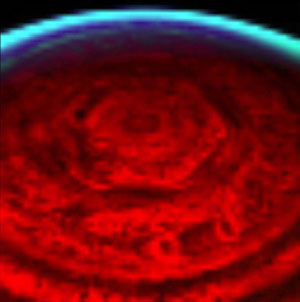
It was recently reported that there's a hexagonal rotating structure (see the image at left) at the North pole of Saturn.

We may not have found other life in our Solar System, but we have, it appears, found a polygon. An odd, six-sided, honeycomb-shaped feature circling the entire north pole of Saturn has captured the interest of scientists with NASA's Cassini mission.


NASA's Voyager 1 and 2 spacecraft produced images of the hexagon over two decades ago. The fact that it has appeared in the recent Cassini images indicates that it is a long-lived feature. A second hexagon, significantly darker than the brighter historical feature, is also visible in the Cassini pictures. The spacecraft's visual and infrared mapping spectrometer is the first instrument to capture the entire hexagon feature in one image.


Now others have seen the same phenomenon in the lab.


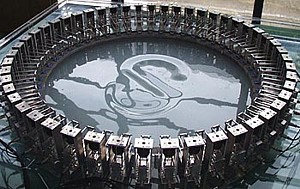
The unusual phenomenon in question involves rotating a bottom plate under a liquid in a circular (cylindrical) container. Bohr and his team of students at the Technical University and at the Niels Bohr Institute set up an experiment to find out whether or not such conditions would lead to stable deformations of a water surface into polygon shapes. The findings from their experiment were published May 3rd in Physical Review Letters.

Bohr tells PhysOrg.com that a somewhat similar experiment took place eight years ago with a different team (including Clive Ellegaard and others). “We had fluid falling on a plane, like water from a faucet. We found that even if the rim of the plate is completely circular, the fluid surface can be shaped like a polygon.”
While the first polygon experiment Bohr did involved stationary polygons, the most recent effort shows rotating polygons. “Not only are these shapes rotating,” says Bohr, “but they are rotating at a different speed than the plate beneath them.”
This is a fascinating phenomena that is, apparently, unexplained as yet. Here's another site for a video and more links.


(Hat tip: Ilachina)

Are cellular phones killing bees?

Interesting article on how our cellular phones could be disrupting the navigation of bees.

Thursday, April 12, 2007

Putnam Mathematical Competition Problems

Click on the link for the pdf file of the Putnam Mathematical Competition problems.

Good luck with them!

Sunday, April 08, 2007

Planet of the Apes: Apes as People

In a ground-breaking case at the Mödling district court, just southwest of Vienna, Austria, a judge is to rule over "the humanness of a chimp"– specifically, over whether it deserves a legal guardian.

The chimpanzee in question is called Hiasl. He was born in the Sierra Leone jungle in 1981, captured by animal traders and illegally shipped to Austria, destined for a vivisection lab. Customs officials intercepted the crate and Hiasl was handed to an animal sanctuary. Now, years later, the sanctuary has gone bankrupt and Hiasl is to be sent to a zoo.
This is the most ridiculous legal item I've seen a long time. Of course the chimp is NOT a human. To say otherwise is to say that we, (you, me, your friends, etc.) are chimps. Clearly not the case.

Nonetheless, as an animal lover (dogs, in particular) I should think the court could see it's way to appointing a caregiver for the chimp without equating the chimp to a human. The caregiver would have certain rights as an owner and thereby take care of the animal. Anything more is an insult to humans.

Air traffic control, automatically

Fighter pilots will one day be able to control entire squadrons of uncrewed combat aircraft as well as their own plane, following successful flight demonstrations of a multi-aircraft remote control system in UK airspace.

In addition to cutting the number of pilots risked in military operations, the remote control system could one day also be used to auto-land hijacked planes. Or they might allow lone pilots to orchestrate complex search and rescue operations.

This is not as new as it would seem. Just today I was in a meeting discussing how we might see unmanned aerial vehicles flying in U.S. airspace and how cargo planes could become pilotless. This demonstration is one step to seeing those ideas become a reality.


Wheat at risk

"This thing has immense potential for social and human destruction." Startling words - but spoken by the father of the Green Revolution, Nobel laureate Norman Borlaug, they are not easily dismissed.

An infection is coming, and almost no one has heard about it. This infection isn't going to give you flu, or TB. In fact, it isn't interested in you at all. It is after the wheat plants that feed more people than any other single food source on the planet. And because of cutbacks in international research, we aren't prepared. The famines that were banished by the advent of disease-resistant crops in the Green Revolution of the 1960s could return, Borlaug told New Scientist.

The disease is Ug99, a virulent strain of black stem rust fungus (Puccinia graminis), discovered in Uganda in 1999. Since the Green Revolution, farmers everywhere have grown wheat varieties that resist stem rust, but Ug99 has evolved to take advantage of those varieties, and almost no wheat crops anywhere are resistant to it.

Not only is Ug99 a threat in itself, but even if we have resistant wheat, we have still another problem:
However, Ug99 has another ace up its sleeve. The spores blowing in the wind now are from the asexual stage that grows on wheat. If any blow onto the leaves of its other host, the barberry bush (Berberis vulgaris), they will change into the sexual form and swap genes with whatever other stem rusts they find. Barberry is native to west Asia. "As if it wasn't challenging enough breeding varieties that resist this thing," laments Ward. "All I know is that what blows into Iran will not be the same as what blows out."
One solution is to apply fungicide to the crops which for many countries will work until new wheat can be developed that's resistant. But for poor countries fungicide is too expensive.

If you like to gamble, maybe it's a good time to go long on wheat futures?

Monday, April 02, 2007

The food cycle in the ocean

A shortage of big sharks along the U.S. East Coast is letting their prey flourish, and that prey is going hog wild, demolishing bay scallop populations.

That's the conclusion of researchers led by the late Ransom Myers of Dalhousie University in Halifax, Nova Scotia, who died this week. Combining census surveys from the past 35 years, Myers' team found shrinking populations of big sharks and shellfish and increasing numbers of smaller sharks and rays.

"Affecting something at the top [of the food web] is going to have huge consequences as effects ramify through the system," says study collaborator Charles H. Peterson of the University of North Carolina's Institute of Marine Sciences at Morehead City. As part of the new study, he and his colleagues explored some of those effects by protecting bay scallops from the cownose ray (Rhinoptera bonasus), one of the flourishing midlevel predators.

So, the cownose rays have multiplied and are eating more of the delicacies of scallops. What to do? Should we hunt down the rays now or, as the article later suggests make the rays a delicacy themselves?
Cownose rays have grown so abundant along the U.S. East Coast that fisheries managers are trying to promote them as a seafood delicacy. TV cooking-show host Emeril Lagasse has even developed some recipes. (Picture caption)
I have never eaten a ray and have no desire to ever do so. But if people like them, why not hunt them and eat them? They are part of the food chain, as are we, and we should look at them as food just like we do for a cucumber.

Bon apetit!


Sunspots erupt out high!

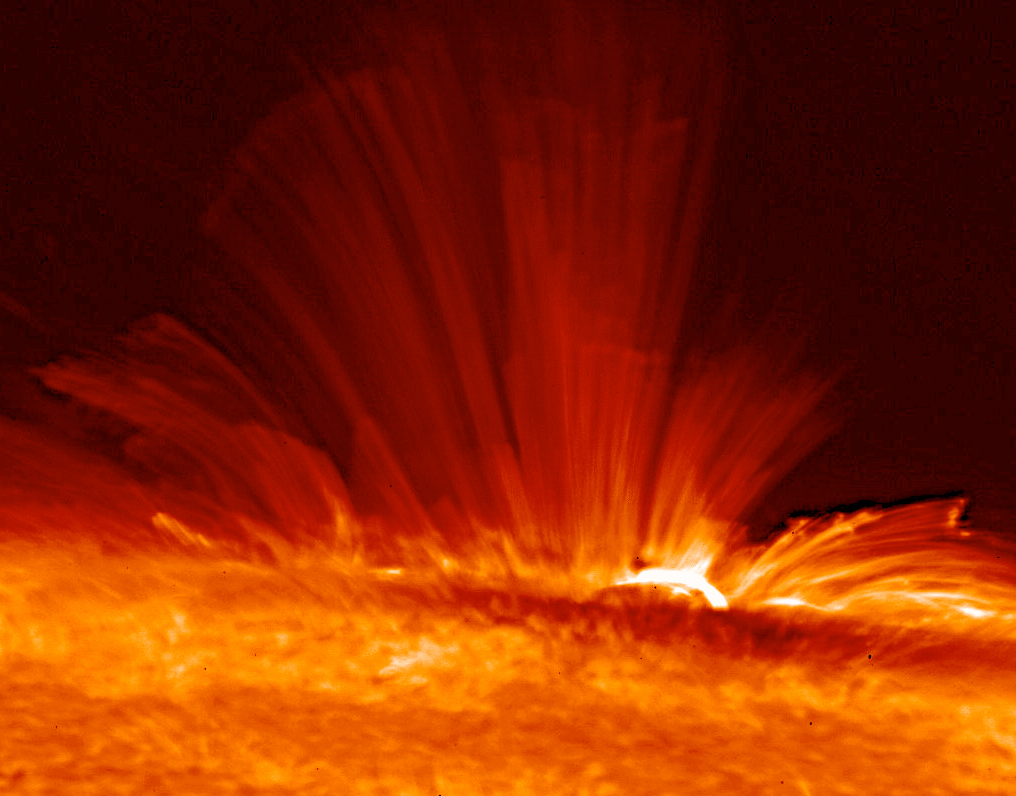
From the Astronomy Picture of the Day:
Why are there dark spots on the sun? Although noted for thousands of years, sunspots have been known for decades to be regions of the Sun that are slightly depressed and cooled by the Sun's complex and changing magnetic field. High resolution pictures like the above image from Japan's new Sun-watching Hinode satellite, however, are helping to increase modern understanding. In the center of the above image is a sunspot, but not seen in the usual orientation --this sunspot is seen sideways. Of particular interest is erupting glowing gas that shows how the Sun's magnetic field comes right out of the spot center, but curves markedly around the spot edges. Better understanding of how the Sun ejects particles into space may result in more accurate predictions of solar storms that affect satellites, astronauts, and even power grids on Earth.

Monday, March 19, 2007

Fauxtography spotting

Nice post on discovering forgeries in digital photographs.

Jurassic Crocodile In Eastern Oregon


Artists conception of the ancient creature.


An ancient sea-going crocodile has surfaced from the rocks of Crook County in eastern Oregon.

It's discovery by the North American Research Group (NARG), whose members were digging for Jurassic-age mollusks known as ammonites, is another confirmation that the Blue Mountains consist of rocks that traveled from somewhere in the Far East, says retired University of Oregon geologist William Orr, who was called in to examine the find for the state.

The remains - about 50 percent of a 6- to 8-foot reptile, including long, needlepoint teeth - were found imbedded in Jurassic rock on private property in the Snowshoe Formation of the Izee Terrane south of Dayville, Ore. Rocks containing the fossils were slowly cut out of the rock, after NARG members realized that the linear appearance of the fossils in the region's hard rocks suggested that a whole creature had been found, Orr said.

"This taxon was a crocodile-like creature but had a fish tail," said Orr, a NARG adviser and director of the Thomas Condon State Museum of Fossils at the University of Oregon. "This creature lived in Jurassic times, so it's 150 to 180 million years old. It probably lived in an area from Japan to East Timor, somewhere in the western Pacific in a tropical estuarine environment."

The fossils are generally found in Japan or China so that the finding in Oregon indicates that possible:
[T]he remains in Oregon migrated eastward in rock by continental drift, a theory of land movement in geological time now encompassed under plate tectonics. Terrane formations, such as those where these fossils were found, are believed to be portions of the earth's crust riding apart of a plate that is pushed upward at contact with another plate.
An incredible find.


Monday, February 26, 2007

Verification of Pollack's art with fractals

Richard Taylor from the University of Oregon reported 8-years ago that he found Jackson Pollack's artwork to have fractal qualities. Not that they are a fractal, because fractals have detail at all scales of magnification. So, some people wanted to use Taylor's approach to verify found paintings as original Pollack artwork.

Well, a graduate student at Western Reserve University in Cleveland, Katherine Jones-Smith
made some doodles on a page—"pretty ugly" ones, she says—she found that they shared the qualities of a Pollock, according to an analysis that follows Taylor's approach. "Either Taylor is wrong, or Kate's drawings are worth $40 million," says Jones-Smith's collaborator Harsh Mathur. "We'd be happy either way."
This started a discussion as to whether Taylor's approach can actually verify artwork.

Frankly, fractals are a mess when you try to define them because so many objects that you would like to be fractals don't fit in a single definition.

I think Michael Barnsley says it best:
For authentication, it doesn't matter whether it's legitimate to call Pollock paintings fractal, says Michael Barnsley of Australian National University in Canberra. Taylor has a reproducible technique that produces numbers from a painting, and he can correlate those numbers with different artists. "That doesn't allow you to authenticate or not authenticate a painting, but you could certainly add it into the collection of information that you have to say that it's more likely," he says.
Fractals are ill-defined now but the methods we use to measure fractal dimension have a place in our mathematical toolbox. A place, among many other tools, but not the only tool.

Wednesday, February 14, 2007

Astronomy Picture of the Day

I LOVE these pictures from NASA and the Hubble telescope. They never cease to amaze me and I marvel at their beauty. Just gorgeous.

Thursday, February 08, 2007

What a picture from Hubble

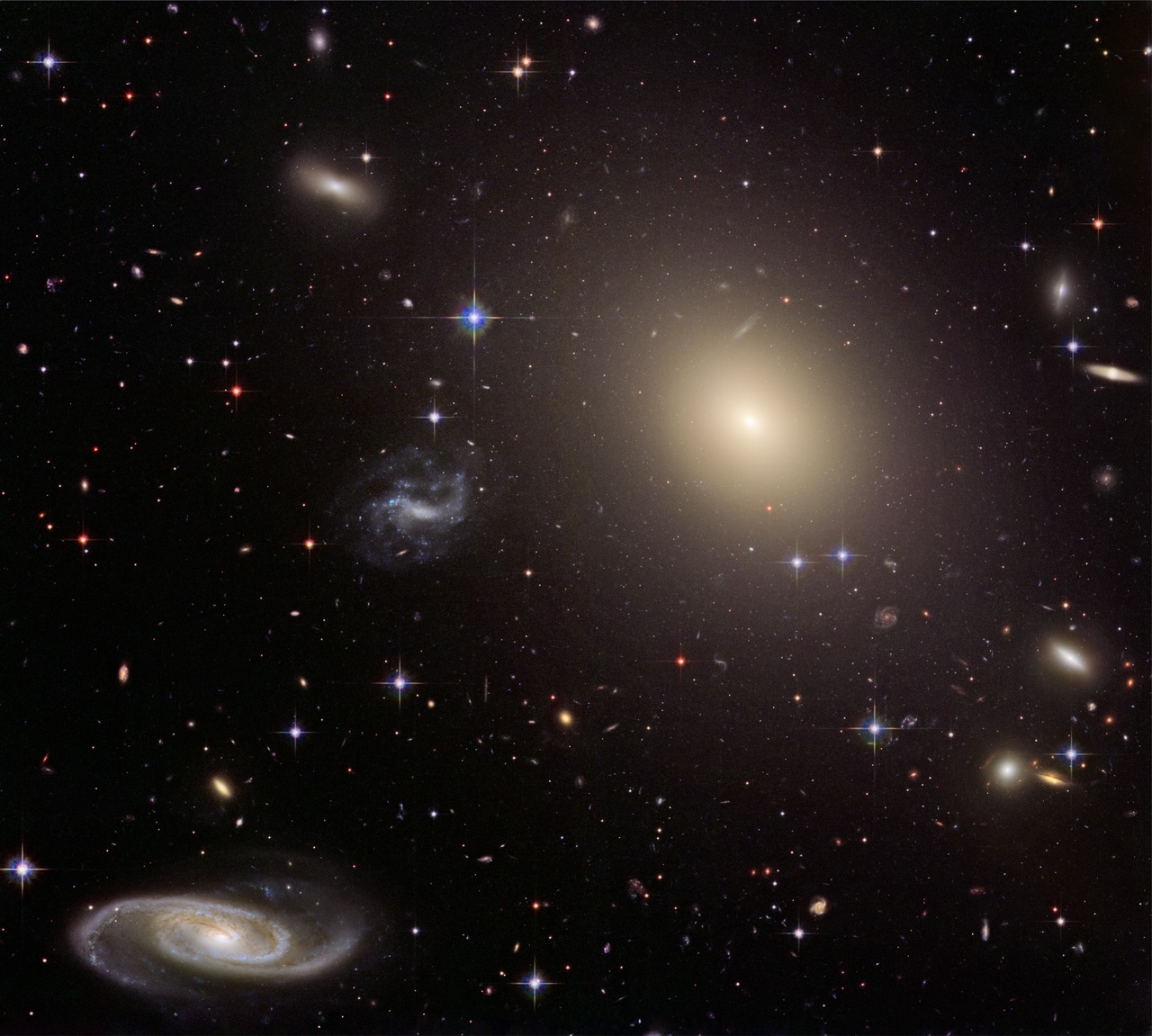
It's like something out of photoshop with the imagination of an artist. EXCEPT, it's real. This is a picture from the Hubble Telescope, on the Astronomy Picture of the Day. Here's their explanation:
This stunning group of galaxies is far, far away - about 450 million light-years from planet Earth - cataloged as galaxy cluster Abell S0740. Dominated by the cluster's large central elliptical galaxy (ESO 325-G004), this sharp Hubble view takes in a remarkable assortment of galaxy shapes and sizes with only a few spiky foreground stars scattered through the field. The giant elliptical galaxy spans over 100,000 light years and contains about 100 billion stars, comparable in size to our own spiral Milky Way. The Hubble data reveal a wealth of detail in even these distant galaxies, including magnificent arms and dust lanes, star clusters, ring structures, and gravitational lensing arcs.
Wow, that one part (just a part) of the image is 100,000 light years across and contains approximately 100-billion starts. Read that again. The galaxy is enormous and it's only a small part of the image.

Staggering. Just staggering.

Juggling light: It can be done

A pulse of light can be stopped, transported, and restarted again using a cloud of super-cold atoms, US researchers have shown. The technique could ultimately be used for advanced computing devices or gravity detectors.

The experiments demonstrate physicists' increasing ability to manipulate light. Being able to control it in this way could be useful for optical or quantum computers, the team suggests.

I didn't understand the details of the article, but if you do, please leave a comment about it.

NASA reviews policy after astronaut goes beserk

NASA is reviewing its psychological screening process for astronauts, following astronaut Lisa Nowak's arrest for allegedly attempting to murder a romantic rival.

Police in Orlando, Florida, US, say that Nowak drove 1500 kilometres to try to kidnap and possibly kill Air Force Captain Colleen Shipman (see Astronaut accused of attempted murder released on bail). Both women may have been vying for the affections of NASA astronaut Bill Oefelein.

In response to the shocking event, NASA Administrator Michael Griffin has requested an internal review of the psychological screening procedures used to admit new astronauts. He also asked for a review of any follow-up psychological evaluations of working astronauts, including who conducts the screening.

I've busy with work and unable to post for a while. But the news on Nowak is unbelievable. This woman is a disgrace to NASA and a disgrace to the United States Navy. What's worse is that NASA, and I bet the Navy, never bothered to see the signs of her deranged behavior.

Let's hope NASA changes their policies to screen out such people, and not just at the start of a career, but throughout an astronaut's career and the same goes for the Navy.

Thursday, January 18, 2007

Getting close to mid-night: Bulletin of Atomic Nuclear Scientists

So, the famous Bulletin of Atomic Scientists believes we are two minutes closer to destruction than we have been in the past. Here's how they put it:

This deteriorating state of global affairs leads the Board of Directors of the Bulletin of the Atomic Scientists--in consultation with a Board of Sponsors that includes 18 Nobel laureates--to move the minute hand of the “Doomsday Clock” from seven to five minutes to midnight.

This is another example of people with a certain expertise in one area, thinking they have expertise in another area. Scientists are generally smart people, perhaps some of the smartest on the planet we call home. But being smart as a scientist does not mean one is competent in other areas.

For example, while Richard Feynman was a genius in physics, he was no politician. That is, Feynman's expertise in physics did not mean that he had any deep insight in politics. He may have insight of his own, of course, but if you want political opinion it's best to go with a politician.

What's this have to do with the time creeping closer to mid-night?

Just this: the catastrophe that the Bulletin is "predicting" is more of a political catastrophe and not a scientific one. It is a political question as to whether nuclear bombs will be detonated not a scientific one. If the world ends due to nuclear bombs that responsibility rests with our political leaders; scientists have done their part already in building the bombs.

This year, The Bulletin also cites "Global Warming" as part of the coming (five minutes away!) catastrophe. Once again, the scientists have no say in Global Warming (if it even exists and I don't believe it). The question of climate is beyond the control of any scientist. Sure, scientists study climate and have opinions but whether the world will "end" due to some climate change is beyond them.

To try to predict "the end" is to scare people into believing others who, while smart in one area, have no business in other areas.

Thursday, January 11, 2007

Invisibility: Mathematically possible

November 30, 2006: The invisibility cloak recently built by scientists at Duke University and Imperial College in London has received enormous attention all over the world. This breakthrough cloaking device makes a copper disk invisible at specific microwave frequencies. As it turns out, Mathematics Professor Allan Greenleaf of the University of Rochester along with Matti Lassas, who is now at the Helsinki University of Technology, and Gunther Uhlmann of the University of Washington, started the mathematics behind invisibility several years ago in the context of medical imaging and quantum mechanics. Joined by fourth member Yaroslav Kurylev of Loughborough University, the team has announced the mathematics of full-wave invisibility at all frequencies (http://www.arxiv.org/abs/math.AP/0611185). In their latest work, they examine the problem of cloaking not just passive objects, but also active devices that are emitting electromagnetic waves, and show that this requires modifying the original constructions.

(hat tip: Ilachina)

Goldbach conjecture: Proved?

Here's a paper that the authors say proved Goldbach's conjecture. From Wikipedia:

Goldbach's conjecture is one of the oldest unsolved problems in number theory and in all of mathematics. It states:

Every even integer greater than 2 can be written as the sum of two primes.

For example,

4 = 2 + 2
6 = 3 + 3
8 = 3 + 5
10 = 3 + 7 = 5 + 5
12 = 5 + 7
14 = 3 + 11 = 7 + 7
etc.


It's a very old problem and one that if solved, would be welcomed news in mathematics.

Journal of Fourier Analysis and Applications

The University of Maryland is having a two-day seminar on Fourier Series in February. As part of the program you can get a trial copy of the Journal of Fourier Analysis and Applications free, just follow link above.

The journal is math-oriented but worth perusing. Enjoy.

Sunday, January 07, 2007

Junk science

Ian Gilmartin, 60, has invented a mini water wheel capable of supplying enough electricity to power a house - for free. The contraption is designed to be used in small rivers or streams - ideal for potentially thousands of homes across Britain.

It is the first off-the-shelf water-wheel system that can generate a good supply of electricity from as little as an eight-inch water fall.

Have a laugh and read the article.

Dark Matter: What matters to the universe


The study, published in Nature journal, provides the best evidence yet that the distribution of galaxies follows the distribution of dark matter.
Scientists have mapped a small part of the sky in terms of the distribution of dark matter. There is reason to believe that this will show that the evolution of galaxies follows this distribution and that dark matter does, indeed, play a unique role in the development of our universe.

Additional article here, original article from Nature here.

Tuesday, December 26, 2006

Addicted to the 'Net? You're not alone

Ever feel that you have to publish something as often as possible on the Internet? Crazy to see your name on the screen, in Google listings or on Yahoo!? If so, you're not alone.

Hello, my name is Richard and I am an egosurfer. The habit began about five years ago, and now I need help. Like most journalists, I can't deny that one of my private joys is seeing my byline in print. Now the internet is allowing me to feed this vanity to an ever greater extent, and the occasional sneaky web search has grown into a full-blown obsession with how high up Google's ranking my articles appear when I put my name into the search box. When I last looked, my best effort was a rather humiliating 47th place. You know you have a problem when you find yourself competing for ranking with a retired basketball player from the 1970s.

Not that I'm alone in suffering from a dysfunctional techno-habit. New technologies have revealed a whole raft of hitherto unsuspected personality problems: think crackberry, powerpointlessness or cheesepodding (see "Modern maladies", bottom). Most of us are familiar with sending an email to a colleague sitting a couple of feet away instead of talking to them. Some go onto the web to snoop on old friends, colleagues or even first dates. More of us than ever reveal highly personal information on blogs or MySpace entries. A few will even use internet anonymity to fool others into believing they are someone else altogether. So are these web syndromes and technological tics new versions of old afflictions, or are we developing fresh mind bugs?

Developing a bad habit is easier than many might think.

No argument here.

Phase change memory

A team of scientists has announced a breakthrough in computer memory technology that heralded more sophisticated and reliable MP3 players, digital cameras and other devices.

Scientists from IBM, Macronix and Qimonda said they developed a material that made "phase-change" memory 500 to 1,000 times faster than the commonly-used "flash" memory, while using half as much power.

"You can do a lot of things with this phase-change memory that you can't do with flash," IBM senior manager of nanoscale science Spike Narayan told AFP.

"You can replace disks, do instant-on computers, or carry your own fancy computer application in your hand. It would complement smaller technology if manufacturers wanted to conjure things up."

Technical details of the research were to be presented to engineers gathered at the 2006 International Electronic Devices Meeting in San Francisco.

Interesting and exciting. The quest for better memory devices never ceases, and never ceases to amaze me.

(hat tip: Ilachina)

Wednesday, December 20, 2006

The Three-Body Problem: Book Review

The following review was posted to the Mathematical Association of America's website.

The Three-Body Problem by Mauri Valtonen and Hannu Karttunen


Publisher: Cambridge University Press (2006)
Details: 345 pages, Hardcover

Price: $80.00
ISBN: 0521852242

Category: Monograph
Topics: Mathematical Physics, Dynamical Systems, Classical Mechanics, Celestial Mechanics

MAA Review

[Reviewed by David Mazel, on 12/20/2006]

An undergraduate, having taken calculus and some physics, comes across the two-body problem. Specifically, what is the motion of two bodies in space acting under their mutual gravitational attraction? She quickly finds that she can solve the equations, and for given initial conditions, the solutions are conic sections. Then, the natural question to ask is: What is the solution if we now expand the system to three bodies? Here the problem is not so easy. In fact, it is impossible to solve in closed form.

This book begins by recounting what the student would have learned in that physics class and then goes into specifics of the three-body problem. Not only is the problem unsolvable in closed form; the solution, in general, involves chaotic dynamics. Nonetheless, there is much that can be learned by studying various forms of the problem under differing conditions. This book goes a long way to exploring these forms and explaining how the different scenarios can be approached.

The authors begin with a presentation of Newtonian mechanics and the solution of the two-body problem. The authors use physics to motivate the mathematics and derive the equations of motion — here, and throughout the book. Thus, the discussions are complete and present the ideas from the view of mathematical physics.

After discussion of the two-body problem we are introduced to Hamiltonian mechanics and some restricted three-body problems such as satellite orbits, and scatterings of bodies from a binary orbit. Other topics include escapes, three body scattering, and capture. The final topics deal with perturbations and various astrophysical problems such as black holes and the evolution of comet orbits.

Throughout the book the authors present diagrams to illustrate their points but these diagrams are limited in their utility. The authors could have presented more illustrative diagrams and figures to better qualify the text.

When I started reading I thought the book would discuss chaos and its relationship to the three body problem. After all, that's the first thought that comes to mind today. There is mention of this phenomenon, but very little, and no attention given to simulating orbits of three-body motion. For me, this was a disappointment.

Finally, the spirit of the book is mathematical physics; consequently, the authors often leave it to the reader to sort through the mathematics. I often found, for example, that I had to review earlier parts of the text and search for the equations — always present somewhere in the text but not explicitly noted nor cited — needed to follow the derivations and fill in many of the steps.

In short, this is a good text on the mathematical physics of the problem for the experienced practitioner. Everyone else, I'm afraid, will find it a challenge to read and follow the mathematics.

Friday, December 15, 2006

Mathematics in the court room

Ivars Peterson writes of two cases where mathematics comes to light in court.

Robots as Transformers

Remember as a kid how you could take a robot and with a few twist and changes make the robot into something else? The robot wasn't actually a robot and while it didn't move by itself, you had a pretty good idea of how, if you had the technology, that robot could move. A little imagination and your play robot was the real thing. Then, if you had a little sadistic bent to yourself, you could pull off a limb of your robot. Now, could you imagine how to make this deformed robot move? I bet you could.

Fast forward to the present and meet Victor Zykov from Cornell University. He and he colleagues have built a robot that, when it loses a limb, is able to visualize itself (not as seen by a child playing with the robot) and determine how to move with the limbs it has left.

So, this robot can remake itself in terms of mobility when it's damaged.

Read the article, it's fascinating and is a leap forward in robotics.

Wireless power: No more extension cords?

1) Power from mains to antenna, which is made of copper
2) Antenna resonates at a frequency of 6.4MHz, emitting electromagnetic waves
3) 'Tails' of energy from antenna 'tunnel' up to 5m (16.4ft)
4) Electricity picked up by laptop's antenna, which must also be resonating at 6.4MHz. Energy used to re-charge device
5) Energy not transferred to laptop re-absorbed by source antenna. People/other objects not affected as not resonating at 6.4MHz
It's not the end of extension cords, but it is the beginning of looking at how we might use the concept of resonance to delivery electricity to electronic devices.


The answer the team came up with was "resonance", a phenomenon that causes an object to vibrate when energy of a certain frequency is applied.

"When you have two resonant objects of the same frequency they tend to couple very strongly," Professor Soljacic told the BBC News website.

Resonance can be seen in musical instruments for example.

"When you play a tune on one, then another instrument with the same acoustic resonance will pick up that tune, it will visibly vibrate," he said.

Instead of using acoustic vibrations, the team's system exploits the resonance of electromagnetic waves. Electromagnetic radiation includes radio waves, infrared and X-rays.

hat tip: Ilachina

Images by Neutrinos

This a photo of the sun. Not taken with the usual medium for viewing the sun (photons), but taken with neutrinos. Partly at night. Through the earth. It was photographed by the Super-Kamiokande experiment in Japan with 503.8 days and nights of exposure.


More on neutrios here.

Earth from Space: Smithsonian Institution

These sand dunes in Yemen are part of Earth's largest expanse of desert, which covers much of southern Saudi Arabia as well. Data from two satellites were combined to produce this image's vivid colors: blue indicates the rocky composition of the land surface and contrasts sharply with the highly reflective sand dunes in yellow.

Here's a wonderful site that lets you view our planet Earth from space. Unlike Google Earth that lets you move through imagery of the planet, this site allows you to view our planet based on ecology and social topics.
(hat tip: ilachina)

Tuesday, December 05, 2006

Understanding Black Holes

This is clever and instructive site that explains black holes in an interactive manner.

Thursday, November 30, 2006

Quantum computers: Pure fantasy

QUANTUM computing will never work. At least, that's the view of one physicist who thinks that unavoidable noise will always stand in its way.

So says Michael Dyakonov of the University of Montpellier in France. The link has a short article about the noise corrections needed will make quantum computers for any reasonable size (in bits) impossible due to noise.

Wednesday, November 29, 2006

Radioactive isotopes for sale


I can't make this stuff up.

Hat tip: Atlas Shrugs.

Self-Reference: How much is too much?

This paper has the first author cited 28 times in the references.

Hat tip: Mini-AIR

Open source science: Model for Innovation

In a perfect world, scientists share problems and work together on solutions for the good of society. In the real world, however, that's usually not the case. The main obstacles: competition for publication and intellectual property protection.

Is there a model for encouraging large-scale scientific problem solving? Yes, and it comes from an unexpected and unrelated corner of the universe: open source software development.


Sharing helps everyone to do better; if you don't believe it, ask a grade schooler. This turns out to be true in business as well. There was study not long ago (I don't have a link) that found the people who cooperate with others do better at work than people who keep their work private.

Thursday, November 16, 2006

Images of the brain and universe


These aren't particularly new but I don't remember posting them. The first picture is a slice of tissue of the brain of a mouse. Note the fractal structure. Mark Miller from Brandeis did this.

The second picture is of a simulation of the beginning of the universe showing large cluster of galaxies surrounded by stars, galaxies and dark matter. Pretty amazing similarity, huh?

Tuesday, November 14, 2006

Bruce Schneier: Wrong on this one

I often read Bruce Schneier's blog because he covers topics in security and cryptography. His security ideas are often on target but miss the point. (He's concerned with the security devices and often fails to account for psychology and why people do what they do. More on that another time.) His posts on cyptography are another story. These are usually excellent and insightful. You should read these, but skip the security posts.

Tonight, I saw the following:

The Inherent Inaccuracy of Voting

In a New York Times op-ed, New York University sociology professor Dalton Conley points out that vote counting is inherently inaccurate:

The rub in these cases is that we could count and recount, we could examine every ballot four times over and we'd get -- you guessed it -- four different results. That's the nature of large numbers -- there is inherent measurement error. We'd like to think that there is a "true" answer out there, even if that answer is decided by a single vote. We so desire the certainty of thinking that there is an objective truth in elections and that a fair process will reveal it.

But even in an absolutely clean recount, there is not always a sure answer. Ever count out a large jar of pennies? And then do it again? And then have a friend do it? Do you always converge on a single number? Or do you usually just average the various results you come to? If you are like me, you probably settle on an average. The underlying notion is that each election, like those recounts of the penny jar, is more like a poll of some underlying voting population.

He's right, but it's more complicated than that.

That's a quote from Schneier's blog. I was mortified to see that Schneier agreed with Conley who obviously has no idea what he's talking about. If you have a jar of pennies you can count them exactly. The fact that the one counting may make mistakes is a fault of the process. To correct that, you need a better process.

Here's how one person put it in the comments:

I don't think that Dalton Conley has ever counted a large jar of pennies.

If your count doesn't converge on a single number, then you aren't doing it correctly. Clear a large flat surface. Create stacks of 10 pennies. Group the stacks of 10 by 10s. Collect the groups of 100 by 10. Check the stacks, check the groups, check the collections. Check again. Have your friend repeat the checks. Resolve any discrepancies.

This is accounting, not quantum physics. The pennies are all on the table in front of you and if you can't get an accurate accounting, you aren't trying hard enough.

This fellow, Ray, made me smile.

Sunday, November 12, 2006

Astonomy Picture of the Day

I go to this site just about everyday. I don't always post their pictures, but oftentimes the pictures are too beautiful not to post. Here's one that I like:


From the site:
Three thousand light-years away, a dying star throws off shells of glowing gas. This image from the Hubble Space Telescope reveals the Cat's Eye Nebula to be one of the most complex planetary nebulae known. In fact, the features seen in the Cat's Eye are so complex that astronomers suspect the bright central object may actually be a binary star system. The term planetary nebula, used to describe this general class of objects, is misleading. Although these objects may appear round and planet-like in small telescopes, high resolution images reveal them to be stars surrounded by cocoons of gas blown off in the late stages of stellar evolution.
You've got to admit, this is simply gorgeous. Ah, nature, where beauty is ever-present and ever delightful.

Tuesday, November 07, 2006

Heads UP!


What do you see? If you're my pal Andy you probably see an asteroid heading straight for planet Earth. Kiss yourself good-bye!

If you're not him, then maybe you see Janus, one of the moons of Saturn.
Janus orbits Saturn and sometimes trades places with its sister moon Epimetheus. Janus has a largest diameter of about 190 kilometers and while covered with large craters lacks small craters. One possible reason for this is a fine dust that might cover the small moon, a surface also hypothesized for Pandora and Telesto. Pictured above, Janus was captured in front of the cloud tops of Saturn in late September.

If you're like my pal though, you needn't worry. I'm sure we'll find a way to disrupt our lives without need for celestial malfeasance.

Monday, November 06, 2006

Experience at the Apple Store

My IPOD shuffle would not be recognized when I plugged it into a USB port on any computer I tried; I tried at least three times.

So, I finally took it to the Apple store yesterday in Bethesda, Maryland. The store is open and we walk in. It's a small store, most space is for product display. I walk to the back and see a fellow behind a counter and a line in front. I start to wait but see a screen with names. I infer there is some sort of sign up computer in the front. I wonder around and find a woman, in her fifties, with an apple shirt and she looks like an employee.

She: Can I help you?
Me: Yes, my ipod won't charge or be recognized when I plug it in.
She: Yes, I've seen that before.
Me: Can you fix it?
She: How long have you had it?
Me: I got it around Jan or Feb.
She: Oh, then it's still under warranty.

Me: Can you look at it and tell me if you can fix it?
She: Do you have an appointment?
Me: Well, no, do I need an appointment?
She: Yes, you do.
Me: Can't I just drop it off and whenever it's ready I can come back. I am already here, in person. It's not working so leaving it is fine with me.
She: No, you have to have an appointment.
Me: I can't drop it off?
She: No. You need an appointment and we're filled for today. It's like getting your car fixed, you have to have an appointment.

Me: Well, no I don't. There's a key drop and I can just drop my car off for repairs. Can't I do that here?
She: You must know the mechanic.

Me: pause....
She: Would you like me to help you make an appointment?
Me: Sure, that would be great.
She: Here. (She hands me a card.) Go to this website and you can make an appointment there.
Me: This is nuts. (I walk out.)

Wednesday, November 01, 2006

How Things Work Home Page

I stumbled across this link while using "Stumble Upon" when I was on the phone a few minutes ago. Here's a sample of the questions, you'll have to visit the site to get the answers.

1547. If I were to heat up a brownie and a white piece of cake, would the brownie heat up faster by radiation transfer because of its darker color? — B

1546. How can light "travel" through a vacuum when there were no "particles" in the vacuum on which it could "transmit" its charge? — DC

For my industrial design project, I am redesigning the microwave oven and adding some extra functions. Is it possible for microwaves to somehow measure food properties such as calories, sugar, salt, vitamins, and fat content? How can I translate those readings onto an LCD display so that the user can see them, and can they also be transferred to a computer via Bluetooth? — IB

1544. If something is coasting or moving at a steady pace, is it experiencing a net force of zero? — NP

1543. Can/should a microwave be disposed with the normal trash, what if any are the environmental impacts of the magnetron or other parts sitting in a landfill? — DNR

1542. Why do deep water wells need a pump at the bottom rather than one at the top? — LG, Vancouver

Tuesday, October 31, 2006

Hubble is saved!

NASA's most famous observatory, the Hubble Space Telescope, will get a much anticipated life extension after all. NASA Administrator Michael Griffin announced on Tuesday that a space shuttle will be sent to upgrade Hubble and add a few years to the lifetime of the venerable queen of the sky.

"We are going to add a shuttle servicing mission to the Hubble Space Telescope to the shuttle's manifest to be flown before it retires [in 2010]," Griffin said to applause at NASA's Goddard Space Flight Center in Greenbelt, Maryland, US.

The move, though not unexpected, still had astronomers on the edge of their seats. The telescope is enormously popular and has brought back a wealth of data since its launch aboard a space shuttle in 1990.

"The Hubble Space Telescope has been the greatest telescope since Galileo invented the first one," said US Senator Barbara Mikulski, who pushed NASA to reconsider a final servicing mission.

Now we can find out ever so more about the cosmos. Kudos to NASA for a good decision.

Thursday, October 26, 2006

Sexsomniac

THE first time it happened, Lisa Mahoney woke up to her boyfriend trying to have sex with her. "What are you doing?" she said, pushing him off.

"You started it," he said.

A few years later, a friend of hers crashed in her bed one night. The next morning he told her that she had made sexual advances toward him in her sleep.

Now, eight years after the first incident, Mahoney has a different boyfriend. She attacks him nearly every night they share a bed, aggressively trying to initiate sex - and remembers none of it in the morning.

This is strange but I'm sure it's quite true.

If you have ugly children, you're beautiful

Sexy males sire dowdy daughters and attractive females bear insipid sons – in fruit flies, at least.

This perverse pattern of inheritance may be one reason why not all individuals are highly attractive. It may even help explain why many of the showiest sexual displays are found in birds and butterflies, rather than other organisms.

The paradox arises because many of the traits that enhance a male's reproductive success are detrimental to female success, and vice versa. For example, female flies that devote a lot of time to feeding may have more energy to put into egg-laying, whereas males may do better spending more of their time mating instead.

So, let's hope the converse isn't true: If you have beautiful offspring, does that mean you're ugly?
I have three beautiful children, I guess I know why now.

Birth control: IUDs better than the Pill?

IT'S a tricky question for women in stable relationships. Do you stay on the pill, even though prolonged use slightly raises the risk of heart disease and other conditions, or do you switch to a less effective contraceptive? Now it seems there is an alternative.

Anneli Pouta at the University of Oulu, Finland, and colleagues studied 2814 women, all aged 31, taking the combined pill, no hormonal contraceptive or fitted with an intrauterine device (IUD) that releases small doses of progesterone into the womb.

Women on the combined pill had higher blood pressure, cholesterol and insulin levels than those who were not. Women fitted with IUDs, which are more than 99 per cent effective at preventing pregnancy, had none of these problems, probably because hormones are released locally rather than into the general circulation, Pouta says.

So, for young women the pill is fine. After the age of 40 the IUD seems the better choice.

Mars Rover: Getting moving


The Mars rover is starting to move again after spending the Martian winter hunkered down. Above is a panaromic picture of the red planet.

Wednesday, October 25, 2006

Printing on water

I forgot to post this. The link is from an email and I found that email tonight while sorting out my folder.

Just looking at this, a letter on the surface of water, gives me chills. Do you remember the movie The Abyss? Remember the scene where the deep sea creatures manipulate water, "at the molecular level" to quote one character?

Carl Sagan Videos

Click the link to start to view Carl Sagan's Cosmos series television shows.

Enjoy!

(hat tip: Ilachina)

Science: Professionals only?

Here's an article from Slate magazine where a sociologist, Harry Collins, was able to answer questions on gravitational waves as well as researchers in the field.

In a recent experiment of his design, British sociologist Harry Collins asked a scientist who specializes in gravitational waves to answer seven questions about the physics of these waves. Collins, who has made an amateur study of this field for more than 30 years but has never actually practiced it, also answered the questions himself. Then he submitted both sets of answers to a panel of judges who are themselves gravitational-wave researchers. The judges couldn't tell the impostor from one of their own. Collins argues that he is therefore as qualified as anyone to discuss this field, even though he can't conduct experiments in it.

The article (weakly) argues that maybe non-scientist can participate in scientific debates and understand science. This idea though is very misleading.

To begin, the idea that non-scientists cannot debate with scientists is true. To truly debate the merits of a theory (not a theorem that is true or is not true, and please don't post about Godel!) each debater needs to know the theorem and have an insight into the field.

But, and here's the point, if the so-called non-scientist knows enough to debate other scientists, then he's not a non-scientist at all. He's a scientist, pure and simple. One need not have a degree to be a scientist. What's more, one doesn't have to know mathematics to be a scientist either.

(Hat tip: Ilachina)

Monday, October 23, 2006

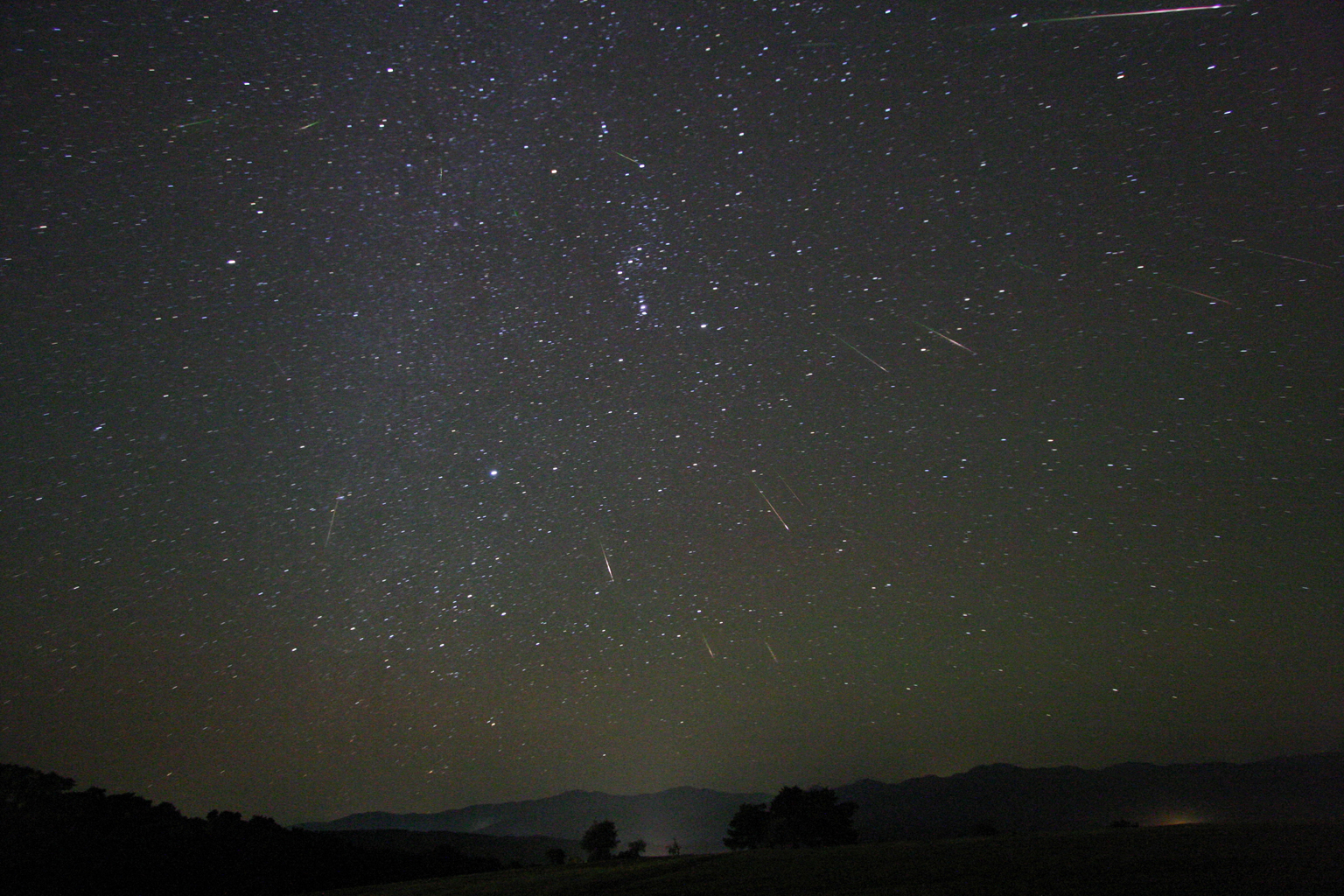
Meteor Shower


Another beautiful picture from Astonomy Picture of the Day.

New word: Aleatory

Last week, October 16--20, I attended a conference on security technology where I presented a paper. At the end of the week there was a talk on the Evaluation of Risk from Acts of Terrorism. Interesting topic.

The author used the word "aleatory" and that was new one for me. Here's what it means:

1.Law. depending on a contingent event: an aleatory contract.
2.of or pertaining to accidental causes; of luck or chance; unpredictable: an aleatory element.
3.Music. employing the element of chance in the choice of tones, rests, durations, rhythms, dynamics, etc.
(From Dictionary.com Click here for the definition.)

Makes sense, and I thought I'd pass along my new vocabulary word.

Thursday, October 12, 2006

Pamphlets for publishing

I ran across this site, or publisher really, from checking out a political blog that linked to a what I thought would be a book. The book, that really is a pamphlet of some sort, costs $10.00. Pretty cheap today so I looked a little closer. The publisher is "The New Pahphleteer" and a Yahoo! search led me to this site (see link above).

The site is for people to get ideas out in a short pamphlet instead of, or in supplement to, a long book. It's a great idea because I think people will read a pamphlet, take away an idea or two, and them move on to the next topic. We're so busy today, so bombarded with talk, television, pundits (some of whom are not even close to experts) that we have little time to read and digest ideas.

A pamphlet is a good way to stay informed within the short time we have to read.

Friday, October 06, 2006

New Blogger

Google has a new beta version for blogs. I just switched to it and am trying it out.

Wednesday, October 04, 2006

Worthless feat

A Japanese man recites pi to 100,000 digits. Is this not a totally worthless feat?

I'll tell you what would have been impressive: If he had calculated the digits instead of reciting them from memory. Now that would have been something, but again, not much.

Thursday, September 21, 2006

New Scientist: Is your pet in pain?

Animals are being misdiagnosed for pain. Don't believe it, well, there's a questionairre to complete so you can see:
Wiseman-Orr and Reid have designed a simple one-page questionnaire that can be used to evaluate whether a dog is in pain, an approach they say can be used to objectively evaluate the welfare of any animal in any setting.
You know, if my pet is in pain then I take it to my vet to be put down. That's the way to handle it. It's cold but it's the right thing to do.

Sex Selection: It's available now (and has been)

More people are choosing to choose the sex of their baby than have before. It's still a small percentage, but the trend is clear. With in-vitro fertilization becoming ever more common, couples can easily choose the gender of their future child, and couples are doing so.

For the most part, couples are screening embryos for the right reasons - to avoid passing on dreadful diseases, said Dr. William Gibbons, who runs a fertility clinic in Baton Rouge, La., and is president of the Society for Assisted Reproductive Technology, which assisted with the survey.

"There are thousands of babies born now that we know are going to be free of lethal and/or devastating genetic diseases. That's a good thing," he said.

However, the survey findings also confirm many ethicists' fears that Americans increasingly are seeking "designer babies" not just free of medical defects but also possessing certain desirable traits.

I don't know how to take this, exactly. On the one hand, the ideal way to conceive a child is nature's intended way (that has evolved over MANY years) with natural sex. On the other hand, if couples must have in-vitro fertilization (and I have no sympathy for those who do it who don't have to) why not pick what you want? Afterall, most of the fertilized embroyos will not be kept, so pick the ones you want. Still, it a terribly slippery slope and one that's being greased everyday.

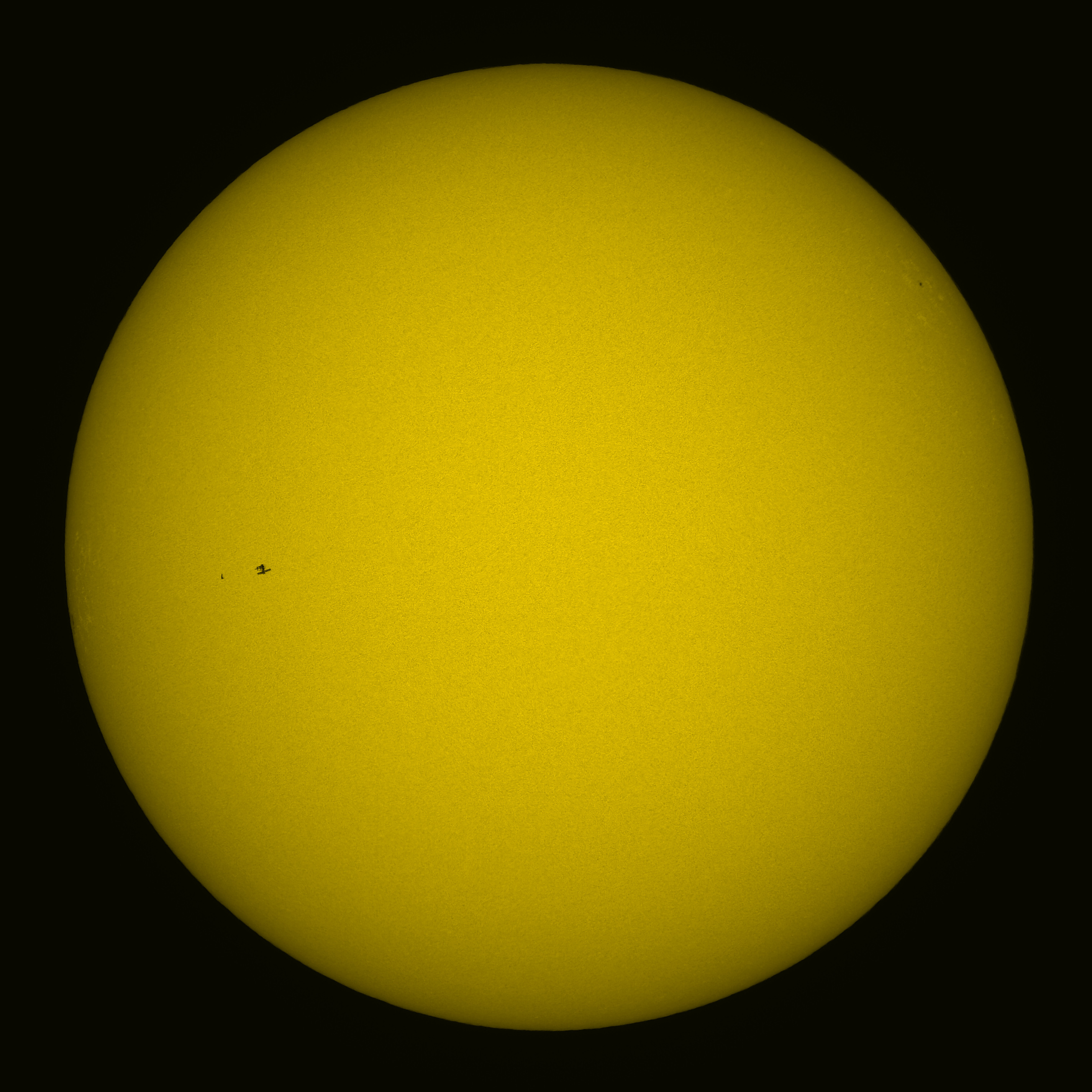
Sunshine makes me happy


While hard to see in this reduced photograph, the two black spots against the shining sun at the International Space station (on the right) and the shuttle Atlantis (on the left). Atlantis has just undocked and moved approximately 200-meters from the space station. This photo was taken near Mamers, Normandy.

Wednesday, September 20, 2006

Women in Science Report

This article from the New York Times is so biased as to be unbelievable. It's about a study from the National Academy of Sciences that concludes there's too much bias in the scientific community for women to succeed. Now if that isn't hogwash, I don't know what is.

I won't comment on the fact that all but one person on the 18-member panel (that's 18, mind you) were women. Imagine such a panel of men finding that the scientific community is biased against men, you'd hear howling of prejudice claims from all corners. No, I won't comment about that.

I will comment that while I was in undergraduate school and then graduate school for 6-1/2 years (Master's and Ph. D.) women got special attention. They were held to lower standards than the men, not always, but sometimes. Plus, when it came time to look for a job, colleges heavily recruited every woman but didn't recruit men much at all. If there was bias, it was directly against men and in favor of women.

And here's more, women who go into academia are then gagainst iven special grants and financial support exclusively for women. How is that bias against women?

The truth is that science is difficult. It's difficult work, difficult to find funding, difficult to balance the demands of a job with a family, and difficult to keep at it, year after year. If the Nataional Academy of Sciences wants to know why more women aren't in science, they should look at social demands, not the environment of the scientific community.

Tuesday, September 19, 2006

Capacitors for Super Batteries

"Nanotube filaments on the battery's electrodes" from the link above.

Researchers at MIT at trying to make batteries that can be very quickly charged and be useful for laptops or cell phones. The key, they believe, is to fabricate capacitors with extremely large surface areas. Capacitors store electricity as an electric field between the plates of the capacitor. In order to increase the energy, the researchers are adding nanoscale fibers to the plates. These fibers increase the surface area and thereby increase the amount of electric charge that a capacitor can store.

That's a clever idea, but I wouldn't throw away the batteries you have just yet. These sorts of ideas seem terrific but in practice something usually (but not always!) happens to make the invention less than stellar. Keep your lithium rechargeables around; they'll still plenty useful.

Tuesday, August 29, 2006

On Perelmand and Yau about who proved the Poincare Conjecture

This article (see the link above) tells a great story of some of the personalities of the mathematicians involved in proving the Poincare Conjecture. It's worth the time to read it all.

Monday, August 28, 2006

The Math Was Complex, the Intentions, Strikingly Simple


George Johnson writes in the New York Times:
[M]athematics has been infused with the legend of the mad genius cut off from the physical world and dwelling in a separate realm of numbers. In ancient times, there was Pythagoras, guru of a cult of geometers, and Archimedes, so distracted by an equation he was scratching in the sand that he was slain by a Roman soldier. Pascal and Newton in the 17th century, Gödel in the 20th — each reinforced the image of the mathematician as ascetic, forgoing a regular life to pursue truths too rarefied for the rest of us to understand.

Last week, a reclusive Russian topologist named Grigory Perelman seemed to be playing to type, or stereotype, when he refused to accept the highest honor in mathematics, the Fields Medal, for work pointing toward the solution of Poincaré’s conjecture, a longstanding hypothesis involving the deep structure of three-dimensional objects. He left open the possibility that he would also spurn a $1 million prize from the Clay Mathematics Institute in Cambridge, Mass.

Unlike Brando turning down an Academy Award or Sartre a Nobel Prize, Dr. Perelman didn’t appear to be making a political statement or trying to draw more attention to himself. It was not so much a medal that he was rejecting but the idea that in the search for nature’s secrets the discoverer is more important than the discovery.

“I do not think anything that I say can be of the slightest public interest,” he told a London newspaper, The Telegraph, instantly making himself more interesting. “I know that self-promotion happens a lot and if people want to do that, good luck to them, but I do not regard it as a positive thing.”

Johnson goes on to give a half-baked, half hearted attempt to describe Perelman's refusal to accept the Fields Medal for his solution to the Poincare Conjecture. Unfortunately, Johnson really misses the point. Here is a man who just wants to think about mathematics and study nature with his own intellect. It is a state of being few of us will ever reach yet we ought to be in awe of anyone who can do this.

In a society steeped in self-promotion for the slightest contribution to any field, we find a man who contributed to the Poincare-conjecture, proved it, and wants to leave that knowledge to others without interference. This is perhaps the most noble gesture we are likely to ever find.

The only person I know who comes close to this but misses by much is Richard Feynman who wanted to turn down the Nobel prize in physics because it would interfere with his work. Feynman accepted the prize, bought a second house with the money, and continued to work.

Perelman is not interested in a second house, wants to live where he is, and be left alone. Is there anything wrong with that?

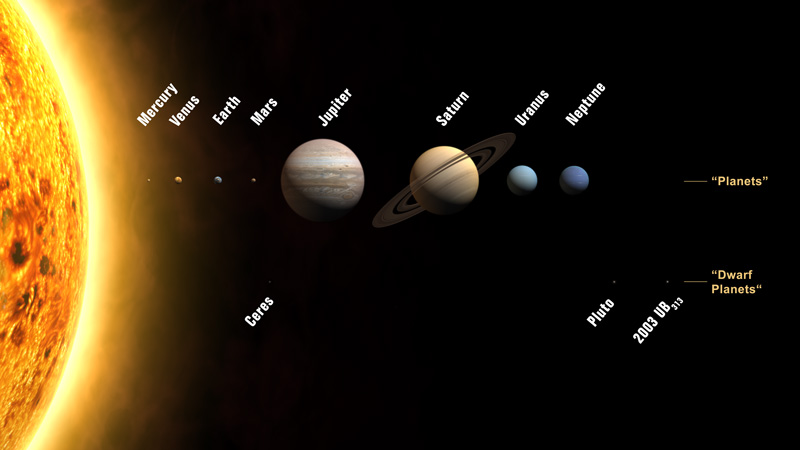
Astronomy Picture of the Day


The International Astronomical Assocication demoted Pluto to a Dwarf Planet. So, our soloar system has only eight planets now.

In truth, who really cares? The idea that A is a planet and B is not a planet is semantics. A is some object in the solar system and it has a mass, location, orbit, etc. B is some other object in the solar system with its own mass, location, orbit, etc. The fact that A is more massive than B is relevant to how we calculate its effects and parameters. There are still these objects in space, regardless of how anyone classifies them.

Tuesday, August 22, 2006

Astronomy Picture of the Day


This cloud is from flares ejected from a C-17 plane. The pattern, that looks like an owl, results from the air flow over the wings, called wingtip vortices.

Pizza Fraud

A fraudster contacts an AT&T service rep and says he works at a pizza parlor and that the phone is having trouble. Until things get fixed, he requests that all incoming calls be forwarded to another number, which he provides.

Pizza orders are thus routed by AT&T to the fraudster's line. When a call comes in, the fraudster pretends to take the customer's order but says payment must be made in advance by credit card.

The unsuspecting customer gives his or her card number and expiration date, and before you can say "extra cheese," the fraudster is ready to go on an Internet shopping spree using someone else's money.

John Britton, an AT&T spokesman, confirmed the contents of the memo and said two separate instances of the call-forwarding scam have been reported so far in Southern California.

This came from Bruce Schneier's blog.

Tuesday, August 15, 2006

Poincare conjecture: Solved?


"Three years ago, a Russian mathematician by the name of Grigory Perelman, a k a Grisha, in St. Petersburg, announced that he had solved a famous and intractable mathematical problem, known as the Poincaré conjecture, about the nature of space.

After posting a few short papers on the Internet and making a whirlwind lecture tour of the United States, Dr. Perelman disappeared back into the Russian woods in the spring of 2003, leaving the world’s mathematicians to pick up the pieces and decide if he was right.

Now they say they have finished his work, and the evidence is circulating among scholars in the form of three book-length papers with about 1,000 pages of dense mathematics and prose between them.

As a result there is a growing feeling, a cautious optimism that they have finally achieved a landmark not just of mathematics, but of human thought."

Dr. Grigory Perelman has proved the Poincare conjecture. While I don't begin to understand the conjecture, at least in a fundamental sense, much less its implications, this is great news for mathematics as well as science in general.

Every step to solving one of the truly remarkable problems of our time, for example, Fermat's Last Theorem, is another step to improving human thought and human experiences.

String Theory: All theory, no substance

Time Magazine has a short article about two books that question string theory:

[D]espite its extraordinary popularity among some of the smartest people on the planet, string theory hasn't been embraced by everyone--and now, nearly 30 years after it made its initial splash, some of the doubters are becoming more vocal. Skeptical bloggers have become increasingly critical of the theory, and next month two books will be hitting the shelves to make the point in greater detail. Not Even Wrong, by Columbia University mathematician Peter Woit, and The Trouble with Physics, by Lee Smolin at the Perimeter Institute for Theoretical Physics in Waterloo, Ont., both argue that string theory (or superstring theory, as it is also known) is largely a fad propped up by practitioners who tend to be arrogantly dismissive of anyone who dare suggest that the emperor has no clothes.
So, it's a fad that has shown absolutely nothing! No predictions that can be tested anyway.

That lack of specificity hasn't slowed down the string folks. Maybe, they've argued, there really are an infinite number of universes--an idea that's currently in vogue among some astronomers as well--and some version of the theory describes each of them. That means any prediction, however outlandish, has a chance of being valid for at least one universe, and no prediction, however sensible, might be valid for all of them.

That sort of reasoning drives critics up the wall. It was bad enough, they say, when string theorists treated nonbelievers as though they were a little slow-witted. Now, it seems, at least some superstring advocates are ready to abandon the essential definition of science itself on the basis that string theory is too important to be hampered by old-fashioned notions of experimental proof.
This is called being wedded to an idea no matter what. It's bad in general and terribly awful for science.

And it is that absence of proof that is perhaps most damning. Physicists have a tolerance for theory; indeed, unless you were there to witness a phenomenon yourself--the Big Bang, say--it will always be, at some level, hypothetical. But the slow accretion of data and evidence eventually eliminates reasonable doubt. Not so--or at least not yet--with strings.

"It's fine to propose speculative ideas," says Woit, "but if they can't be tested, they're not science." To borrow the withering dismissal coined by the great physicist Wolfgang Pauli, they don't even rise to the level of being wrong. That, says Sean Carroll of the University of Chicago, who has worked on strings, is unfortunate. "I wish string theorists would take the goal of connecting to experiment more seriously," he says. "It's true that nobody has any good idea of how to test string theory, but who's to say someone won't wake up tomorrow morning and think of one? The reason so many people keep working on it is that, whatever its flaws, the theory is still more promising than any other approach we have."

In the end, scientists should accept string theory because it's the best physics has. I guess that's right up there with believing the sun revolves around the earth. It's a good theory and was at one time the best around, why should anyone have ever questioned it. And that theory had something string theory doesn't: At least you could see the sun and the earth.

Monday, August 14, 2006

It's all how you see it

I read this today on the link above and thought it worth reading for others:

A man who lived on the northern frontier of China was skilled in interpreting events. One day for no reason, his horse ran away to the nomads across the border. Everyone tried to console him, but his father said, "What makes you so sure this isn't a blessing?" Some months later his horse returned, bringing a splendid nomad stallion. Everyone congratulated him, but his father said, "What makes you so sure this isn't a disaster?" Their household was richer by a fine horse, which the son loved to ride. One day he fell and broke his hip. Everyone tried to console him, but his father said, "What makes you so sure this isn't a blessing?"
A year later the nomads came in force across the border, and every able-bodied man took his bow and went into battle. The Chinese frontiermen lost nine of every ten men. Only because the son was lame did father and son survive to take care of each other. Truly, blessing turns to disaster, and disaster to blessing: the changes have no end, nor can the mystery be fathomed.

From Chinese Fairy Tales and Fantasies, compiled by Moss Roberts, 1979, Pantheon Books


Sunday, August 13, 2006

Friday, August 04, 2006

Statistics: How they helped win World War II

This is quite amazing:

By 1941-42, the allies knew that US and even British tanks had been technically superior to German Panzer tanks in combat, but they were worried about the capabilities of the new marks IV and V. More troubling, they had really very little idea of how many tanks the enemy was capable of producing in a year. Without this information, they were unsure whether any invasion of the continent on the western front could succeed.

The statisticians had one key piece of information, which was the serial numbers on captured mark V tanks. The statisticians believed that the Germans, being Germans, had logically numbered their tanks in the order in which they were produced. And this deduction turned out to be right. It was enough to enable them to make an estimate of the total number of tanks that had been produced up to any given moment.

The basic idea was that the highest serial number among the captured tanks could be used to calculate the overall total. The German tanks were numbered as follows: 1, 2, 3 ... N, where N was the desired total number of tanks produced. Imagine that they had captured five tanks, with serial numbers 20, 31, 43, 78 and 92. They now had a sample of five, with a maximum serial number of 92. Call the sample size S and the maximum serial number M. After some experimentation with other series, the statisticians reckoned that a good estimator of the number of tanks would probably be provided by the simple equation (M-1)(S+1)/S. In the example given, this translates to (92-1)(5+1)/5, which is equal to 109.2. Therefore the estimate of tanks produced at that time would be 109

By using this formula, statisticians reportedly estimated that the Germans produced 246 tanks per month between June 1940 and September 1942. At that time, standard intelligence estimates had believed the number was far, far higher, at around 1,400. After the war, the allies captured German production records, showing that the true number of tanks produced in those three years was 245 per month, almost exactly what the statisticians had calculated, and less than one fifth of what standard intelligence had thought likely.

Emboldened, the allies attacked the western front in 1944 and overcame the Panzers on their way to Berlin. And so it was that statisticians won the war - in their own estimation, at any rate.

This is a lesson for today: Intelligence over estimated the number by a factor of 5. What does that say about the intell world now?

Preditors Prefer Dimwitted Prey

I think this is true in the human world, too.

Tricks to play on your wireless free loaders


Here's a cute solution to a common problem.

Suppose you have a wireless router that people are free loading on. You could encrypt your wireless connection, which is what I do anyway, and probably most people should do, or you can play with the surfers.

This person added software to either redirect the freeloaders to another site, kittenwar, or he did something particularly clever. He forced the images to be turned upside down on whatever sites they visited. Take a look. (Hat tip: Schneier blog.)

Book Review: Essential Mathematics and Statistics for Science

Here isa book review I wrote for the Mathematical Association of America's website:

What is a good way to learn and compute statistics? Is it to pick-up one book, read it, and apply the algorithms to one's problem? Should one have a single book for his/her work or many books? How much theory should one know? Lastly, how can one use the world-wide web with a text book?

Drs. Currell and Dowman have written a statistics textbook for students and researchers. Their book provides brief discussions, formulas, worked examples, and exercises (with short answers in the back) to illustrate topics and usage. In addition to the text itself, there is a well-organized and useful web site for the book (http://eu.wiley.com//legacy/wileychi/currellmaths/ or http://www.wileyeurope.com/go/currellmaths). The web site provides supplementary help, in-depth solutions, and study resources, among other topics. The text and web site complement one another and are excellent at giving the reader a workable grasp of the material.

The text begins with a gentle discussion of statistics, data, and numbers. It discusses units, conversion between units, and then measurements. The discussion and topics are a solid introduction for the beginning student. The book then guides the reader through manipulation of equations, relationships between variables (such as linear, quadratic and exponential) and discusses probability distributions such as normal, binomial, and Poisson. In the final chapters the book discusses statistical tests: F-test, t-test, Chi squared, and non-parametric tests. All these topics are highly relevant to researchers, well presented, and easy to follow. The multitude of examples clarifies the text.

The authors state in the first sentence that the book is for "biological, environmental, chemical, forensic, and sport sciences." This is important because the book, which presents the material at that level, is not the most appropriate for mathematicians, physicists or engineers—anyone with a deeper mathematical background or interest. I was, in fact, struck by the oftentimes cook-book nature of the discussion.

I would have liked more discussion of the mathematics behind the ideas. For example, the method of linear fit is given without any theory such as derivatives. The text shows how to find the parameters with Excel but not what the Excel routines do. Many readers probably have Excel and for those who just want the answer, that may be all they need. (One note: While Excel is popular I urge authors to look at OpenOffice software, www.openoffice.org, in the future. It is free, easy to use, and not proprietary.)

What about using the world-wide web? The authors employ the web for detailed solutions and supplementary help for the reader. This is indeed a plus. Obviously, other web sites can provide details on any topic one desires. But, I believe that having a text book with the web site is the better way to use the web. The reader sees a consistent presentation of each topic both on his paper page and his screen page. The textbook gives the researcher an easy to navigate source of topic, explanation, example, without having to load pages, or search multiple sites for details. Thus this book with its companion web site are all the better.

Tuesday, August 01, 2006

New addition to my family

Please help me welcome our new dog, Bailey, to the family. Bailey is a pure bred golden retriever and was born on April 7, 2006. We brought her home this past Sunday and she has taken to our family very well. She's playful, active, and sweet; everything a golden is supposed to be. Plus, she retrieves!

Friday, July 21, 2006

Sleep alone, improve your brain power

Both men and women do better mentally when they sleep alone. The effect is more pronounced for men though.

Thursday, July 13, 2006

Smells by computer

A Japanese invention can sense a smell and then replicate it. Pretty cool idea.

If you couple this invention with the fact that smells trigger memories, this could be a great memory aid device. If that's done, this would be really cool.

Pair up, it could save your life

The risks of heart attacks for people living alone is double that of people living with a partner. Seems company does make you healthier.

My child's poop smells better than your child's

A study shows that mom's prefer the smell their own child's poop to that of other children's poop. One theory is that moms evolved to this so that they will care for their children.

Frankly, as a father, I knew that I had to change my child's diaper but I didn't have to do so for another person. My daughters babysit and they change diapers without complaint. But this isn't quite the same. It's one thing to change a diaper, it's another to smell different diapers (without having to change them) and prefer one smell over another.

A mystery?

Wednesday, July 12, 2006

Circumcision may stop millions of HIV deaths

I've written about this before. Circumcised men have a much lower chance of contracting AIDS than do uncircumcised men. So, not only do they not get AIDS as easily as others, but the chances of a circumcised man then passing it on is lower. (He can't pass it on if he doesn't get it.)

Of course, as the article notes at the end, it's not a cure and will not stop the disease. Still, lowering the risk of contracting the disease is a very, very good thing.

Friday, July 07, 2006

Astronomy Picture of the Day


This is spiral galaxy M81 that is in teh northern part of the Ursa Major constellation. The second brightest super nova is here. Note the bright yellow nucleus and blue spiral arms.

Go here to see more.