
This is utterly fantastic!
At maps.google.com there is now, for San Francisco, a street view of the city. With Adobe Flashplayer you can see video captures of the streets of the city.
Try this and be amazed.

"NASA scientists working with high-precision planetary radars in California have discovered strong evidence that the planet Mercury might have a molten core.
"Scientists had not expected to find a magnetic field at Mercury," said Professor Jean-Luc Margot of Cornell University, leader of the research team. "Planetary magnetic fields are associated with molten cores, and the prevailing theory was the planet was too small to have a molten core."Since then, multiple radar observations have ruled out a solid core, leading to the finding that Mercury's core is molten -- or at least the outer core is molten and not forced to rotate along with its shell."
I'm not sure what this means in the grand scheme of things, but it goes to explaining more of our universe. And that's a good thing.

The mallard Anas platyrhynchos: a species with high levels of forced copulations. Females have very elaborate vaginas (left) to counter males' phalluses (right). (Image: Patricia Brennan et al.)
"Some female ducks and geese have evolved complex genitalia to thwart unwelcome mating attempts, according to a new study.
Males of some species, such as mallard, have a notorious habit of "raping" females. They and other wildfowl are among the 3% of bird species whose males have phalluses big enough to insert into the vaginas of females, whether or not the female consents.
Now, in the most detailed analysis yet of duck and goose vaginas, researchers have established that females of these species have evolved vaginal features to thwart unwelcome males.
Some vaginas had spiral channels that would impede sex by twisting in the opposite direction to that of the male phallus. Others had as many as eight cul-de-sac pouches en route, that could prevent fertilisation by capturing unwelcome sperm. Moreover, these features were only found in species renowned for forced sex. All other species had simple male and female genitalia.“These structures are wonderfully devious, sending sperm down the wrong road or impeding penetration,” says Birkhead.
He says that the features demonstrate an evolutionary "arms race" in which control over reproduction alternates between the sexes. If the male develops a longer, more elaborate phallus to force copulation, females wrest back control by developing features to thwart males who rape.
“It shows that females are not passive in averting exploitation by males with large phalluses,” says Birkhead. "
This is a terrific example of co-evolution. The aggressive males evolve to perpertuate their genes, hence the force coupling. The females evolve, almost simultaneously it seems, to counter the evolution of the males.

"Like a column collapsing under the burden of a heavy roof, erectile dysfunction is a classical mechanical engineering problem, says a US urologist. Using mathematical models of penis geometry and hydrostatic pressure, doctors can predict when penises will fail – and in which vagina – he says.
The most widely investigated parameter of penile rigidity is intracavernosal pressure (ICP) – the fluid pressure achieved by blood build up in the two expandable "caverns" of the penis. For a healthy man, the erect ICP is between 60 and 90 millimetres of mercury (mmHg), but can drop to just 30 mmHg, in men with erectile dysfunction (ED)."Here's the abstract from the Journal:
"Two major branches of engineering mechanics are fluid mechanics and structural mechanics, with many practical problems involving the effect of the first on the second. An example is the design of an aircraft's wings to bend within reasonable limits without breaking under the action of lift forces exerted by the air flowing over them; another is the maintenance of the structural integrity of a dam designed to hold back a water reservoir which would exert very large forces on it. Similarly, fluid and structural mechanics are involved in the engineering analysis of erectile function: it is the hydraulic action of increased blood flow into the corpora cavernosa that creates the structural rigidity necessary to prevent collapse of the penile column."
OOPS, that's wrong. It's first people then animals, so says the article. Used to be we tried experimental drugs on animals and then prescribed the drugs on people. That's in reverse:
Vets have rejected claims by a British animal welfare charity that giving dogs drugs to treat behavioural problems will create a population of "pill-popping pets".
The Royal Society for the Prevention of Cruelty to Animals expressed alarm at the news that an antidepressant called Reconcile - containing the same serotonin-reuptake inhibitor used in the human drug Prozac - has been licensed for use in dogs by the US Food and Drug Administration.
"Pet owners have a duty of care towards their animals," says charity scientist Penny Hawkins. "Pharmaceuticals should not be used to help sustain an unsustainable lifestyle by addressing problems that should be dealt with by other means, such as more exercise."
“”Pet owners have a duty of care towards their animals. Drugs should not be used to sustain an unsustainable lifestyle
It used to be that if you had a dog, and it was a problem, you either gave the dog away, or had it killed. Simple. Dogs are dogs, after all, not people. Now, we're seeing a slide to drugs for dogs (and I'm sure other animals) that will only take us further along to more drugs, more medical treatment, more costs, and, if owners opt not to do these things, there will be societal (read: animal rights activits) pressure to force owners to do them.But vets specialising in treating behavioural problems say medication can be extremely useful in treating anxiety symptoms such as howling and destructiveness.
Dogs with behavioural problems account for about a quarter those that are euthanised by veterinary practices, so by increasing the chances of successfully managing a problem drugs can improve welfare.
YOU are surfing the net, and stop at a sports site you regularly visit to read the latest headlines. You are always careful to avoid sites that appear suspect, so you feel safe online. Unbeknownst to you, though, and to the innocent owner of the website, a piece of malicious code has been added to the page you are viewing. This uploads software onto your computer via your browser, turning it into a "zombie" PC under the remote control of a malicious user.While installing firewalls and antivirus software on your computer may keep it safe from conventional threats such as worms and viruses, these security tools do not inspect data downloaded through browsers - a loophole that attackers can exploit. "The firewall is dead," says Google security specialist Niels Provos.
The threat is real, not just a theoretical possibility:
Provos warned that many web users are becoming the victims of "drive-by" downloads of bots from innocent websites corrupted to exploit browser vulnerabilities. As firewalls allow free passage to code or programs downloaded through the browser, the bot is able to install itself on the PC. Anti-virus software kicks in at this point, but some bots avoid detection by immediately disabling it. Once a computer has become infected with the malicious software, the zombie periodically connects to a web server controlled by the botmaster to receive instructions and download more software.
To determine the scale of the problem, Provos's group at Google analysed several billion web pages and selected 4.5 million suspicious pages for more detailed study. To test for malicious software, or malware, they loaded a program designed to simulate a computer with a vulnerable version of Internet Explorer and monitored what happened. They found around 450,000 web pages that launched drive-by downloads of malicious programs. Another 700,000 pages launched downloads of suspicious software. More than two-thirds of the malicious programs identified were those that infected computers with bot software or programs that collected data on banking transactions and emailed it to a temporary email account.You don't even know it's there. The result: be very careful with the sites you go to. If possible, don't use Internet Explorer; IE is a disaster for security.
 Sunday, April 15, is the 300th birthday of Leonhard Euler (pronounced "oiler"), one of the most important mathematicians ever to have lived.
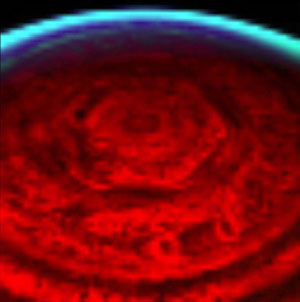 It was recently reported that there's a hexagonal rotating structure (see the image at left) at the North pole of Saturn.
We may not have found other life in our Solar System, but we have, it appears, found a polygon. An odd, six-sided, honeycomb-shaped feature circling the entire north pole of Saturn has captured the interest of scientists with NASA's Cassini mission.
NASA's Voyager 1 and 2 spacecraft produced images of the hexagon over two decades ago. The fact that it has appeared in the recent Cassini images indicates that it is a long-lived feature. A second hexagon, significantly darker than the brighter historical feature, is also visible in the Cassini pictures. The spacecraft's visual and infrared mapping spectrometer is the first instrument to capture the entire hexagon feature in one image.
 The unusual phenomenon in question involves rotating a bottom plate under a liquid in a circular (cylindrical) container. Bohr and his team of students at the Technical University and at the Niels Bohr Institute set up an experiment to find out whether or not such conditions would lead to stable deformations of a water surface into polygon shapes. The findings from their experiment were published May 3rd in Physical Review Letters.
 Bohr tells PhysOrg.com that a somewhat similar experiment took place eight years ago with a different team (including Clive Ellegaard and others). “We had fluid falling on a plane, like water from a faucet. We found that even if the rim of the plate is completely circular, the fluid surface can be shaped like a polygon.”
While the first polygon experiment Bohr did involved stationary polygons, the most recent effort shows rotating polygons. “Not only are these shapes rotating,” says Bohr, “but they are rotating at a different speed than the plate beneath them.”This is a fascinating phenomena that is, apparently, unexplained as yet. Here's another site for a video and more links.

In a ground-breaking case at the Mödling district court, just southwest of Vienna, Austria, a judge is to rule over "the humanness of a chimp"– specifically, over whether it deserves a legal guardian.This is the most ridiculous legal item I've seen a long time. Of course the chimp is NOT a human. To say otherwise is to say that we, (you, me, your friends, etc.) are chimps. Clearly not the case.
The chimpanzee in question is called Hiasl. He was born in the Sierra Leone jungle in 1981, captured by animal traders and illegally shipped to Austria, destined for a vivisection lab. Customs officials intercepted the crate and Hiasl was handed to an animal sanctuary. Now, years later, the sanctuary has gone bankrupt and Hiasl is to be sent to a zoo.

Fighter pilots will one day be able to control entire squadrons of uncrewed combat aircraft as well as their own plane, following successful flight demonstrations of a multi-aircraft remote control system in UK airspace.This is not as new as it would seem. Just today I was in a meeting discussing how we might see unmanned aerial vehicles flying in U.S. airspace and how cargo planes could become pilotless. This demonstration is one step to seeing those ideas become a reality.In addition to cutting the number of pilots risked in military operations, the remote control system could one day also be used to auto-land hijacked planes. Or they might allow lone pilots to orchestrate complex search and rescue operations.
Not only is Ug99 a threat in itself, but even if we have resistant wheat, we have still another problem:"This thing has immense potential for social and human destruction." Startling words - but spoken by the father of the Green Revolution, Nobel laureate Norman Borlaug, they are not easily dismissed.
An infection is coming, and almost no one has heard about it. This infection isn't going to give you flu, or TB. In fact, it isn't interested in you at all. It is after the wheat plants that feed more people than any other single food source on the planet. And because of cutbacks in international research, we aren't prepared. The famines that were banished by the advent of disease-resistant crops in the Green Revolution of the 1960s could return, Borlaug told New Scientist.
The disease is Ug99, a virulent strain of black stem rust fungus (Puccinia graminis), discovered in Uganda in 1999. Since the Green Revolution, farmers everywhere have grown wheat varieties that resist stem rust, but Ug99 has evolved to take advantage of those varieties, and almost no wheat crops anywhere are resistant to it.
However, Ug99 has another ace up its sleeve. The spores blowing in the wind now are from the asexual stage that grows on wheat. If any blow onto the leaves of its other host, the barberry bush (Berberis vulgaris), they will change into the sexual form and swap genes with whatever other stem rusts they find. Barberry is native to west Asia. "As if it wasn't challenging enough breeding varieties that resist this thing," laments Ward. "All I know is that what blows into Iran will not be the same as what blows out."One solution is to apply fungicide to the crops which for many countries will work until new wheat can be developed that's resistant. But for poor countries fungicide is too expensive.

A shortage of big sharks along the U.S. East Coast is letting their prey flourish, and that prey is going hog wild, demolishing bay scallop populations.So, the cownose rays have multiplied and are eating more of the delicacies of scallops. What to do? Should we hunt down the rays now or, as the article later suggests make the rays a delicacy themselves?That's the conclusion of researchers led by the late Ransom Myers of Dalhousie University in Halifax, Nova Scotia, who died this week. Combining census surveys from the past 35 years, Myers' team found shrinking populations of big sharks and shellfish and increasing numbers of smaller sharks and rays.
"Affecting something at the top [of the food web] is going to have huge consequences as effects ramify through the system," says study collaborator Charles H. Peterson of the University of North Carolina's Institute of Marine Sciences at Morehead City. As part of the new study, he and his colleagues explored some of those effects by protecting bay scallops from the cownose ray (Rhinoptera bonasus), one of the flourishing midlevel predators.
Cownose rays have grown so abundant along the U.S. East Coast that fisheries managers are trying to promote them as a seafood delicacy. TV cooking-show host Emeril Lagasse has even developed some recipes. (Picture caption)I have never eaten a ray and have no desire to ever do so. But if people like them, why not hunt them and eat them? They are part of the food chain, as are we, and we should look at them as food just like we do for a cucumber.
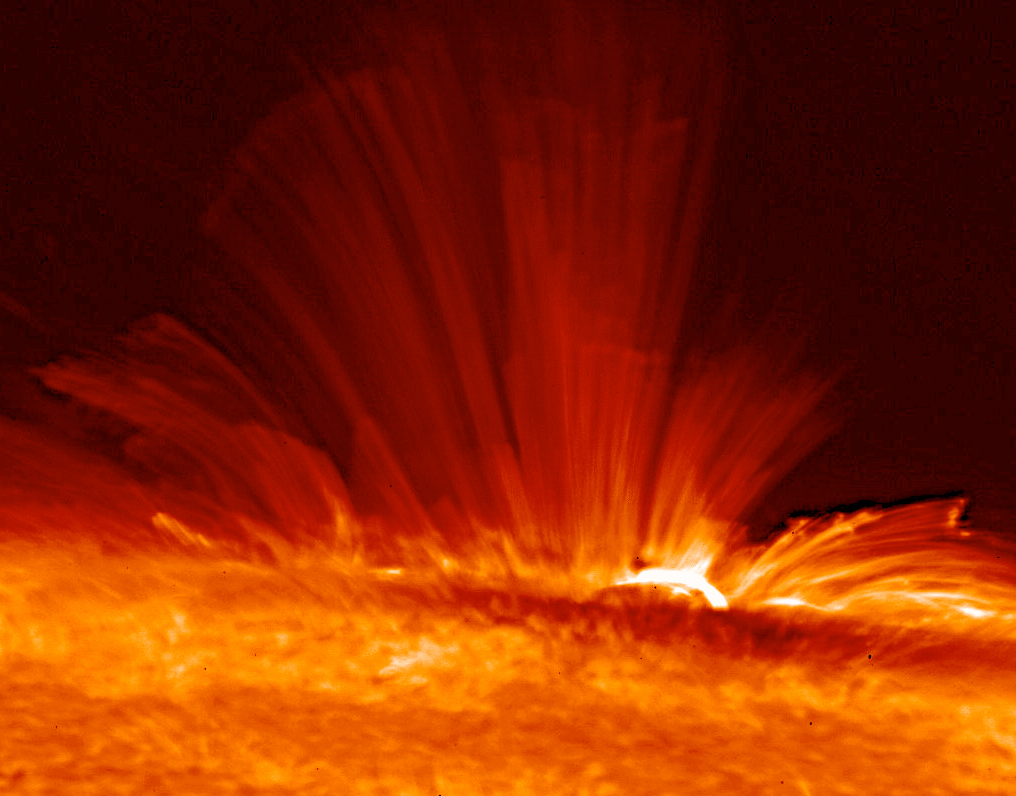 From the Astronomy Picture of the Day:
Why are there dark spots on the sun? Although noted for thousands of years, sunspots have been known for decades to be regions of the Sun that are slightly depressed and cooled by the Sun's complex and changing magnetic field. High resolution pictures like the above image from Japan's new Sun-watching Hinode satellite, however, are helping to increase modern understanding. In the center of the above image is a sunspot, but not seen in the usual orientation --this sunspot is seen sideways. Of particular interest is erupting glowing gas that shows how the Sun's magnetic field comes right out of the spot center, but curves markedly around the spot edges. Better understanding of how the Sun ejects particles into space may result in more accurate predictions of solar storms that affect satellites, astronauts, and even power grids on Earth.

An ancient sea-going crocodile has surfaced from the rocks of Crook County in eastern Oregon.The fossils are generally found in Japan or China so that the finding in Oregon indicates that possible:It's discovery by the North American Research Group (NARG), whose members were digging for Jurassic-age mollusks known as ammonites, is another confirmation that the Blue Mountains consist of rocks that traveled from somewhere in the Far East, says retired University of Oregon geologist William Orr, who was called in to examine the find for the state.
The remains - about 50 percent of a 6- to 8-foot reptile, including long, needlepoint teeth - were found imbedded in Jurassic rock on private property in the Snowshoe Formation of the Izee Terrane south of Dayville, Ore. Rocks containing the fossils were slowly cut out of the rock, after NARG members realized that the linear appearance of the fossils in the region's hard rocks suggested that a whole creature had been found, Orr said.
"This taxon was a crocodile-like creature but had a fish tail," said Orr, a NARG adviser and director of the Thomas Condon State Museum of Fossils at the University of Oregon. "This creature lived in Jurassic times, so it's 150 to 180 million years old. It probably lived in an area from Japan to East Timor, somewhere in the western Pacific in a tropical estuarine environment."
[T]he remains in Oregon migrated eastward in rock by continental drift, a theory of land movement in geological time now encompassed under plate tectonics. Terrane formations, such as those where these fossils were found, are believed to be portions of the earth's crust riding apart of a plate that is pushed upward at contact with another plate.An incredible find.
made some doodles on a page—"pretty ugly" ones, she says—she found that they shared the qualities of a Pollock, according to an analysis that follows Taylor's approach. "Either Taylor is wrong, or Kate's drawings are worth $40 million," says Jones-Smith's collaborator Harsh Mathur. "We'd be happy either way."This started a discussion as to whether Taylor's approach can actually verify artwork.
For authentication, it doesn't matter whether it's legitimate to call Pollock paintings fractal, says Michael Barnsley of Australian National University in Canberra. Taylor has a reproducible technique that produces numbers from a painting, and he can correlate those numbers with different artists. "That doesn't allow you to authenticate or not authenticate a painting, but you could certainly add it into the collection of information that you have to say that it's more likely," he says.Fractals are ill-defined now but the methods we use to measure fractal dimension have a place in our mathematical toolbox. A place, among many other tools, but not the only tool.
 I LOVE these pictures from NASA and the Hubble telescope. They never cease to amaze me and I marvel at their beauty. Just gorgeous.
 It's like something out of photoshop with the imagination of an artist. EXCEPT, it's real. This is a picture from the Hubble Telescope, on the Astronomy Picture of the Day. Here's their explanation:
This stunning group of galaxies is far, far away - about 450 million light-years from planet Earth - cataloged as galaxy cluster Abell S0740. Dominated by the cluster's large central elliptical galaxy (ESO 325-G004), this sharp Hubble view takes in a remarkable assortment of galaxy shapes and sizes with only a few spiky foreground stars scattered through the field. The giant elliptical galaxy spans over 100,000 light years and contains about 100 billion stars, comparable in size to our own spiral Milky Way. The Hubble data reveal a wealth of detail in even these distant galaxies, including magnificent arms and dust lanes, star clusters, ring structures, and gravitational lensing arcs.Wow, that one part (just a part) of the image is 100,000 light years across and contains approximately 100-billion starts. Read that again. The galaxy is enormous and it's only a small part of the image.

