
I can't do better than the author of this link, so go here to read it all.University of Washington physicist (and science-fiction author) John Cramer is moving forward with his experiment in backward causality, thanks in part to tens of thousands of dollars in contributions sent in by his fans. Although Cramer emphasizes that his lab is looking at “nonlocal quantum communication” rather than backward time travel per se, the gadgetry he’s assembling could settle a controversy surrounding a seemingly faster-than-light effect that Albert Einstein thought was downright spooky.
Boiled down to its basics, the experiment involves splitting laser light into two beams, so that characteristics of one beam are reflected in the other beam as well. That's an example of what physicists call quantum entanglement. Specifically, Cramer has been planning to fiddle with one of the entangled laser beams such that it takes on the property of waves or particles. If one beam behaves like particles, the entangled photons of light in the other beam should behave like particles, too.
Friday, July 20, 2007
Interesting physics experiments in the offing


Thursday, July 19, 2007
Sex in your sleep
If you think it’s impossible to have sex while you sleep, think again, according to a new study.
There are at least 11 different sex-related sleep disorders, collectively referred to as “sexsomnia” or “sleepsex,” that affect people who are otherwise psychologically healthy—causing them to unknowingly engage in various sexual activities during the night.
Carlos Schenck, a psychiatrist at the Minnesota Regional Sleep Disorders Center, and his colleagues have studied a number of behavioral disorders associated with sleep.
“Any basic instinct can come out in the context of sleep,” Schenck told LiveScience. “All sorts of things can happen.”
So, be careful when you're sleeping, as if that's possible. But, if your roommate tells you something weird about yourself, it just may be true.
A WOW video
It is truly fun to watch and when you think of the work it took to make these remote control airplanes, and that they work together, well, that's just fantastic. Here's what my friend said:
This aircraft runs on four chainsaw motors. You can just imagine how much time, effort, skill and money these guys have put into this thing.Here's the link:
Tuesday, July 17, 2007
Simple yet inexplicable illusions and unknowns
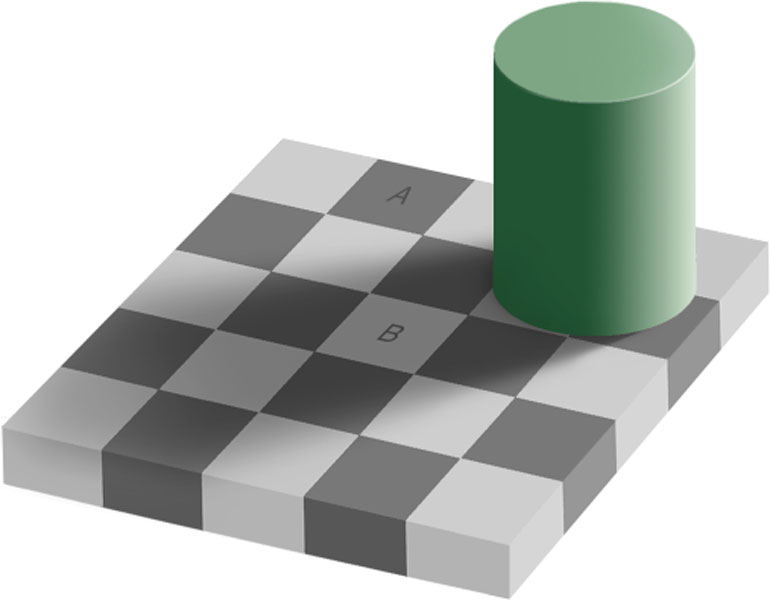
The Astronomy Picture of the Day today is not about astronomy, per se, but rather about illusions. The image above is fairly common. You see the checkerboard pattern but are squares A and B the same color? They look different to me. Then you see the picture below.
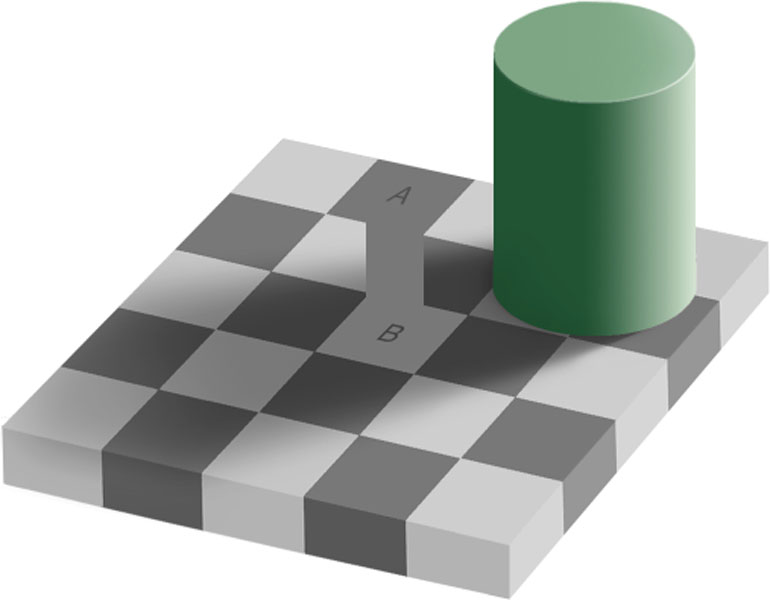 The squares are connected so that instead of looking like different colors, they look close to identical. (I still see square A as darker than square B but maybe that's my age showing.)
No one knows why people see the squares as different colors, but we do.
The site also has a link that, with a few clicks, takes you to this picture.
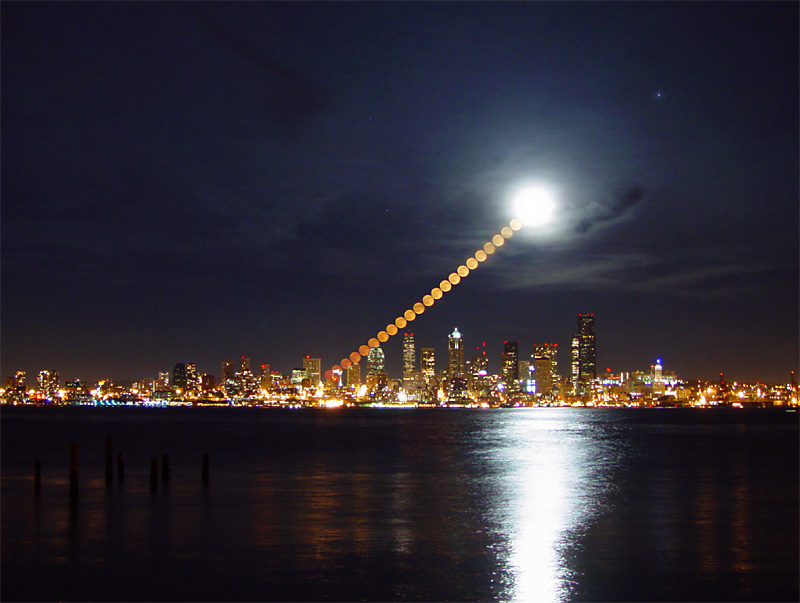
Ever notice that when the moon is near the horizon it looks much bigger than it does high in the sky? I've seen it may times, low to the horizon, and my wife calls that a "harvest moon," although that's not really right. In any case, the moon does seem much larger when it is near the horizon than when it's high. In truth, the moon always has an angular diameter of about 0.5-degree, so it's not any bigger when it is low than when it's high.
No one knows why we see the moon this way, some say we interpret distance objects as wider (so on the horizon we "see" this distance but in high in the sky we don't interpret it as such) or one's eyes focus differently for the different positions of the moon.
So, here are two simple phenomena which no one understands. These pictures reminded me of another phenomena that I thought was a legend. The phenomena is that if you place equal measures of cold water and hot water in a freezer the hot water will freeze first. Sounds crazy, I mean, the hot water has to cool to the temperature of the cold water before it can freeze so we would expect the cold water to freeze first. The cold water has a head-start as each cools to 32-degree Fahrenheit.
Not so. In fact, yesterday I was browsing the (now purchased and its way to me) book The Science of Cooking by Peter Barham and in there I found the following.
 In this short excerpt, we see that hot water does freeze faster than cold water and yet the experts, physicists no less, are stumped. They have no idea why.
I think we should revel in these puzzles and see that with all we know, we know very little. Our eyes mislead us in viewing a simple picture, they mislead us in viewing the heavenly skies, and science can't explain (yet!) the nature of water freezing. Simple yet inexplicable.
It makes me wonder: just what can we know and of what can we be certain?
Wednesday, July 11, 2007
Beautiful graphics: Singles in the U.S. and Viagra emails
 On Carl Bialik's Blog (The Numbers Guy for the Wall Street Journal) he has interesting post on single women in New York City. You can find his post at the link above.
What I found interesting was not just the post (if you're married, as I am, finding single women isn't much of a concern) but the graphic he linked to, shown above and a link here. The graphic presents a quick way to see where most single people live, color coded by gender; men are blue, women are orange. At a glance you can see density of singles and make quick comparisons of sizes based on the circle size. Each circle not only tells the number of singles, and the gender, but also location given the placement of the circle on the underlying map of the United States.
Graphics such as these are simply wonderful. They show data in a clear, easy to use manner, that allows the reader to quickly see trends or numbers that a table would obscure.
Here's another beautiful graphic:
 This graphic comes from the current issue of American Scientist and it is in Brian Hayes's column How Many Ways Can You Spell V1@gra? His column is very good; I recommend you click the link and read it.
The graphic though, is truly wonderful. He shows you various spellings of Viagra (the article is about the proliferation of spam and Viagra is a common spam email) along the left column. The color bars help organize the different spellings (red for ordinary alphabetic characters; yellow for accented characters; olive for spellings with numbers and other non-alphabetic characters; brown for spellings with spaces or hyphens; and blue for correct spellings. Time is along the bottom, left to right and the number of emails (he uses his received spam for data) is shown by the area of the disks. From this it's easy to see that:
Vertical correlations within the table suggest that many of the mailings were coordinated and may have been conducted by the same individuals or groups.With a glance you can see patterns in the data, relate pieces of data to each other, and quickly see what the author is trying to show you.
Monday, July 09, 2007
Astronomy Picture of the Day: Can't resist
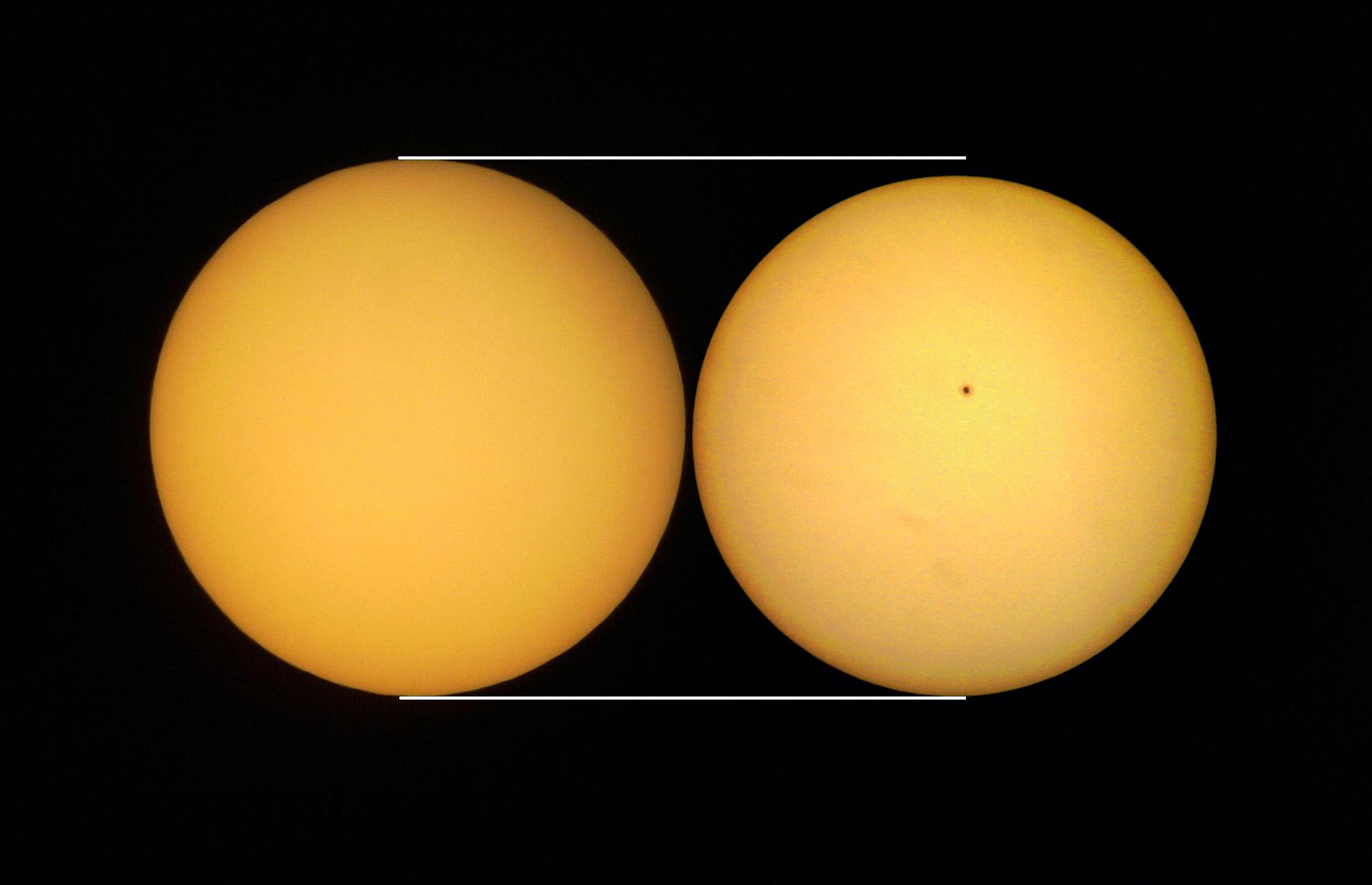
Explanation: When is the Sun most distant from Earth? It happened again just this past weekend. A common misconception is that the Sun is most distant during the winter, when it's the coldest. In truth, however, the seasonal temperatures are more greatly influenced by the number of daylight hours and how high the Sun rises. For example, during northern winter, the tilt of the Earth causes the Sun to be above the horizon for a shorter time and remain lower in the sky than in northern summer. The picture compares the relative size of the Sun during Earth's closest approach in January (northern winter) on the left, and in July (northern summer) on the right. The angular size of the Sun is noticeably smaller during July, when it is farther away. If the Earth's orbit was perfectly circular, the Sun would always appear to be the same size. These two solar images were taken from Spain during 2006, but the same effect can be seen in any year from any Earth-bound location.

Friday, July 06, 2007
Astronomy Picture of the Day

Explanation: Spiral galaxy NGC 2903 is only some 20 million light-years distant in the constellation Leo. One of the brighter galaxies visible from the northern hemisphere, it is surprisingly missing from Charles Messier's famous catalog of celestial sights. This impressively sharp color image shows off the galaxy's beautiful blue spiral arms. Included in the ground-based telescopic view are intriguing details of NGC 2903's central regions -- a remarkable mix of old and young star clusters with immense dust and gas clouds. In fact, NGC 2903 exhibits an exceptional rate of star formation activity near its center, also bright in radio, infrared, ultraviolet, and x-ray bands. Just a little smaller than our own Milky Way, NGC 2903 is about 80,000 light-years across.I can't get enough of these.
No Way Physics: Thought provoking
Many principles of physics are of the form "If you do this, what will happen is that." Newton's second law, for example, says that the acceleration of a particular mass will be proportional to the force applied to it. Such principles imply that certain effects are practically impossible. A small number of principles, however, belong to a different category. These say, in effect, "That cannot happen." Such principles imply that certain effects are physically impossible.The article goes on to explain that such laws force scientists to re-think their theories, to try to find ways to make something work that is actually impossible. Such provocations lead us to new theories and new technologies.Notorious examples of the latter include the first two laws of thermodynamics. The first law says that energy cannot be created or destroyed ("You can't win"), while the second can be stated in several forms, such as that heat cannot be transferred from a colder to a warmer body or that the entropy of a closed system always increases ("You can't break even, either"). Other examples include Heisenberg's uncertainty principle and the relativity principles regarding the impossibility of recognizing absolute velocity and the prohibition of faster-than-light travel.
Such principles often represent not "new physics" but deductions from other principles. What is different about them is their form. And to say that something is physically impossible tends to make scientists want to rebel.
While some things are truly impossible, sometimes being told something is impossible is the first step to getting it done.
Wednesday, June 27, 2007
Mathematics Plus: A truly wonderful zine

A friend of mine sent me an innocent email just a few minutes ago. It read:
Dave,
I like Cambridge U.'s Plus Math-zine.
They came out with their new quarterly
issue this month:
http://plus.maths.org/issue43/
Greg C.
So, I ambled over to this site not knowing what to expect. Was I in for a most pleasant surprise!
Here's a beautiful zine that gives the most beautifully illustrated articles on so many topics. I think anyone who goes through these zines, the current issue or past issues (hit the archives button) will be in for a treat.
I've spent some time just now downloading and printing articles on Euler, special relativity, game theory, Godel, among others.
The articles have links to other sites, animations, videos, code listings, and each article is available as a pdf file so you can easily print them. Some you'll want to read on-line, see the animations, play the videos, and enjoy. Others you can print for later.
Enjoy, I know I will.
Science toys at home
I love the theme of science-oriented toys you can make at home with everyday things around your house.
Thursday, June 21, 2007
Peet to peer Patents
Peer-to-Patent opens the patent examination process to public participation for the first time.Become part of this historic pilot program. Help the USPTO find the information relevant to assessing the claims of pending patent applications.
Become a community reviewer and improve the quality of patents.
This is an idea whose time has come. There will be kinks to work out, processes to improve, but it's almost impossible to believe that the patent office cannot benefit from this. Kudos to everyone who made this possible.
Here's a good interview on this.Portraits of Scientists
Wednesday, May 30, 2007
Computer interface for the future, NOW
 Click on the link to see the whole video. You'll see how images and text can move on the screen in front of the person, be manipulated and shared in real-time.
It's worth viewing, maybe even twice.
Google with a Street View

This is utterly fantastic!
At maps.google.com there is now, for San Francisco, a street view of the city. With Adobe Flashplayer you can see video captures of the streets of the city.
Try this and be amazed.
Friday, May 04, 2007
Molten core on the planet Mercury, possibl
"NASA scientists working with high-precision planetary radars in California have discovered strong evidence that the planet Mercury might have a molten core.
"Scientists had not expected to find a magnetic field at Mercury," said Professor Jean-Luc Margot of Cornell University, leader of the research team. "Planetary magnetic fields are associated with molten cores, and the prevailing theory was the planet was too small to have a molten core."Since then, multiple radar observations have ruled out a solid core, leading to the finding that Mercury's core is molten -- or at least the outer core is molten and not forced to rotate along with its shell."
I'm not sure what this means in the grand scheme of things, but it goes to explaining more of our universe. And that's a good thing.
Fighting rape with co-evolution

The mallard Anas platyrhynchos: a species with high levels of forced copulations. Females have very elaborate vaginas (left) to counter males' phalluses (right). (Image: Patricia Brennan et al.)
"Some female ducks and geese have evolved complex genitalia to thwart unwelcome mating attempts, according to a new study.
Males of some species, such as mallard, have a notorious habit of "raping" females. They and other wildfowl are among the 3% of bird species whose males have phalluses big enough to insert into the vaginas of females, whether or not the female consents.
Now, in the most detailed analysis yet of duck and goose vaginas, researchers have established that females of these species have evolved vaginal features to thwart unwelcome males.
Some vaginas had spiral channels that would impede sex by twisting in the opposite direction to that of the male phallus. Others had as many as eight cul-de-sac pouches en route, that could prevent fertilisation by capturing unwelcome sperm. Moreover, these features were only found in species renowned for forced sex. All other species had simple male and female genitalia.“These structures are wonderfully devious, sending sperm down the wrong road or impeding penetration,” says Birkhead.
He says that the features demonstrate an evolutionary "arms race" in which control over reproduction alternates between the sexes. If the male develops a longer, more elaborate phallus to force copulation, females wrest back control by developing features to thwart males who rape.
“It shows that females are not passive in averting exploitation by males with large phalluses,” says Birkhead. "
This is a terrific example of co-evolution. The aggressive males evolve to perpertuate their genes, hence the force coupling. The females evolve, almost simultaneously it seems, to counter the evolution of the males.
Research on Erectile Dysfunction

Here's something truly amazing. Not for it's work, although I have to believe it's good, but for the nature of the research.
"Like a column collapsing under the burden of a heavy roof, erectile dysfunction is a classical mechanical engineering problem, says a US urologist. Using mathematical models of penis geometry and hydrostatic pressure, doctors can predict when penises will fail – and in which vagina – he says.
The most widely investigated parameter of penile rigidity is intracavernosal pressure (ICP) – the fluid pressure achieved by blood build up in the two expandable "caverns" of the penis. For a healthy man, the erect ICP is between 60 and 90 millimetres of mercury (mmHg), but can drop to just 30 mmHg, in men with erectile dysfunction (ED)."Here's the abstract from the Journal:
"Two major branches of engineering mechanics are fluid mechanics and structural mechanics, with many practical problems involving the effect of the first on the second. An example is the design of an aircraft's wings to bend within reasonable limits without breaking under the action of lift forces exerted by the air flowing over them; another is the maintenance of the structural integrity of a dam designed to hold back a water reservoir which would exert very large forces on it. Similarly, fluid and structural mechanics are involved in the engineering analysis of erectile function: it is the hydraulic action of increased blood flow into the corpora cavernosa that creates the structural rigidity necessary to prevent collapse of the penile column."
If you have a copy of the paper, please email it to me. Thanks.
First it was animals, then people...
OOPS, that's wrong. It's first people then animals, so says the article. Used to be we tried experimental drugs on animals and then prescribed the drugs on people. That's in reverse:
Vets have rejected claims by a British animal welfare charity that giving dogs drugs to treat behavioural problems will create a population of "pill-popping pets".
The Royal Society for the Prevention of Cruelty to Animals expressed alarm at the news that an antidepressant called Reconcile - containing the same serotonin-reuptake inhibitor used in the human drug Prozac - has been licensed for use in dogs by the US Food and Drug Administration.
"Pet owners have a duty of care towards their animals," says charity scientist Penny Hawkins. "Pharmaceuticals should not be used to help sustain an unsustainable lifestyle by addressing problems that should be dealt with by other means, such as more exercise."
“”Pet owners have a duty of care towards their animals. Drugs should not be used to sustain an unsustainable lifestyle
It used to be that if you had a dog, and it was a problem, you either gave the dog away, or had it killed. Simple. Dogs are dogs, after all, not people. Now, we're seeing a slide to drugs for dogs (and I'm sure other animals) that will only take us further along to more drugs, more medical treatment, more costs, and, if owners opt not to do these things, there will be societal (read: animal rights activits) pressure to force owners to do them.But vets specialising in treating behavioural problems say medication can be extremely useful in treating anxiety symptoms such as howling and destructiveness.
Dogs with behavioural problems account for about a quarter those that are euthanised by veterinary practices, so by increasing the chances of successfully managing a problem drugs can improve welfare.
Web browsers: Still unsafe
YOU are surfing the net, and stop at a sports site you regularly visit to read the latest headlines. You are always careful to avoid sites that appear suspect, so you feel safe online. Unbeknownst to you, though, and to the innocent owner of the website, a piece of malicious code has been added to the page you are viewing. This uploads software onto your computer via your browser, turning it into a "zombie" PC under the remote control of a malicious user.While installing firewalls and antivirus software on your computer may keep it safe from conventional threats such as worms and viruses, these security tools do not inspect data downloaded through browsers - a loophole that attackers can exploit. "The firewall is dead," says Google security specialist Niels Provos.
The threat is real, not just a theoretical possibility:
Provos warned that many web users are becoming the victims of "drive-by" downloads of bots from innocent websites corrupted to exploit browser vulnerabilities. As firewalls allow free passage to code or programs downloaded through the browser, the bot is able to install itself on the PC. Anti-virus software kicks in at this point, but some bots avoid detection by immediately disabling it. Once a computer has become infected with the malicious software, the zombie periodically connects to a web server controlled by the botmaster to receive instructions and download more software.
To determine the scale of the problem, Provos's group at Google analysed several billion web pages and selected 4.5 million suspicious pages for more detailed study. To test for malicious software, or malware, they loaded a program designed to simulate a computer with a vulnerable version of Internet Explorer and monitored what happened. They found around 450,000 web pages that launched drive-by downloads of malicious programs. Another 700,000 pages launched downloads of suspicious software. More than two-thirds of the malicious programs identified were those that infected computers with bot software or programs that collected data on banking transactions and emailed it to a temporary email account.You don't even know it's there. The result: be very careful with the sites you go to. If possible, don't use Internet Explorer; IE is a disaster for security.
Tuesday, April 17, 2007
Happy Birthday, Leonhard Euler
 Sunday, April 15, is the 300th birthday of Leonhard Euler (pronounced "oiler"), one of the most important mathematicians ever to have lived.
Click the above link to read a wonderful description of his famous equation: eiπ = –1
If you want to read some wonderful books, check out Paul Nahin's books: An Imaginary Tale and
Dr. Euler's Fabulous Formula: Cures Many Mathematical Ills.
These books are worth reading and you'll learn about the mathematics of Euler.
The Mathematical Association of America has a wonderful column by Ed Sandifer entitled "How Euler Did It." Dr. Sandifer translates (I guess) some of Euler's original papers, tells you what Euler did, how he did it, and why that result is important.