Powered By Blogger

Friday, August 24, 2007

Plagiarism in physics

From Ars Mathematica I learned about an article at Ars Technica describing a scandal involving plagiarism of theoretical physics papers by about 20 different people, some of them students at the Middle East Technical University in Ankara. Many of the papers were refereed and published in well-known journals, and one made it into what is now perhaps the most well-known particle theory journal, the Journal of High Energy Physics.

The rest of the post gives more detail and quotes.

Frankly, I think this just shows the greed in people.
According to Dr. Sarioglu, [faculty member at METU] two of the authors of this paper were graduate students with a prodigious track record of publication: over 40 papers in a 22-month span.
Think about those numbers. That's almost two papers a month. Incredible. To do that kind of work as graduate students, who generally work for themselves without students under them, is too good to be true; and it was, obviously.

My question is: Where was the faculty advisor?

If you go to the link above, check out the comments for more insights.

Teenageres in love, Madly in love

Adolescents who claim they are "madly in love" might not be too far off the mark: a new study suggests that they show almost manic behaviours.

Serge Brand of the Psychiatric University Clinics in Basel, Switzerland, and his colleagues surveyed 113 teenagers at around 17 years of age, asking them to complete questionnaires about their conduct and mood and to keep a log of their sleep patterns. Of those, 65 indicated they had recently fallen in love and experienced intense romantic emotions.

Thelovestruck teenagers showed many behaviours resembling "hypomania" – a less intense form of mania. For example, they required about an hour less sleep each night than teens who didn't have a sweetheart. They were also more likely to report acting compulsively, with 60% saying they spent too much money compared with fewer than 30% of teenagers who were not in love.

Moreover, the lovestruck teens were more than twice as likely to say they had lots of ideas and creative energy. Worryingly, they were also more likely to say they drove fast and took risks on the road.


Yep, that about explains it Speaking from experience, once as a teenager, now father to three teenagers, one who has a boyfriend, I can testify that teenagers do some wacky things. It's nice to see that scientists have confirmed what most parents already know. The article doesn't say how long this behavior will last but, as most parents also know, there's always an end.

Friday, August 10, 2007

Is this real?

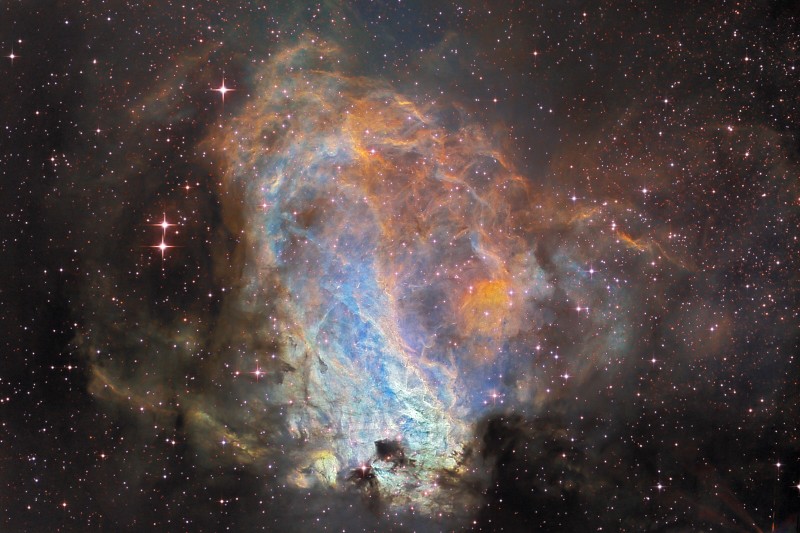
My last post was about image editing. So, I went to the Astronomy Picture of the Day for a real image. Alas, it's not, from their caption:

Colors in the gorgeous image were picked to emphasize light emitted by specific elements in the nebula excited by the energetic starlight.

So, what picture does capture reality?

Pictures: From Graphics to outright lies

Here's an image that we start with.

I have a dear friend whose hobby is photography. He doesn't just take photos though because he's an artist. So, he takes pictures, digital pictures, and then he processes them to make beautiful prints. You can see some here. What's interesting is that the pictures you see are not what the scene showed but rather the pictures are what he wants you to see. They are art, and as art, they are gorgeous and well worth having. I proudly display many of these works in my office.

But they are not a capture of reality. (It is interesting to ask just what is a capture of reality and how do you know it. That's a post for another time.)

Now two scientists have devised an automated algorithm that allows you to easily remove, edit, and change your digital pictures to take out what you don't like and replace with something that will fill-in the picture realistically. This is letting a computer effectively edit out reality from your pictures.

Digital photographers could soon be able to erase unwanted elements in photos by using tools that scan for similar images in online libraries.

Research teams have developed an algorithm that uses sites like Flickr to help discover light sources, camera position and composition in a photo.

Using this data the tools then search for objects, such as landscapes or cars, that match the original.

The teams aim to create image libraries that anyone can use to edit snaps.

In the past you could edit pictures, use Photoshop and change what you liked and didn't like. Now, it is automated (well, almost) so that soon you won't have to work at making phony images. Phony images are fine, of course, we are free to change them as we like. But to have the process automated, well, that just seems like making it all the more easy to distort reality.

This is the same image with the roof removed and phony boats inserted. A beautiful graphic but not a photo of the actual scene.

From dust to dust..

The Bible tells us that man goes from dust to dust. How fitting then that we should find the following:
Life on earth is organic. It is composed of organic molecules, which are simply the compounds of carbon, excluding carbonates and carbon dioxide. The idea that particles of inorganic dust may take on a life of their own is nothing short of alien, going beyond the silicon-based life forms favoured by some science fiction stories.

Now, an international team has discovered that under the right conditions, particles of inorganic dust can become organised into helical structures. These structures can then interact with each other in ways that are usually associated with organic compounds and life itself.

So, while we think of life as special, we are no more special than dust, or helically-shaped molecules.

Until now, physicists assumed that there could be little organisation in such a cloud of particles. However, Tsytovich and his colleagues demonstrated, using a computer model of molecular dynamics, that particles in a plasma can undergo self-organization as electronic charges become separated and the plasma becomes polarized. This effect results in microscopic strands of solid particles that twist into corkscrew shapes, or helical structures. These helical strands are themselves electronically charged and are attracted to each other.

Quite bizarrely, not only do these helical strands interact in a counterintuitive way in which like can attract like, but they also undergo changes that are normally associated with biological molecules, such as DNA and proteins, say the researchers. They can, for instance, divide, or bifurcate, to form two copies of the original structure. These new structures can also interact to induce changes in their neighbours and they can even evolve into yet more structures as less stable ones break down, leaving behind only the fittest structures in the plasma.

So, could helical clusters formed from interstellar dust be somehow alive? "These complex, self-organized plasma structures exhibit all the necessary properties to qualify them as candidates for inorganic living matter," says Tsytovich, "they are autonomous, they reproduce and they evolve".

Call it in, but the Bible had it first. (Hattip: ilachina)

Friday, July 27, 2007

Google Earth Image: A Plane in Flight


While working this morning with Google Earth, I came across this image. It's just outside of Chicago's O'Hare airport, by the way.

At first glance I thought I was looking an airport, then I realized there weren't any runways nearby. So I asked myself, how did the airplane get there? I then realized that the images are from satellites, of course!, so the plane you see is actually in flight.

Pretty cool, eh?

(The white line is for work; it's not part of the image itself.)

Friday, July 20, 2007

NSF: U.S.A. shows slow growth in technical articles published

The United States is not increasing the number of research articles (science and engineering) it publishes. We still produce more than any other country but our rate of growth is level while other countries are producing papers at an accelerated rate.

A new National Science Foundation (NSF) report finds the number of U.S. science and engineering (S&E) articles in major peer-reviewed journals flattened in the 1990s, after more than two decades of growth, but U.S. influence in world science and technology remains strong.

The report, Changing U.S. Output of Scientific Articles: 1988 - 2003, finds changes occurred despite continued increases in funding and personnel for research and development. Flattening occurred in nearly all U.S. research disciplines and types of institutions.

In contrast, emerging Asian nations had large increases in publication numbers, reflecting their growing expertise in science and technology. European Union totals also went up.

This is not a surprise to anyone who even glances at the literature today. Check out arXiv.org and you'll see more and more preprints from outside the Unites States. True, many of these are from the states but more and more are not.

Still, the NSF finds some positive news:

"In addition to numbers published, one should look at another very important indicator -- article quality," said Derek Hill, senior analyst and a coauthor of the report. "The more often an article is cited by other publications, the higher quality it's believed to have. While citation is not a perfect indicator, U.S. publications are more highly cited than those from other countries."

In raw numbers, the United States continues to publish far more articles than any other country and remains a major force in world S&E. However its overall share of published articles has declined while other nations produce more.

And how are other nations doing in publishing?

Four Asian societies--China, Singapore, South Korea, and Taiwan--out-distanced all others in the world between 1992 and 2003 with an average annual growth rate of 15.9 percent in publications.

According to the report, Japan's article output rose at an average annual rate of 3.1 percent, five times faster than the United States.

The European Union, which passed the U.S. several years ago in total numbers of articles published, posted an average annual growth rate of 2.8 percent during the same period, more than four times faster than the United States.

It's no secret that the U.S. is ahead now in total numbers but we will not stay there for long. Witness, for example, who is doing basic research in physics ---the Europeans at CERN while our basic research stalls.

The truth is that it's very difficult to get funding for research in industry today. It's tough to get funding at universities, too. And do you know what else? When you get funding there is little support to publish. In fact, the trend is not to publish so as not to tell others (competitors) what you are doing.

I am now writing a paper on some of my work and the one thing that comes out is: tell enough to get the idea across but not so much that others can reproduce what I've done. For a company, that makes sense because, after all, the company is in business to make money. If the company tells others how to do what we now do, well, it won't be long before our market share dwindles to little. However, this trend is now true at universities where professors and administrators seek to patent and sell research. It didn't used to be that way: professors sought to publish whatever they did, sometimes even publishing junk. Today, schools want to profit so publishing is not as important as it used to be.

I fear that in the near future our lack of scholarly discourse, of which publications are central, will mark a steady decline in our scientific progress. (While I'm on this topic, let me state one more indicator. The U.S. is losing promising scientists because we do not seek to employ them when they graduate. So they return to their native countries and contribute there instead of here. In essence we give them an education that they take back and then compete with us. Is that bad? I don't know.)



Interesting physics experiments in the offing

University of Washington physicist (and science-fiction author) John Cramer is moving forward with his experiment in backward causality, thanks in part to tens of thousands of dollars in contributions sent in by his fans. Although Cramer emphasizes that his lab is looking at “nonlocal quantum communication” rather than backward time travel per se, the gadgetry he’s assembling could settle a controversy surrounding a seemingly faster-than-light effect that Albert Einstein thought was downright spooky.

Boiled down to its basics, the experiment involves splitting laser light into two beams, so that characteristics of one beam are reflected in the other beam as well. That's an example of what physicists call quantum entanglement. Specifically, Cramer has been planning to fiddle with one of the entangled laser beams such that it takes on the property of waves or particles. If one beam behaves like particles, the entangled photons of light in the other beam should behave like particles, too.

I can't do better than the author of this link, so go here to read it all.

Thursday, July 19, 2007

Sex in your sleep

I stumbled upon this while looking at space.com for when the planet Mars will be visible in August. It's somewhat interesting, though.

If you think it’s impossible to have sex while you sleep, think again, according to a new study.

There are at least 11 different sex-related sleep disorders, collectively referred to as “sexsomnia” or “sleepsex,” that affect people who are otherwise psychologically healthy—causing them to unknowingly engage in various sexual activities during the night.

Carlos Schenck, a psychiatrist at the Minnesota Regional Sleep Disorders Center, and his colleagues have studied a number of behavioral disorders associated with sleep.

“Any basic instinct can come out in the context of sleep,” Schenck told LiveScience. “All sorts of things can happen.”


So, be careful when you're sleeping, as if that's possible. But, if your roommate tells you something weird about yourself, it just may be true.

A WOW video

I got this link from a good friend in an email today. I didn't think much about it, but I started to watch, and I have to say, it's simply fantastic. You'll see a scale model of the B-29 bomber with an X-1 rocket. The B-29 takes off with the X-1 on its belly. The B-29 then flies up and releases the X-1. The rocket flies on its own, and even goes to an accelerated flight. Then the rocket safely lands and you see the B-29 flying. Watch for the flat spin, it's about half-way through, and then you'll see the rest of the flight.

It is truly fun to watch and when you think of the work it took to make these remote control airplanes, and that they work together, well, that's just fantastic. Here's what my friend said:

This aircraft runs on four chainsaw motors. You can just imagine how much time, effort, skill and money these guys have put into this thing.
Here's the link:

http://users.skynet.be/fa926657/files/B29.wmv

Tuesday, July 17, 2007

Simple yet inexplicable illusions and unknowns


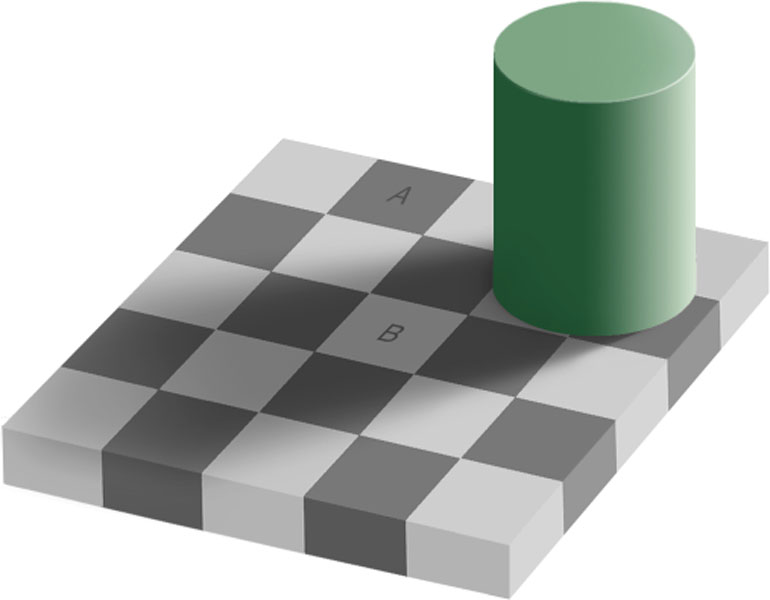
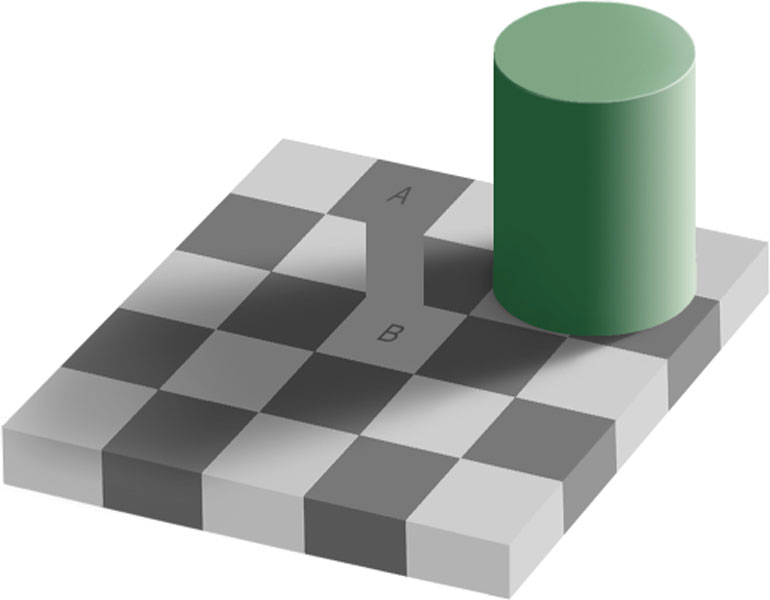
The Astronomy Picture of the Day today is not about astronomy, per se, but rather about illusions. The image above is fairly common. You see the checkerboard pattern but are squares A and B the same color? They look different to me. Then you see the picture below.

The squares are connected so that instead of looking like different colors, they look close to identical. (I still see square A as darker than square B but maybe that's my age showing.)

No one knows why people see the squares as different colors, but we do.

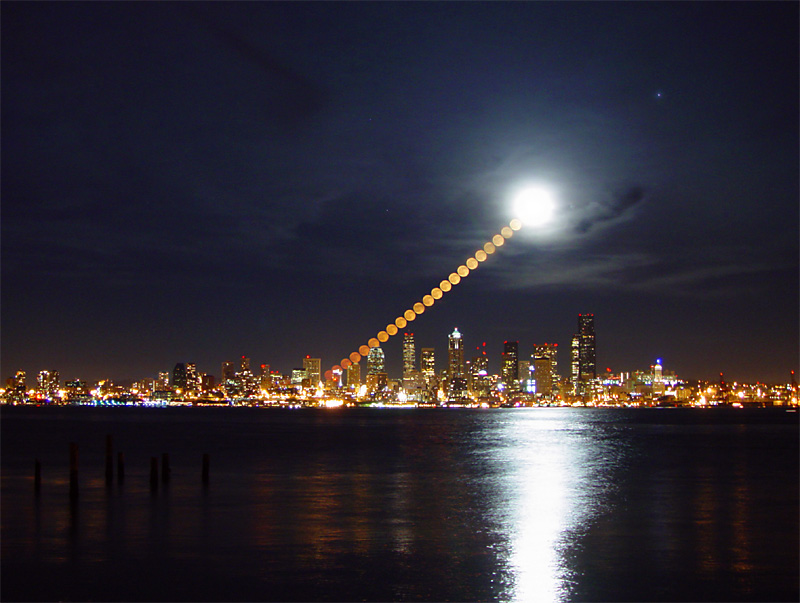
The site also has a link that, with a few clicks, takes you to this picture.


Ever notice that when the moon is near the horizon it looks much bigger than it does high in the sky? I've seen it may times, low to the horizon, and my wife calls that a "harvest moon," although that's not really right. In any case, the moon does seem much larger when it is near the horizon than when it's high. In truth, the moon always has an angular diameter of about 0.5-degree, so it's not any bigger when it is low than when it's high.

No one knows why we see the moon this way, some say we interpret distance objects as wider (so on the horizon we "see" this distance but in high in the sky we don't interpret it as such) or one's eyes focus differently for the different positions of the moon.

So, here are two simple phenomena which no one understands. These pictures reminded me of another phenomena that I thought was a legend. The phenomena is that if you place equal measures of cold water and hot water in a freezer the hot water will freeze first. Sounds crazy, I mean, the hot water has to cool to the temperature of the cold water before it can freeze so we would expect the cold water to freeze first. The cold water has a head-start as each cools to 32-degree Fahrenheit.

Not so. In fact, yesterday I was browsing the (now purchased and its way to me) book The Science of Cooking by Peter Barham and in there I found the following.

In this short excerpt, we see that hot water does freeze faster than cold water and yet the experts, physicists no less, are stumped. They have no idea why.

I think we should revel in these puzzles and see that with all we know, we know very little. Our eyes mislead us in viewing a simple picture, they mislead us in viewing the heavenly skies, and science can't explain (yet!) the nature of water freezing. Simple yet inexplicable.

It makes me wonder: just what can we know and of what can we be certain?

Wednesday, July 11, 2007

Beautiful graphics: Singles in the U.S. and Viagra emails

On Carl Bialik's Blog (The Numbers Guy for the Wall Street Journal) he has interesting post on single women in New York City. You can find his post at the link above.

What I found interesting was not just the post (if you're married, as I am, finding single women isn't much of a concern) but the graphic he linked to, shown above and a link here. The graphic presents a quick way to see where most single people live, color coded by gender; men are blue, women are orange. At a glance you can see density of singles and make quick comparisons of sizes based on the circle size. Each circle not only tells the number of singles, and the gender, but also location given the placement of the circle on the underlying map of the United States.

Graphics such as these are simply wonderful. They show data in a clear, easy to use manner, that allows the reader to quickly see trends or numbers that a table would obscure.

Here's another beautiful graphic:

This graphic comes from the current issue of American Scientist and it is in Brian Hayes's column How Many Ways Can You Spell V1@gra? His column is very good; I recommend you click the link and read it.

The graphic though, is truly wonderful. He shows you various spellings of Viagra (the article is about the proliferation of spam and Viagra is a common spam email) along the left column. The color bars help organize the different spellings (red for ordinary alphabetic characters; yellow for accented characters; olive for spellings with numbers and other non-alphabetic characters; brown for spellings with spaces or hyphens; and blue for correct spellings. Time is along the bottom, left to right and the number of emails (he uses his received spam for data) is shown by the area of the disks. From this it's easy to see that:
Vertical correlations within the table suggest that many of the mailings were coordinated and may have been conducted by the same individuals or groups.
With a glance you can see patterns in the data, relate pieces of data to each other, and quickly see what the author is trying to show you.

Monday, July 09, 2007

Astronomy Picture of the Day: Can't resist

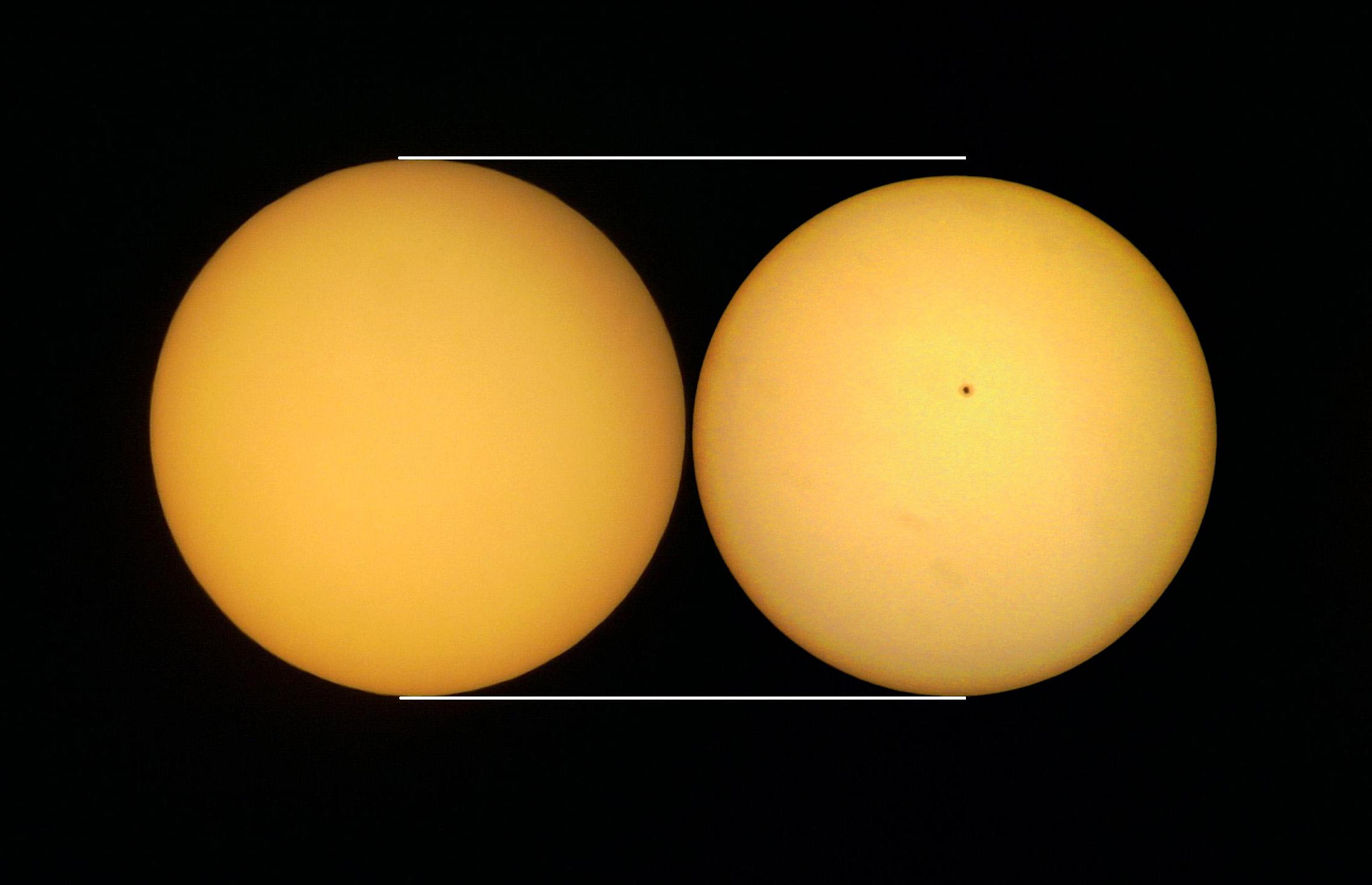
Explanation: When is the Sun most distant from Earth? It happened again just this past weekend. A common misconception is that the Sun is most distant during the winter, when it's the coldest. In truth, however, the seasonal temperatures are more greatly influenced by the number of daylight hours and how high the Sun rises. For example, during northern winter, the tilt of the Earth causes the Sun to be above the horizon for a shorter time and remain lower in the sky than in northern summer. The picture compares the relative size of the Sun during Earth's closest approach in January (northern winter) on the left, and in July (northern summer) on the right. The angular size of the Sun is noticeably smaller during July, when it is farther away. If the Earth's orbit was perfectly circular, the Sun would always appear to be the same size. These two solar images were taken from Spain during 2006, but the same effect can be seen in any year from any Earth-bound location.

Friday, July 06, 2007

Astronomy Picture of the Day


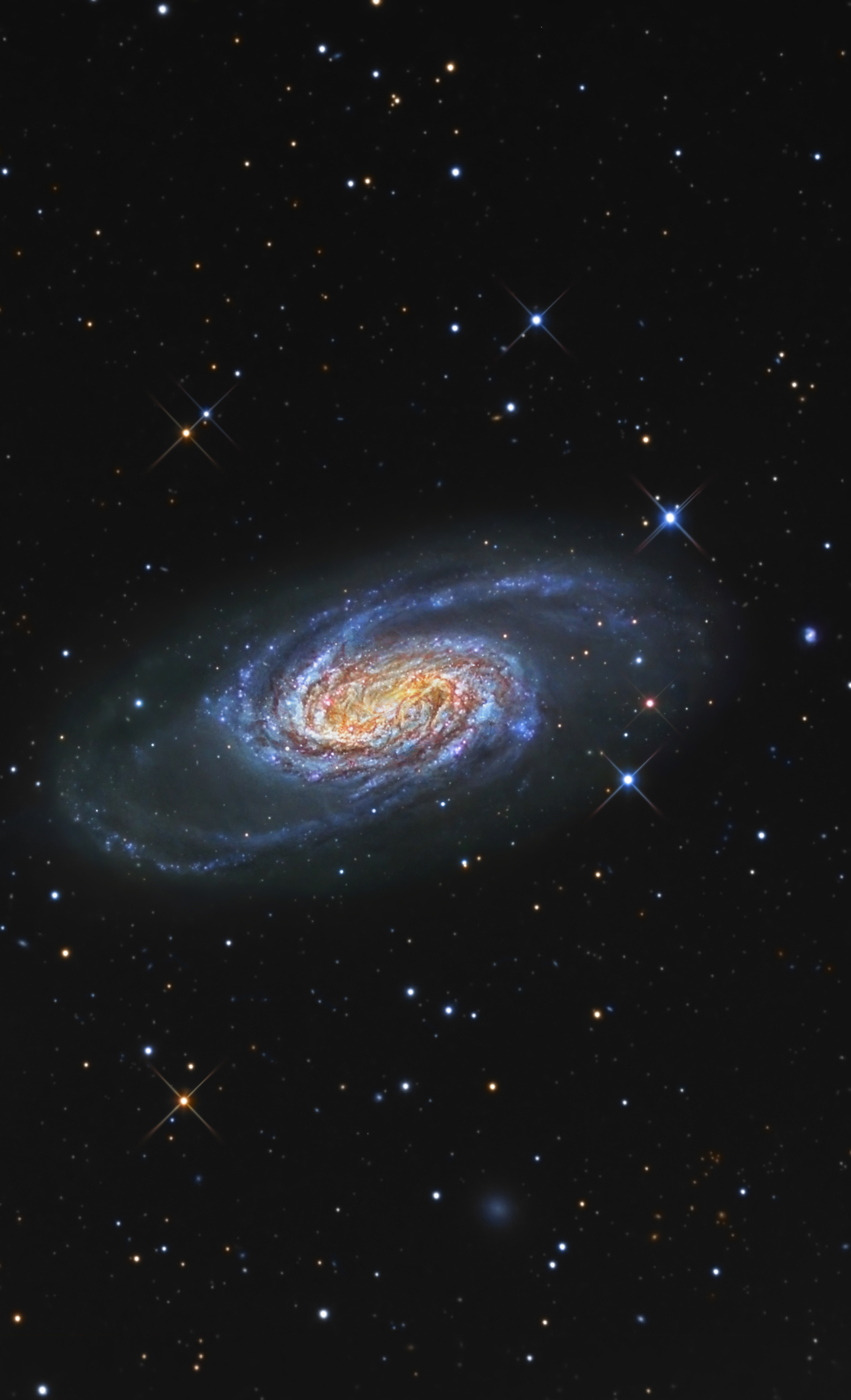
Explanation: Spiral galaxy NGC 2903 is only some 20 million light-years distant in the constellation Leo. One of the brighter galaxies visible from the northern hemisphere, it is surprisingly missing from Charles Messier's famous catalog of celestial sights. This impressively sharp color image shows off the galaxy's beautiful blue spiral arms. Included in the ground-based telescopic view are intriguing details of NGC 2903's central regions -- a remarkable mix of old and young star clusters with immense dust and gas clouds. In fact, NGC 2903 exhibits an exceptional rate of star formation activity near its center, also bright in radio, infrared, ultraviolet, and x-ray bands. Just a little smaller than our own Milky Way, NGC 2903 is about 80,000 light-years across.
I can't get enough of these.

No Way Physics: Thought provoking

Many principles of physics are of the form "If you do this, what will happen is that." Newton's second law, for example, says that the acceleration of a particular mass will be proportional to the force applied to it. Such principles imply that certain effects are practically impossible. A small number of principles, however, belong to a different category. These say, in effect, "That cannot happen." Such principles imply that certain effects are physically impossible.

Notorious examples of the latter include the first two laws of thermodynamics. The first law says that energy cannot be created or destroyed ("You can't win"), while the second can be stated in several forms, such as that heat cannot be transferred from a colder to a warmer body or that the entropy of a closed system always increases ("You can't break even, either"). Other examples include Heisenberg's uncertainty principle and the relativity principles regarding the impossibility of recognizing absolute velocity and the prohibition of faster-than-light travel.

Such principles often represent not "new physics" but deductions from other principles. What is different about them is their form. And to say that something is physically impossible tends to make scientists want to rebel.

The article goes on to explain that such laws force scientists to re-think their theories, to try to find ways to make something work that is actually impossible. Such provocations lead us to new theories and new technologies.

While some things are truly impossible, sometimes being told something is impossible is the first step to getting it done.

Wednesday, June 27, 2007

Mathematics Plus: A truly wonderful zine


A friend of mine sent me an innocent email just a few minutes ago. It read:

Dave,

I like Cambridge U.'s Plus Math-zine.
They came out with their new quarterly
issue this month:
http://plus.maths.org/issue43/

Greg C.

So, I ambled over to this site not knowing what to expect. Was I in for a most pleasant surprise!

Here's a beautiful zine that gives the most beautifully illustrated articles on so many topics. I think anyone who goes through these zines, the current issue or past issues (hit the archives button) will be in for a treat.

I've spent some time just now downloading and printing articles on Euler, special relativity, game theory, Godel, among others.

The articles have links to other sites, animations, videos, code listings, and each article is available as a pdf file so you can easily print them. Some you'll want to read on-line, see the animations, play the videos, and enjoy. Others you can print for later.

Enjoy, I know I will.

Science toys at home

I ran across this site while waiting for a program to run. It's pretty neat.

I love the theme of science-oriented toys you can make at home with everyday things around your house.

Thursday, June 21, 2007

Peet to peer Patents

Peer-to-Patent opens the patent examination process to public participation for the first time.

Become part of this historic pilot program. Help the USPTO find the information relevant to assessing the claims of pending patent applications.

Become a community reviewer and improve the quality of patents.

This is an idea whose time has come. There will be kinks to work out, processes to improve, but it's almost impossible to believe that the patent office cannot benefit from this. Kudos to everyone who made this possible.

Here's a good interview on this.

Portraits of Scientists

The Wisconsin Historical Society presents portraits of scientists. It's worth some time to thumb through them.

Wednesday, May 30, 2007

Computer interface for the future, NOW

Click on the link to see the whole video. You'll see how images and text can move on the screen in front of the person, be manipulated and shared in real-time.

It's worth viewing, maybe even twice.