
From Hulu.com, we have the Family Guy (Fox TV) and the multiverse.
The show is fun to watch, a bit raunchy, but the physics aspect is horrible. Still, one wouldn't watch the show to learn physics.
Wednesday, September 30, 2009


Friday, August 14, 2009
Humans: Some of what we don't know
Blushing, laughter, pubic hair, teenagers, dreams, altruism, art, superstition, kissing, and, (my favorite!) nose picking.
Do you have more?
Do you have more?
Cheerleader for Science

This comes via Fox News where a cheerleader has blog for science. It's pretty good and motivating.
It used to be people liked science for its intrinsic knowledge and for the love of discovery. Today, we don't really seem to find value in knowledge for the sake of knowing. That's too bad.
So, if a cheerleader can promote science, well, maybe people will move from seeing science as a cheer to seeing science as worthwhile in itself.
Tuesday, April 07, 2009
Laptops and real viruses: A winning combination

[T]he same team used viruses to construct the negative electrode, or anode, of the battery. In the new work, the researchers engineered viruses for the positive electrode, or cathode. When the two are put together, the virus batteries should perform better than traditional lithium ion batteries and also be environmentally friendly, the team reports.“Because the viruses are living organisms, we had to use only water-based solvents, no high pressures and no high temperatures,” says Angela Belcher, a materials scientist at the Massachusetts Institute of Technology in Cambridge and a study coauthor.
Astronomy Picture of the Day
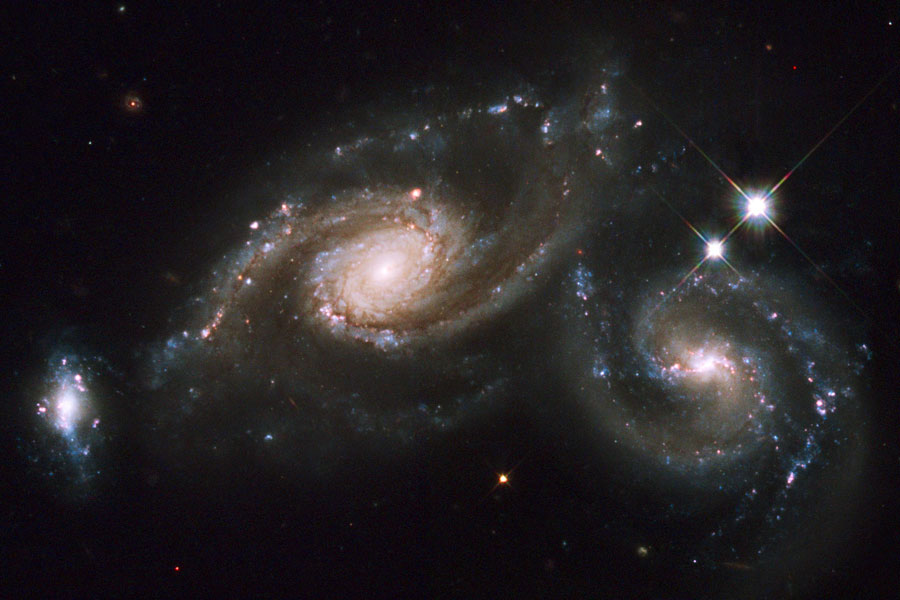 From the site:
Explanation: Two galaxies are squaring off in Virgo and here are the latest pictures. When two galaxies collide, the stars that compose them usually do not. This is because galaxies are mostly empty space and, however bright, stars only take up only a small fraction of that space. But during the collision, one galaxy can rip the other apart gravitationally, and dust and gas common to both galaxies does collide. If the two galaxies merge, black holes that likely resided in each galaxy center may eventually merge. Because the distances are so large, the whole thing takes place in slow motion -- over hundreds of millions of years. Besides the two large spiral galaxies, a smaller third galaxy is visible on the far left of the above image of Arp 274, also known as NGC 5679. Arp 274 spans about 200,000 light years across and lies about 400 million light years away toward the constellation of Virgo.
This is interesting, to me, for the following:
- The collision is a "non-event." Sure, it'll happen but take almost forever to do so.
- The collision will effect little: When it happens there is little actually colliding, just dust and gas. Yawn!
- The galaxies seem to have spirals in the opposite sense: This actually is interesting. The middle galaxy is spinning clockwise while the galaxy on the right is spinning counter-clockwise. I find that pretty neat.
Sunday, April 05, 2009
The Rest of the Story
Here's a story for your Sunday:
So, I'm riding my bike tonight, it's almost 6:30 p.m. now and I just got back. I'm still in my sweaty clothes, typing.
As I'm coming home, just two blocks from home, I'm in the street and riding about 16 mph. Cars parked on both sides, I'm on the right but in the street next to parked cars.
Ahead is a car coming straight for me, with a girl on a cell phone. I think she'll stop, she doesn't. I stop and almost hit the car. Well, not that close, but on a bike, you know what I mean.
Lo and behold, it's my daughter Shayna in MY car. She calls out "Dad, what are you doing?"
I turn around and pedal to her.
"Shayna, you almost hit me."
"I saw you, dad."
"You could have killed me."
"Dad, what are you doing in the street?"
(Think Lebowski, "his health is bad" scene...)
"Shayna, you almost killed your father! Shayna, you're killing your
father!" (I actually said this, too.)
"Dad, what are you doing in the street. Get out of the street."
"Shayna, you almost hit me. I could be dead."
"Dad, Get out of the street. Why are you in the street?"
"You're killing me. You know that? Shayna, where are you going?"
"Dad, go home" and, as she drives away I hear "and get out of the street!"
She's off and I go home.
Now, the "rest of the story:"
So, why was Shayna on her cell phone when she almost hit me? Because
her mother called her. That's right, I could be dead because my
daughter could have hit me while taking a call from her mother.
My son said to me: "So, if you got hit, you'd have to pay in some way. How's that make you feel?"
So, I'm riding my bike tonight, it's almost 6:30 p.m. now and I just got back. I'm still in my sweaty clothes, typing.
As I'm coming home, just two blocks from home, I'm in the street and riding about 16 mph. Cars parked on both sides, I'm on the right but in the street next to parked cars.
Ahead is a car coming straight for me, with a girl on a cell phone. I think she'll stop, she doesn't. I stop and almost hit the car. Well, not that close, but on a bike, you know what I mean.
Lo and behold, it's my daughter Shayna in MY car. She calls out "Dad, what are you doing?"
I turn around and pedal to her.
"Shayna, you almost hit me."
"I saw you, dad."
"You could have killed me."
"Dad, what are you doing in the street?"
(Think Lebowski, "his health is bad" scene...)
"Shayna, you almost killed your father! Shayna, you're killing your
father!" (I actually said this, too.)
"Dad, what are you doing in the street. Get out of the street."
"Shayna, you almost hit me. I could be dead."
"Dad, Get out of the street. Why are you in the street?"
"You're killing me. You know that? Shayna, where are you going?"
"Dad, go home" and, as she drives away I hear "and get out of the street!"
She's off and I go home.
Now, the "rest of the story:"
So, why was Shayna on her cell phone when she almost hit me? Because
her mother called her. That's right, I could be dead because my
daughter could have hit me while taking a call from her mother.
My son said to me: "So, if you got hit, you'd have to pay in some way. How's that make you feel?"
Thursday, April 02, 2009
Being in the picture
 Here's a jacket to lett you feel a movie. To wit:
The jacket contains 64 independently controlled actuators distributed across the arms and torso. The actuators are arrayed in 16 groups of four and linked along a serial bus; each group shares a microprocessor. The actuators draw so little current that the jacket could operate for an hour on its two AA batteries even if the system was continuously driving 20 of the motors simultaneously.
So what can the jacket make you feel? Can it cause a viewer to feel a blow to the ribs as he watches Bruce Lee take on a dozen thugs? No, says Lemmens. Although the garment can simulate outside forces, translating kicks and punches is not what the actuators are meant to do. The aim, he says, is investigating emotional immersion.
I love this! Movies have terrific visual effects, even 3-D. The sounds is awesome, too. Now, to be able to feel, to have your sense of touch, as part of the experience, that's just terrific. I hope these can be mass produced and that movie makers and theaters will cater to it.
Friday, February 13, 2009

Tuesday, February 10, 2009
The Intenet in 8-minutes
The link above takes you to a great animated video on the development of the Internet. The animation is limited, but the narration and script are excellent and fun to watch.
Enjoy.
Enjoy.
Tuesday, February 03, 2009
Beet bottle vibrations


Here's a study of vibrational modes for a beer bottle. I'm not sure what good it is, but for fun it's worth reading. Enjoy.
Drugs in the future
 Here's a possible future. Put on the goggles, attach earphones, and you are in another place, another time, and tuned out of the world.
Likely, who knows? Certainly it's a possibility.
Your senses as sensors for the universe
In response to a friend's post, I wrote the following. Please enjoy the following.
It's an interesting, no, fascinating discovery that blind people can take such pictures. That they know of cracks in the sidewalk, where people’s heads are, and how to photograph, are amazing feats. It is truly wondrous and miraculous.
Or is it?
Is it so hard to believe that the blind can take beautiful pictures? Perhaps. But, may be not. Let’s explore our senses and see what we might find.
There is a current view in physics that the universe is a computer. This view holds that information is conserved and that it cannot be destroyed. What is information? Well, let us posit that information is a description of the universe, or of a part of that universe that we are experiencing at a specific place and time. There may be more to it, but clearly this is part of information of the universe.
We experience the universe through our senses: seeing, hearing, taste, smell, touch. Instead of calling them senses, let’s call them sensors. Our sensors don’t so much sense the universe as they measure the universe. When we drink tea, our mouths measure the temperature, either hot tea or ice tea. Our taste buds measure the sweetness. When we look we measure objects in our view for shape, color, and position relative to other objects in our field of view. Thus, seeing is really an act of measuring. Some of our senses have a higher resolution than others; we can hear a wide range of amplitudes, see an extremely diverse set of colors, but we cannot discern different tastes so well.
From our measurements we derive a sense of our universe. How do we derive that sense? Our brain. Our own internal, massively connected, computer. Our brains take measurements from our sensors and use those measurements to make sense of our universe. Our brains integrate our sight with our hearing, with our smell, with every sensor we have to describe our world.
For example, we can easily recognize smoke in the kitchen from a pot that’s on fire. We see the flames, see the smoke, hear the crackle, and smell the burn and feel the heat. We know where we are and our brains deduce a pot on fire.
Are our senses limited? In a way, yes, they measure one thing such as sound with our hearing. But that is not a true limitation. Consider a bat. Bats, as you know, emit sound, listen for reflections (echoes) and their brains are able to “see” and easily navigate in the dark of night. Thus hearing can be seeing.
Consider next: sonar. Ships send sound waves through the ocean and from these sound waves computers can print maps of the ocean floor. From sounds come pictures. One sensor can be used to produce what another type of sensor would produce. The trick, the key, is the processing.
Or, if you like, consider radar. A plane sends electromagnetic radiation to the ground and with special processing, that radiation is transformed to a picture of the ground complete with buildings, foliage, cars, and other objects present. It’s not sight, it’s radar and it’s call SAR: Synthetic Aperture Radar.
With those ideas in mind, let’s consider this book. The blind taking pictures. Far fetched? I should think not. Inside each of these creative and inventive people is a brain, a processor. This processor can take all sorts of measurements and with the proper program, call it training, give the user (that person) a sense of his surroundings. Hence, the beautiful story of the girl who “sees” cracks in the sidewalk with her stick. Her vision fails her but her brain is undeterred and processes measurements of touch to give her a sense of the ground beneath her feet.
Our bodies are fascinating and marvelous.
What can we learn from this beyond the lovely pictures and, possibly, what more one can do with a camera? I am no great photographer like my bowling buddy. However, I submit we all can learn to use our sensors in new ways that we are not now trained to do. And with that we can draw new beauty, and new visions, from the universe around us.
Sunday, November 09, 2008
Michael Crichton's Speeches
Michael Crichton passed away this past week at the age of 66. While I've enjoyed many of his novels and movies, what I didn't know is that he had deep and thoughtful opinions about how science is conducted.
If you go to his site, click on speeches and take a look at any of them. You'll find them insightful, thought provoking, and I think, spot on as to one area that wrong with scientific research today.
If you go to his site, click on speeches and take a look at any of them. You'll find them insightful, thought provoking, and I think, spot on as to one area that wrong with scientific research today.
A Letter to President Bush
As the second and last term of President Bush comes to a close, I'd like to share with you a letter I sent him. Here it is:
November 9, 2009
Dear President Bush,
I wanted to write you a short note to tell you that I'll miss you at the end of your second term. I voted for you twice and I have been proud to support you. You've kept our country safe after a terrible attack, you've been true to your values (and to values I share with you), and you've let me rest easy these past eight years.
An article by Jim Towey in this weekend's Wall Street Journal struck me and encouraged me to write you to say thank you. (It's entitled "Why I'll Miss President Bush.")
Thank you for being my President. Thank you for your leadership these past eight years. Thank you for protecting our country. Thank you for making difficult decisions. And thank you for devoting yourself to our nation.
I hope that the rest of your life will be filled success and joy. May G-d give you continued strength and guidance.
Sincerely yours,
David S. Mazel
November 9, 2009
Dear President Bush,
I wanted to write you a short note to tell you that I'll miss you at the end of your second term. I voted for you twice and I have been proud to support you. You've kept our country safe after a terrible attack, you've been true to your values (and to values I share with you), and you've let me rest easy these past eight years.
An article by Jim Towey in this weekend's Wall Street Journal struck me and encouraged me to write you to say thank you. (It's entitled "Why I'll Miss President Bush.")
Thank you for being my President. Thank you for your leadership these past eight years. Thank you for protecting our country. Thank you for making difficult decisions. And thank you for devoting yourself to our nation.
I hope that the rest of your life will be filled success and joy. May G-d give you continued strength and guidance.
Sincerely yours,
David S. Mazel
Thursday, September 04, 2008
The Large Hadron Collider: Rap Video
This video is not only fun, it's descriptive of the collider program.
Enjoy.
Enjoy.
Monday, August 18, 2008
Sunday, July 20, 2008
Snag Films
Here's a new website for documentary films that you can watch and easily link to in your own site.
I found out about it from Walt Mossberg's Wall Street Journal column.
Enjoy!
I found out about it from Walt Mossberg's Wall Street Journal column.
Enjoy!
Thursday, July 10, 2008
Intelligence takes a holidy
Is "black hole" a racially insensitive term?
Apparently to some. From the City Hall Blog at the Dallas Morning News:
A special meeting about Dallas County traffic tickets turned tense and bizarre this afternoon.
County commissioners were discussing problems with the central collections office that is used to process traffic ticket payments and handle other paperwork normally done by the JP Courts.
Commissioner Kenneth Mayfield, who is white, said it seemed that central collections "has become a black hole" because paperwork reportedly has become lost in the office.
Commissioner John Wiley Price, who is black, interrupted him with a loud "Excuse me!" He then corrected his colleague, saying the office has become a "white hole."
That prompted Judge Thomas Jones, who is black, to demand an apology from Mayfield for his racially insensitive analogy.
Mayfield shot back that it was a figure of speech and a science term.
Judge Jones should be very glad that the central collections office has not become a white hole, a theoretical object that ejects matter from beyond its event horizon, rather than sucking it in. It wouldn't be fun for Dallas to find itself so near a quasar.
The deep level of ignorance is overwhelming.
Wednesday, July 02, 2008
Global Warming: Yellow Science
This is one the best essays I've read on why we should all worry about global warming. But it's not the idea of global warming, rather it is the "science" such as it is, of the so-called experts.
[O]ver the past several decades an increasing number of scientists have shed the restraints imposed by the scientific method and begun to proclaim the truth of man-made global warming. This is a hypothesis that remains untested, makes no predictions that can be tested in the near future, and cannot offer a numerical explanation for the limited evidence to which it clings. No equations have been shown to explain the relationship between fossil-fuel emission and global temperature. The only predictions that have been made are apocalyptic, so the hypothesis has to be accepted before it can be tested.Read the whole thing.The only evidence that can be said to support this so-called scientific consensus is the supposed correlation of historical global temperatures with historical carbon-dioxide content in the atmosphere. Even if we do not question the accuracy of our estimates of global temperatures into previous centuries, and even if we ignore the falling global temperatures over the past decade as fossil-fuel emissions have continued to increase, an honest scientist would still have to admit that the hypothesis of man-made global warming hardly rises to the level of "an assertion of what has been or would be the result of carrying out a specified observational procedure." Global warming may or may not be "the greatest scam in history," as it was recently called by John Coleman, a prominent meteorologist and the founder of the Weather Channel. Certainly, however, under the scientific method it does not rise to the level of an "item of physical knowledge."
Subscribe to:
Posts (Atom)