Powered By Blogger

Tuesday, April 17, 2007

Rotating polygons in space and in the lab

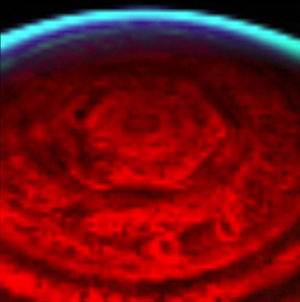
It was recently reported that there's a hexagonal rotating structure (see the image at left) at the North pole of Saturn.

We may not have found other life in our Solar System, but we have, it appears, found a polygon. An odd, six-sided, honeycomb-shaped feature circling the entire north pole of Saturn has captured the interest of scientists with NASA's Cassini mission.


NASA's Voyager 1 and 2 spacecraft produced images of the hexagon over two decades ago. The fact that it has appeared in the recent Cassini images indicates that it is a long-lived feature. A second hexagon, significantly darker than the brighter historical feature, is also visible in the Cassini pictures. The spacecraft's visual and infrared mapping spectrometer is the first instrument to capture the entire hexagon feature in one image.


Now others have seen the same phenomenon in the lab.


The unusual phenomenon in question involves rotating a bottom plate under a liquid in a circular (cylindrical) container. Bohr and his team of students at the Technical University and at the Niels Bohr Institute set up an experiment to find out whether or not such conditions would lead to stable deformations of a water surface into polygon shapes. The findings from their experiment were published May 3rd in Physical Review Letters.

Bohr tells PhysOrg.com that a somewhat similar experiment took place eight years ago with a different team (including Clive Ellegaard and others). “We had fluid falling on a plane, like water from a faucet. We found that even if the rim of the plate is completely circular, the fluid surface can be shaped like a polygon.”
While the first polygon experiment Bohr did involved stationary polygons, the most recent effort shows rotating polygons. “Not only are these shapes rotating,” says Bohr, “but they are rotating at a different speed than the plate beneath them.”
This is a fascinating phenomena that is, apparently, unexplained as yet. Here's another site for a video and more links.


(Hat tip: Ilachina)

Are cellular phones killing bees?

Interesting article on how our cellular phones could be disrupting the navigation of bees.

Thursday, April 12, 2007

Putnam Mathematical Competition Problems

Click on the link for the pdf file of the Putnam Mathematical Competition problems.

Good luck with them!

Sunday, April 08, 2007

Planet of the Apes: Apes as People

In a ground-breaking case at the Mödling district court, just southwest of Vienna, Austria, a judge is to rule over "the humanness of a chimp"– specifically, over whether it deserves a legal guardian.

The chimpanzee in question is called Hiasl. He was born in the Sierra Leone jungle in 1981, captured by animal traders and illegally shipped to Austria, destined for a vivisection lab. Customs officials intercepted the crate and Hiasl was handed to an animal sanctuary. Now, years later, the sanctuary has gone bankrupt and Hiasl is to be sent to a zoo.
This is the most ridiculous legal item I've seen a long time. Of course the chimp is NOT a human. To say otherwise is to say that we, (you, me, your friends, etc.) are chimps. Clearly not the case.

Nonetheless, as an animal lover (dogs, in particular) I should think the court could see it's way to appointing a caregiver for the chimp without equating the chimp to a human. The caregiver would have certain rights as an owner and thereby take care of the animal. Anything more is an insult to humans.

Air traffic control, automatically

Fighter pilots will one day be able to control entire squadrons of uncrewed combat aircraft as well as their own plane, following successful flight demonstrations of a multi-aircraft remote control system in UK airspace.

In addition to cutting the number of pilots risked in military operations, the remote control system could one day also be used to auto-land hijacked planes. Or they might allow lone pilots to orchestrate complex search and rescue operations.

This is not as new as it would seem. Just today I was in a meeting discussing how we might see unmanned aerial vehicles flying in U.S. airspace and how cargo planes could become pilotless. This demonstration is one step to seeing those ideas become a reality.


Wheat at risk

"This thing has immense potential for social and human destruction." Startling words - but spoken by the father of the Green Revolution, Nobel laureate Norman Borlaug, they are not easily dismissed.

An infection is coming, and almost no one has heard about it. This infection isn't going to give you flu, or TB. In fact, it isn't interested in you at all. It is after the wheat plants that feed more people than any other single food source on the planet. And because of cutbacks in international research, we aren't prepared. The famines that were banished by the advent of disease-resistant crops in the Green Revolution of the 1960s could return, Borlaug told New Scientist.

The disease is Ug99, a virulent strain of black stem rust fungus (Puccinia graminis), discovered in Uganda in 1999. Since the Green Revolution, farmers everywhere have grown wheat varieties that resist stem rust, but Ug99 has evolved to take advantage of those varieties, and almost no wheat crops anywhere are resistant to it.

Not only is Ug99 a threat in itself, but even if we have resistant wheat, we have still another problem:
However, Ug99 has another ace up its sleeve. The spores blowing in the wind now are from the asexual stage that grows on wheat. If any blow onto the leaves of its other host, the barberry bush (Berberis vulgaris), they will change into the sexual form and swap genes with whatever other stem rusts they find. Barberry is native to west Asia. "As if it wasn't challenging enough breeding varieties that resist this thing," laments Ward. "All I know is that what blows into Iran will not be the same as what blows out."
One solution is to apply fungicide to the crops which for many countries will work until new wheat can be developed that's resistant. But for poor countries fungicide is too expensive.

If you like to gamble, maybe it's a good time to go long on wheat futures?

Monday, April 02, 2007

The food cycle in the ocean

A shortage of big sharks along the U.S. East Coast is letting their prey flourish, and that prey is going hog wild, demolishing bay scallop populations.

That's the conclusion of researchers led by the late Ransom Myers of Dalhousie University in Halifax, Nova Scotia, who died this week. Combining census surveys from the past 35 years, Myers' team found shrinking populations of big sharks and shellfish and increasing numbers of smaller sharks and rays.

"Affecting something at the top [of the food web] is going to have huge consequences as effects ramify through the system," says study collaborator Charles H. Peterson of the University of North Carolina's Institute of Marine Sciences at Morehead City. As part of the new study, he and his colleagues explored some of those effects by protecting bay scallops from the cownose ray (Rhinoptera bonasus), one of the flourishing midlevel predators.

So, the cownose rays have multiplied and are eating more of the delicacies of scallops. What to do? Should we hunt down the rays now or, as the article later suggests make the rays a delicacy themselves?
Cownose rays have grown so abundant along the U.S. East Coast that fisheries managers are trying to promote them as a seafood delicacy. TV cooking-show host Emeril Lagasse has even developed some recipes. (Picture caption)
I have never eaten a ray and have no desire to ever do so. But if people like them, why not hunt them and eat them? They are part of the food chain, as are we, and we should look at them as food just like we do for a cucumber.

Bon apetit!


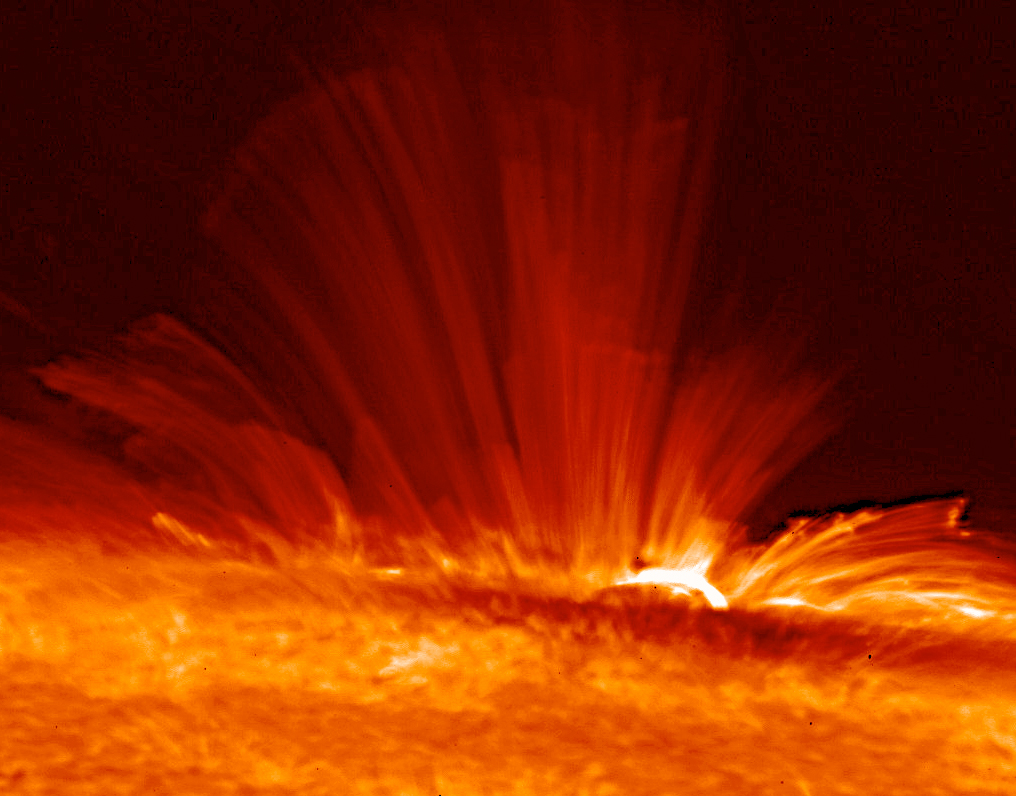
Sunspots erupt out high!

From the Astronomy Picture of the Day:
Why are there dark spots on the sun? Although noted for thousands of years, sunspots have been known for decades to be regions of the Sun that are slightly depressed and cooled by the Sun's complex and changing magnetic field. High resolution pictures like the above image from Japan's new Sun-watching Hinode satellite, however, are helping to increase modern understanding. In the center of the above image is a sunspot, but not seen in the usual orientation --this sunspot is seen sideways. Of particular interest is erupting glowing gas that shows how the Sun's magnetic field comes right out of the spot center, but curves markedly around the spot edges. Better understanding of how the Sun ejects particles into space may result in more accurate predictions of solar storms that affect satellites, astronauts, and even power grids on Earth.

Monday, March 19, 2007

Fauxtography spotting

Nice post on discovering forgeries in digital photographs.

Jurassic Crocodile In Eastern Oregon


Artists conception of the ancient creature.


An ancient sea-going crocodile has surfaced from the rocks of Crook County in eastern Oregon.

It's discovery by the North American Research Group (NARG), whose members were digging for Jurassic-age mollusks known as ammonites, is another confirmation that the Blue Mountains consist of rocks that traveled from somewhere in the Far East, says retired University of Oregon geologist William Orr, who was called in to examine the find for the state.

The remains - about 50 percent of a 6- to 8-foot reptile, including long, needlepoint teeth - were found imbedded in Jurassic rock on private property in the Snowshoe Formation of the Izee Terrane south of Dayville, Ore. Rocks containing the fossils were slowly cut out of the rock, after NARG members realized that the linear appearance of the fossils in the region's hard rocks suggested that a whole creature had been found, Orr said.

"This taxon was a crocodile-like creature but had a fish tail," said Orr, a NARG adviser and director of the Thomas Condon State Museum of Fossils at the University of Oregon. "This creature lived in Jurassic times, so it's 150 to 180 million years old. It probably lived in an area from Japan to East Timor, somewhere in the western Pacific in a tropical estuarine environment."

The fossils are generally found in Japan or China so that the finding in Oregon indicates that possible:
[T]he remains in Oregon migrated eastward in rock by continental drift, a theory of land movement in geological time now encompassed under plate tectonics. Terrane formations, such as those where these fossils were found, are believed to be portions of the earth's crust riding apart of a plate that is pushed upward at contact with another plate.
An incredible find.


Monday, February 26, 2007

Verification of Pollack's art with fractals

Richard Taylor from the University of Oregon reported 8-years ago that he found Jackson Pollack's artwork to have fractal qualities. Not that they are a fractal, because fractals have detail at all scales of magnification. So, some people wanted to use Taylor's approach to verify found paintings as original Pollack artwork.

Well, a graduate student at Western Reserve University in Cleveland, Katherine Jones-Smith
made some doodles on a page—"pretty ugly" ones, she says—she found that they shared the qualities of a Pollock, according to an analysis that follows Taylor's approach. "Either Taylor is wrong, or Kate's drawings are worth $40 million," says Jones-Smith's collaborator Harsh Mathur. "We'd be happy either way."
This started a discussion as to whether Taylor's approach can actually verify artwork.

Frankly, fractals are a mess when you try to define them because so many objects that you would like to be fractals don't fit in a single definition.

I think Michael Barnsley says it best:
For authentication, it doesn't matter whether it's legitimate to call Pollock paintings fractal, says Michael Barnsley of Australian National University in Canberra. Taylor has a reproducible technique that produces numbers from a painting, and he can correlate those numbers with different artists. "That doesn't allow you to authenticate or not authenticate a painting, but you could certainly add it into the collection of information that you have to say that it's more likely," he says.
Fractals are ill-defined now but the methods we use to measure fractal dimension have a place in our mathematical toolbox. A place, among many other tools, but not the only tool.

Wednesday, February 14, 2007

Astronomy Picture of the Day

I LOVE these pictures from NASA and the Hubble telescope. They never cease to amaze me and I marvel at their beauty. Just gorgeous.

Thursday, February 08, 2007

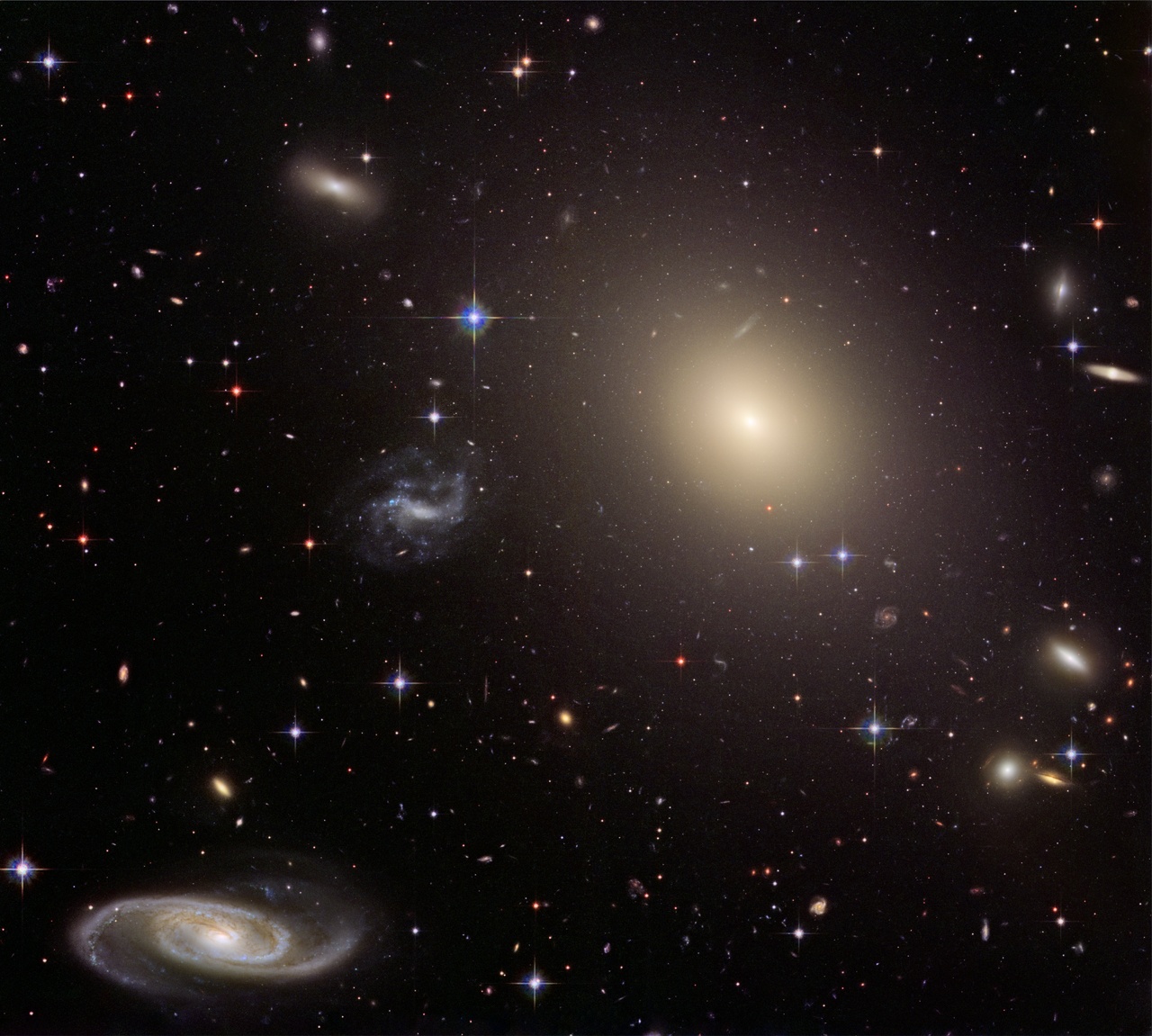
What a picture from Hubble

It's like something out of photoshop with the imagination of an artist. EXCEPT, it's real. This is a picture from the Hubble Telescope, on the Astronomy Picture of the Day. Here's their explanation:
This stunning group of galaxies is far, far away - about 450 million light-years from planet Earth - cataloged as galaxy cluster Abell S0740. Dominated by the cluster's large central elliptical galaxy (ESO 325-G004), this sharp Hubble view takes in a remarkable assortment of galaxy shapes and sizes with only a few spiky foreground stars scattered through the field. The giant elliptical galaxy spans over 100,000 light years and contains about 100 billion stars, comparable in size to our own spiral Milky Way. The Hubble data reveal a wealth of detail in even these distant galaxies, including magnificent arms and dust lanes, star clusters, ring structures, and gravitational lensing arcs.
Wow, that one part (just a part) of the image is 100,000 light years across and contains approximately 100-billion starts. Read that again. The galaxy is enormous and it's only a small part of the image.

Staggering. Just staggering.

Juggling light: It can be done

A pulse of light can be stopped, transported, and restarted again using a cloud of super-cold atoms, US researchers have shown. The technique could ultimately be used for advanced computing devices or gravity detectors.

The experiments demonstrate physicists' increasing ability to manipulate light. Being able to control it in this way could be useful for optical or quantum computers, the team suggests.

I didn't understand the details of the article, but if you do, please leave a comment about it.

NASA reviews policy after astronaut goes beserk

NASA is reviewing its psychological screening process for astronauts, following astronaut Lisa Nowak's arrest for allegedly attempting to murder a romantic rival.

Police in Orlando, Florida, US, say that Nowak drove 1500 kilometres to try to kidnap and possibly kill Air Force Captain Colleen Shipman (see Astronaut accused of attempted murder released on bail). Both women may have been vying for the affections of NASA astronaut Bill Oefelein.

In response to the shocking event, NASA Administrator Michael Griffin has requested an internal review of the psychological screening procedures used to admit new astronauts. He also asked for a review of any follow-up psychological evaluations of working astronauts, including who conducts the screening.

I've busy with work and unable to post for a while. But the news on Nowak is unbelievable. This woman is a disgrace to NASA and a disgrace to the United States Navy. What's worse is that NASA, and I bet the Navy, never bothered to see the signs of her deranged behavior.

Let's hope NASA changes their policies to screen out such people, and not just at the start of a career, but throughout an astronaut's career and the same goes for the Navy.

Thursday, January 18, 2007

Getting close to mid-night: Bulletin of Atomic Nuclear Scientists

So, the famous Bulletin of Atomic Scientists believes we are two minutes closer to destruction than we have been in the past. Here's how they put it:

This deteriorating state of global affairs leads the Board of Directors of the Bulletin of the Atomic Scientists--in consultation with a Board of Sponsors that includes 18 Nobel laureates--to move the minute hand of the “Doomsday Clock” from seven to five minutes to midnight.

This is another example of people with a certain expertise in one area, thinking they have expertise in another area. Scientists are generally smart people, perhaps some of the smartest on the planet we call home. But being smart as a scientist does not mean one is competent in other areas.

For example, while Richard Feynman was a genius in physics, he was no politician. That is, Feynman's expertise in physics did not mean that he had any deep insight in politics. He may have insight of his own, of course, but if you want political opinion it's best to go with a politician.

What's this have to do with the time creeping closer to mid-night?

Just this: the catastrophe that the Bulletin is "predicting" is more of a political catastrophe and not a scientific one. It is a political question as to whether nuclear bombs will be detonated not a scientific one. If the world ends due to nuclear bombs that responsibility rests with our political leaders; scientists have done their part already in building the bombs.

This year, The Bulletin also cites "Global Warming" as part of the coming (five minutes away!) catastrophe. Once again, the scientists have no say in Global Warming (if it even exists and I don't believe it). The question of climate is beyond the control of any scientist. Sure, scientists study climate and have opinions but whether the world will "end" due to some climate change is beyond them.

To try to predict "the end" is to scare people into believing others who, while smart in one area, have no business in other areas.

Thursday, January 11, 2007

Invisibility: Mathematically possible

November 30, 2006: The invisibility cloak recently built by scientists at Duke University and Imperial College in London has received enormous attention all over the world. This breakthrough cloaking device makes a copper disk invisible at specific microwave frequencies. As it turns out, Mathematics Professor Allan Greenleaf of the University of Rochester along with Matti Lassas, who is now at the Helsinki University of Technology, and Gunther Uhlmann of the University of Washington, started the mathematics behind invisibility several years ago in the context of medical imaging and quantum mechanics. Joined by fourth member Yaroslav Kurylev of Loughborough University, the team has announced the mathematics of full-wave invisibility at all frequencies (http://www.arxiv.org/abs/math.AP/0611185). In their latest work, they examine the problem of cloaking not just passive objects, but also active devices that are emitting electromagnetic waves, and show that this requires modifying the original constructions.

(hat tip: Ilachina)

Goldbach conjecture: Proved?

Here's a paper that the authors say proved Goldbach's conjecture. From Wikipedia:

Goldbach's conjecture is one of the oldest unsolved problems in number theory and in all of mathematics. It states:

Every even integer greater than 2 can be written as the sum of two primes.

For example,

4 = 2 + 2
6 = 3 + 3
8 = 3 + 5
10 = 3 + 7 = 5 + 5
12 = 5 + 7
14 = 3 + 11 = 7 + 7
etc.


It's a very old problem and one that if solved, would be welcomed news in mathematics.

Journal of Fourier Analysis and Applications

The University of Maryland is having a two-day seminar on Fourier Series in February. As part of the program you can get a trial copy of the Journal of Fourier Analysis and Applications free, just follow link above.

The journal is math-oriented but worth perusing. Enjoy.

Sunday, January 07, 2007

Junk science

Ian Gilmartin, 60, has invented a mini water wheel capable of supplying enough electricity to power a house - for free. The contraption is designed to be used in small rivers or streams - ideal for potentially thousands of homes across Britain.

It is the first off-the-shelf water-wheel system that can generate a good supply of electricity from as little as an eight-inch water fall.

Have a laugh and read the article.