
Studies now show that the best way to prevent the spread of AIDS is to be faithful to one's partner. No secret there. If you're partner is uninfected and so are you, then you're safe. If one has lots of partners, well, he will likely have relations with an infected person.
Circumcision is a suprise though. Seems that current studies show that circumcised men reduce male to female transmission by 60%-75%. I read about a study in Africa on this very issue and the researchers were so astounded by this discovery that they stopped the study and told the uncircumcised men to get a circumcision. They felt that continuing the study put people at risk because the prevention was so much greater.
Friday, April 28, 2006


Some Physicists oppose the use of nuclear weapons
Various physicists and mathematicians oppose the use of nuclear weapons against Iran and they've written a letter for President Bush, see the link.
Unfortunately, these scientists misunderstand the nature of military planning. They intimate that nuclear weapons should not be an option and want the President to say so. That would be wrong. The President, and any military planner, cannot simply rule-out options and leave himself no alternative. It's impossible to predict what an adversary will do or not do. Because of that, any planner has to leave all options open for the "just in case" scenario. To close off options is to self-limit oneself and thereby give an adversary an advantage he would not have otherwise.
If these scientists did more work with the military I think they could appreciate more of how the military works, plans, and responds to world events. It's not simple and it's not easy.
Unfortunately, these scientists misunderstand the nature of military planning. They intimate that nuclear weapons should not be an option and want the President to say so. That would be wrong. The President, and any military planner, cannot simply rule-out options and leave himself no alternative. It's impossible to predict what an adversary will do or not do. Because of that, any planner has to leave all options open for the "just in case" scenario. To close off options is to self-limit oneself and thereby give an adversary an advantage he would not have otherwise.
If these scientists did more work with the military I think they could appreciate more of how the military works, plans, and responds to world events. It's not simple and it's not easy.
Thursday, April 27, 2006
Factors in why we lie
I don't often cite psychology in my blog because, frankly, I don't read much about it. But this report summary struck a nerve. It discusses why people lie and that fact that we (the "royal we," See the movie The Big Lebowski) are more inclined to lie to co-workers or friends than to strangers.
"We found that consumer’s willingness to lie is related to not only a desire to protect their public selves, or the impressions they convey to others, but also [their] private selves, or their sense of self worth," explain Jennifer J. Argo (University of Alberta), Katherine White (University of Calgary), and Darren W. Dahl (University of British Columbia).
The first study to use social comparison theory to explain why and when we lie, the researchers argue that our willingness to lie is directly related to perceived threats to our self-esteem and self-image. People feel threatened by the possibility of being suckers and lie more readily when they overpaid for an item. However, people are less likely to lie if they know that a better deal is attainable, say, with a short-term gym membership.
"When public self image is threatened, individuals are often motivated to engage in impression management tactics such as lying," explain the authors.
Tuesday, April 25, 2006
Eye glasses that change with you
 Science News reports on newly developed eye glasses that can change their focus electronically depending on what the wearer needs. Here's how the article describes the workings of these new glasses:
While the glasses look clunkly now, you can be sure that with futher development and work, the glasses will look better, perform better, and be useful.[T]he researchers created sandwiches of glass sheets separated by a fluid layer 5 micrometers thick. The filling consists of a transparent substance, a type of liquid crystal, that's made up of rod-shaped molecules suspended in a liquid. The team used precise computer-chip–manufacturing methods to apply a bull's-eye pattern of transparent electrodes to the inner surface of one of the glass sheets.
In response to voltages applied to those electrodes, the liquid-crystal rods rotate into new orientations, explains Guoqiang Li of the University of Arizona and a member of the development team. The rod orientation determines the speed at which light passes through the liquid-crystal layer. Light rays bend as they traverse the layer and so can become focused, much as they would when passing through an ordinary lens.
Sunday, April 16, 2006
Designer Drink: Alcoholic without alcohol
It is now a thought experiment: How to design a molecule that acts on the brain as alcohol does, but, the molecule will not effect the human with sickness, nausea, headaches, or a hang-over? The molecule (or pill, really) will give the taker, that is, druggie (let's be honest) his craved high but without the nasty side effects.
New Scientist reports:
Alcohol exerts its effects on the brain mainly by latching onto signalling molecules called GABA-A receptors. There are dozens of subtypes of these, some of which are associated with specific effects of alcohol. Memory loss, for example, seems to occur because alcohol binds to a subtype in the hippocampus called alpha-5. Nutt [psychopharmacologist David Nutt of the University of Bristol in the UK] says it would be possible to design molecules that bind strongly to the good subtypes but more weakly to the bad ones.
In fact such "partial agonists" of GABA-A receptors already exist in the form of bretazenil and pagoclone, which were developed as anti-anxiety drugs but never commercialised. These molecules also have the advantage of being instantly reversible by the drug flumazenil, which is used as an antidote to overdoses of tranquillisers such as Valium. Alcohol also inhibits NMDA receptors, which are part of a general excitatory signalling circuit, so a second ingredient of the alcohol substitute would be an NMDA antagonist such as dizoclipine, originally developed as a drug for stroke.
So, now we have science, at the thought level to be sure, looking at how to develop designer drugs for alcohol replacement. Somehow this just strikes me to be a drug pusher's dream. We have LSD, heroin, pot, cocaine, and meth. Some natural, some not. Now, someone seeks to design an alcohol-effects-based drug. Alternatively, if such a drug would help alcoholics and others to avoid the problems associated with drinking, then maybe there is something here. Hard for me to tell.
Friday, April 07, 2006
New York Times Book Review: 'Programming the Universe,' by Seth Lloyd
From the review:
The deck of cards for example: The only way one can say that a new deck of cards is ordered is if one knows what ordered cards are--- before you look the deck. If you think ordered cards are when the red and black suits alternate, then that arrangement would be an ordered deck. A new deck would not be ordered because the suits are grouped together. If, to continue, you counted in some other way than how we are taught to count, a different ordering of the cards would be, by definition, ordered.
In short, entropy as it is defined here, and this is how it is often defined, requires one to have outside information with which to measure "randomness." This information cannot come from the cards, it is external to the system. Thus, what one sees as order may not be order at all to someone else. Is entropy then dependent on the observer? Perhaps that's really what is happening, the observer computes the entropy but a different observer could compute a different entropy?
What I know for certain is that I don't know what random means, I don't know what ordered means and I certainly don't know what entropy means.
Perhaps you could help me out?
"Broadly speaking, entropy is the amount of disorder and information in a system. Take, for example, a fresh, unshuffled deck of cards. In that state it has low entropy and contains little information. Just two pieces of data (the hierarchy of suits and the relative ranks of the cards) tell you where to find every card in the deck without looking. Give it a good shuffle and look again. The deck has a lot of entropy and a lot of information. If you want to locate a particular card, you have to hunt through the entire deck. There is only one perfectly ordered state but about 1068 disordered ones, which is why you will never, ever accidentally shuffle the deck back into its original order."This definition of entropy is one that we hear quite often. Entropy is the amount of disorder or randomness. What does that really mean? Frankly, I haven't a clue. What I do have is the belief that others do not have a clue either. They have equations and they speak with authority, but in the end, what does randomness mean?
The deck of cards for example: The only way one can say that a new deck of cards is ordered is if one knows what ordered cards are--- before you look the deck. If you think ordered cards are when the red and black suits alternate, then that arrangement would be an ordered deck. A new deck would not be ordered because the suits are grouped together. If, to continue, you counted in some other way than how we are taught to count, a different ordering of the cards would be, by definition, ordered.
In short, entropy as it is defined here, and this is how it is often defined, requires one to have outside information with which to measure "randomness." This information cannot come from the cards, it is external to the system. Thus, what one sees as order may not be order at all to someone else. Is entropy then dependent on the observer? Perhaps that's really what is happening, the observer computes the entropy but a different observer could compute a different entropy?
What I know for certain is that I don't know what random means, I don't know what ordered means and I certainly don't know what entropy means.
Perhaps you could help me out?
Thursday, April 06, 2006
Drugs trials gone bad, horribly bad
A catastrophic drug safety trial which left six healthy volunteers fighting for their lives was the result of “a powerful pharmacological effect of the product in humans”, the UK government agency charged with investigating the incident said on Wednesday.
The novel drug, called TGN1412, caused multiple organ failure in the six men injected with it at a Northwick Park Hospital, London, UK, on 13 March.
The severe patient reaction in the first human phase I safety trial of the drug was not due to a dosing error, product contamination or manufacturing problems, and the trial was conducted properly according to the agreed protocol, the Medicines and Healthcare products Regulatory Agency (MHRA) said, announcing its interim findings.
The “unprecedented reaction” to the drug was not seen in preclinical test animals at much higher doses, Kent Woods, chief executive officer of the MHRA told reporters. The drug, made by German pharmaceutical company TeGenero, was being tested as a potential treatment for certain autoimmune diseases and leukaemia.
“Even in hindsight, we can see no evidence of any such adverse reactions from the preclinical studies,” Woods said. “The doses given to the humans in the trial were diluted by 500 times – a substantially lower dose than that given to non-human primates, which didn’t show ill effects.”
Five of the six patients have been released from the hospital and the other person is, apparently, doing better. That's good news.
Here are some lessons:
- Drug trials are inherently dangerous. Don't let a physician tell you that the trial is safe because it's supervised. Yes, the trials are supervised but that doesn't make them safe. I have a friend at NIH (National Institutes of Health in Bethesda, MD, just outside of Washington, DC) and he says trials are better than safe. Why? Because the subjects are constantly monitored and watched by doctors all the time. That is not sufficient to guarantee safety.
- Next, lab tests are not enough. There were no problems like these complete organ shut-downs found with lab animals. While animal testing is a necessity, it alone is not enough. Human trials, despite these awful consequences still must be performed. Imagine if the drug were marketed to humans based solely on animal trials? While the problems here are severe, at least they were found before a public release. In that sense, these trials did what they should do: the trials found a fatal problem before the drug could hurt many people.
- Computer simulations are bunk. If these trials had such detrimental effects, and they did, and these effects were completely unforeseen, that tells you that computer simulations which are based on what scientists believe they know, are even more likely to fail. Sure, simulations help scientists to think about a problem. They can highlight problems and potential problems. But, even more than animal testing, they are critically limited. If animal tests are not sufficient, simulations are even less sufficient (if that's even possible).
What women want, what men should now get
This article from New Scientist says that as women grow in their earning power they seek mates that are more physically appealing rather than financially appealing. In the past women looked for men to be providers so that physical appeal was less important than the ability to make a living. Now that women make a very good living on their own, their preferences have changed.
First, men are often attracted to women for their physical appeal, so why shouldn't women be the same? More importantly, now that women do, in fact, earn so much, it's also time that men get from women what women have gotten from men. Namely, that men be permitted (that is, socially acceptable) to stay home and take care of the house without scorn and redicule from others. Let the woman support her husband; it doesn't have to be the other way around.
Next, should the relationship not work out, there should be great effort to have the woman pay for husband support so that alimony will go both ways depending on the earning power of each party. No longer will it be assumed that the man will pay. Finally, there should be equal rights in reproductive freedom. Why is it that a woman is the only party to decide the fate of an unborn baby? The father should be an equal part of that decision as well.
Frankly, this is all fine by me. (Prepare for social commentary, for what this is worth:)WHAT do women want from a man? In the past, surveys have overwhelmingly shown that women want a rich man, and men want a good-looking woman. While not much has changed for men, as women's financial independence has increased, it seems that their preferences have changed.
Fhionna Moore and colleagues at the University of St Andrews, UK, analysed questionnaires from 1851 heterosexual women between the ages of 18 and 35. They found that as a woman's level of "resource control" increases - in other words as they become more financially independent - so does their preference for physical attractiveness in potential partners.
Women who had low levels of control over their cash rated the financial status of a man over his looks. Those with a decent source of income rated physical attractiveness more highly. The study will appear in Evolution and Human Behavior.
First, men are often attracted to women for their physical appeal, so why shouldn't women be the same? More importantly, now that women do, in fact, earn so much, it's also time that men get from women what women have gotten from men. Namely, that men be permitted (that is, socially acceptable) to stay home and take care of the house without scorn and redicule from others. Let the woman support her husband; it doesn't have to be the other way around.
Next, should the relationship not work out, there should be great effort to have the woman pay for husband support so that alimony will go both ways depending on the earning power of each party. No longer will it be assumed that the man will pay. Finally, there should be equal rights in reproductive freedom. Why is it that a woman is the only party to decide the fate of an unborn baby? The father should be an equal part of that decision as well.
Wednesday, April 05, 2006
More astronomy pics
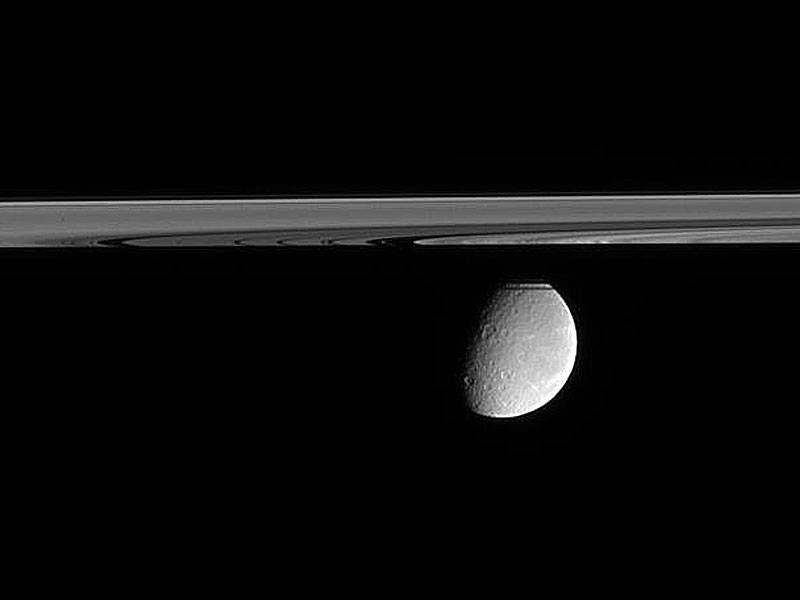 Once more, I still find the astronomy pictures of the day just amazing. Here is a moon of Saturn shown within the shadow of the rings.
 Explanation: When orbiting Saturn, be sure to watch for breathtaking superpositions of moons, rings, and shadows. One such picturesque vista was visible recently to the robot Cassini spacecraft now orbiting Saturn. In late February, Cassini captured Rhea, the second largest moon of Saturn, while looking up from slightly beneath Saturn's expansive ring plane. Signature dark gaps are visible in the nearly edge-on rings. A shadow of Saturn's F ring cuts across the cratered ice-moon. Cassini is scheduled to continue sending back images from the orbit of Saturn until at least 2008.
Great fractals and animations

While surfing just a bit today, I stumbled upon this terrific site. It has many beautiful fractal images and even some animations.
The images are truly beautiful and show the complexity of fractals very well. I downloaded one animation and while it was fun to look at, it wasn't really worth the download time. Nonetheless, a few minutes looking over these images is lots of fun. Enjoy.
Monday, April 03, 2006
Grow your own bladder
Bladders engineered in the laboratory from patients' own cells and then implanted into the body have succeeded in their first clinical trial.
The feat was accomplished by Anthony Atala, at Wake Forest University Medical School in Winston-Salem, North Carolina, and his colleagues. He says that while scientists have had success with skin transplants grown on scaffolds in the past, this is the first time they have grown and transplanted a discrete, complex organ.
The success is the culmination of an idea that the team began exploring 16 years ago. Atala adds that they are also working on growing bio-engineered hearts and pancreases in the lab.
This is a fantastic discovery. The ability to grow even part of a needed organ is a tremendous step forward in medical care.
Many thanks to the researchers for all their great work.
Euclid's Fourteenth Book
Ivars Peterson goes on:When a famous mathematician has something new to say, the whole world pays attention.
Euclid's Elements, which presented the state of the art in geometry around 300 B.C., has been extraordinarily influential. This massive, 13-volume compendium set the standard for mathematical exposition and precise discourse for many centuries. More than 2,000 editions have been published, and new, interactive versions now appear on the World Wide Web.
What's more, there is compelling evidence that Euclid of Alexandria (c. 365–275 B.C.) had a fourteenth book in mind. Officials of the Avril Foundation for Old Occidental Languages have announced that, after a year devoted to authentication and analysis, they are prepared to release the text of a manuscript that appears to be a Latin translation of research notes jotted down by Euclid in preparation for writing a fourteenth volume of Elements.
It's clear that Euclid was uncomfortable with the fifth and most complicated of the five postulates that begin Elements. This postulate states, "If a straight line falling on two straight lines makes the interior angles on the same side less than two right angles, the two straight lines, if produced indefinitely, meet on that side on which the angles are less than two right angles."
Euclid's newly discovered notes propose an alternative way of expressing this notion: "Through any given point can be drawn exactly one straight line parallel to a given straight line." Euclid went on to consider two other cases: In one case, no parallel line can be drawn through the point, and in the other case, more than one parallel line can be drawn. In these two situations, he says, the sum of the interior angles of a triangle is no longer exactly equal to two right angles.
On the surface of a sphere, for example, the sum of the angles of any triangle is greater than two right angles, Euclid notes. Such a geometry has no parallel lines, yet it obeys his first four postulates.
The manuscript hints that Euclid also explored the curious geometry that arises from the existence of multiple parallels. "I have discovered things so wonderful that I was astounded," he wrote at one point. "Out of nothing I have created a strange, new world." Unfortunately, much of this section of the manuscript has deteriorated beyond repair, so only a few tantalizing fragments remain.
Read the rest and then check the date.
Too little sleep: correlated with obesity and diabetes
Widespread sleep deprivation could partly explain the current epidemics of both obesity and diabetes, emerging data suggest.
Too little sleep may contribute to long-term health problems by changing the concentrations of hormones that control appetite, increasing food intake, and disrupting the biological clock, according to Eve Van Cauter of the University of Chicago.
Van Cauter and other researchers discussed possible links between sleep deprivation, expanding waistlines, and obesity-related problems this week in Washington, D.C., at a meeting titled A Scientific Workshop on Sleep Loss and Obesity: Interacting Epidemics.
The article goes on to explain that moderate amounts of sleep, about 8-hours, seems not to correlate with diabetes or obesity.
Each new study seems to say something, but it's never clear just which study one should believe. This one tells us to sleep about 8-hours a night. Seems right to me, but then I sleep about that now. Of course, my waistline isn't what it should be so maybe I should sleep more? Or, should I sleep less but use that "extra" time to exercise? Who can say?
Square Root of Two: A review
Doug Ensley and John Ensley wrote a cute review of the book The Square Root of 2: A Dialogue Concerning a Number and a Sequence where they adopted the style of the book and wrote in the form of a dialogue.
Unfortunately, the book sounds pretty dull and not worth the time. Still, if you have second to read the review, it's entertaining. Here's a sample:
What did you think of David Flannery’s book on the square root of two?
At first I thought, “Can there really be 250 pages of stuff to say about the square root of two?” I also thought it had a cool cover.
So you judged a book by its cover?
Yeah, I guess I did at first. I also wanted to find out how anyone could possibly write an entire book about the square root of two.
In all fairness, the book is more about some mathematics pertaining to the square root of two among other things. It is only as long as it is because of the playful informal dialogue used throughout the entire book.
Isn’t it kind of weird to write a math book in dialogue form? The boldface voice made me think of God on a mountain speaking from a burning chalkboard.
The dialogue form between Master and Pupil is a tradition that goes back to Greek writers like Plato.
I still thing it is weird to write in dialogue form, but I’ll admit that it does make the math pretty easy to understand.
Friday, March 31, 2006
The Sun: What a sight
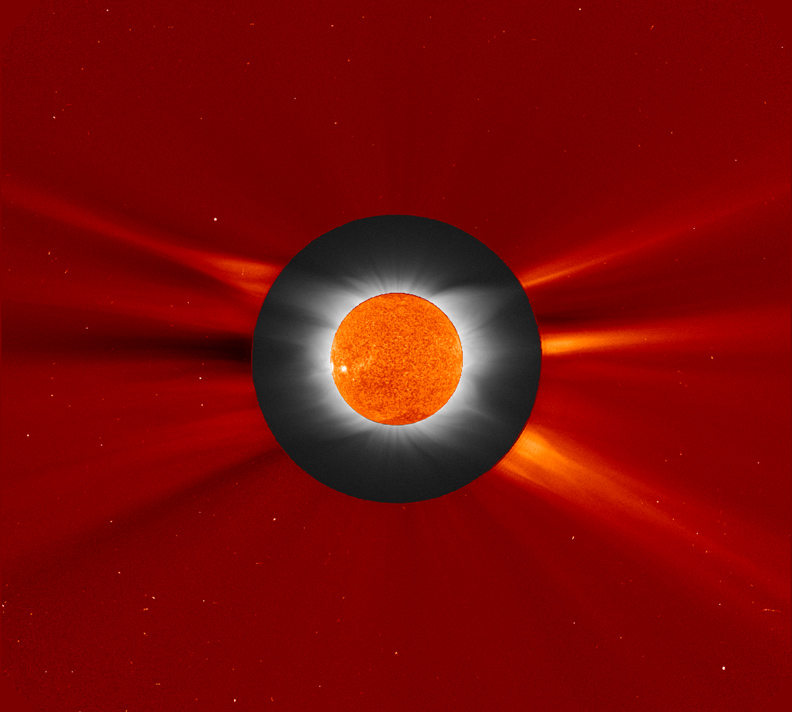 I can't get enough of these:
Explanation: Neither rain, nor snow, nor dark of night can keep the space-based SOlar Heliospheric Observatory (SOHO) from watching the Sun. In fact, from its vantage point 1.5 million kilometers sunward of planet Earth, SOHO's cameras can always monitor the Sun's outer atmosphere, or corona. But only during a total solar eclipse can earth-based observers see the lovely coronal streamers and structures - when the Moon briefly blocks the overwhelmingly bright solar surface. In this composite view, SOHO's uninterrupted view of the solar corona above the solar photosphere (center) and corona far beyond the Sun's disk, are shown in orange hues. The middle, donut-shaped region is the corona as recorded by the Williams College Eclipse Expedition to Kastelorizo Island, Greece during the March 29th total solar eclipse. Merging ground and space-based views allows astronomers to trace features in the corona that reach from just above the Sun's surface into the solar wind.
Thursday, March 30, 2006
Are you boring your friends?
There is now a device that lets users know if they are boring the people they're talking to.
Seriously, the device is quite interesting in that in uses a tiny camera to recognize facial features in listeners. Score one more for technology!
While developed for people with autism, I have to believe that many folks I know could use this as well.A DEVICE that can pick up on people's emotions is being developed to help people with autism relate to those around them. It will alert its autistic user if the person they are talking to starts showing signs of getting bored or annoyed.
One of the problems facing people with autism is an inability to pick up on social cues. Failure to notice that they are boring or confusing their listeners can be particularly damaging, says Rana El Kaliouby of the Media Lab at the Massachusetts Institute of Technology. "It's sad because people then avoid having conversations with them."
Seriously, the device is quite interesting in that in uses a tiny camera to recognize facial features in listeners. Score one more for technology!
Ask: Try it!
Walt Mossberg, in his column with the Wall Street Journal, writes:
Ask.com has its search engine, but it also has news, maps, weather, encyclopeida, blogs and other interesting things. Give it a try. You'll be surprised how good it is.[T]he overhaul has been far more than just marketing. Ads have been cut back to just three at the top and five at the bottom of each page, and they run on a colored background so you know they're not real search results. Instead of running ads down the right side of the page, as Google does, Ask uses that space to help the user refine search results.
In general, Ask's search-results pages are richer and better organized than typical Google results, and they give greater priority to content over ads.
Wednesday, March 29, 2006
Editorial: Books today
I wish to take a moment to reflect on some of the books I see today. In particular, let me begin by asking: What is the purpose to a book? Is it to be read? Is it for reference? Is it for enjoyment?
I was reading The Road to Reality : A Complete Guide to the Laws of the Universe by Roger Penrose last night before going to sleep. Yes, I know, that's not usual bedtime reading but that's what I like, usually. This book tries to be all things to all readers. It has equations and claims to be a sole-source for the known physics of today. A kind of repository to nature's laws. That's fine, but Penrose goes about this by trying to write to the educated reader, one who has a substantial mathematics background.
He then tries to write to the layperson and to do that he explains the mundane. That is, if you know what a complex number is, for example, you certainly don't need him to explain it. If you don't know what a complex number is, well, I don't see how you can read the rest of the book, no matter how much you see that definition. Some minimal background is required to read a book that like this. Trying to please both types of audiences, and everyone in between I should add, simple makes the book unreadable.
What's more, the book is extremely thick: 1136 pages. That's over one-thousand pages bound in a single text! It weighs a few pounds---Amazon says the shipping weight is 3.4 pounds. What does this mean? It means that a person is hardpressed to hold the book and read the pages. The physical structure and weight of a single volume this big makes it impossible.
So, perhaps this book is a reference? Well, no, it's not that because it's clear not organized nor is it indexed to be a useful reference.
In short, the book fails to be much of anything other than a lot of some things but not enough of one thing to be good.
This sounds, and it is, a severe critique of what I am sure Penrose considers an impressive work. The problem is that it's not limited to his work. His book is but an example of a trend.
Nowadays I am seeing more and more books with similar problems. The books don't know who their audience is so they try to be all things to all people. That's a failure. More, books are getting to be extremely long, well in excess of 500-pages at a time. That makes them difficult to read, physically, as I noted above, and difficult to want to finish. You have to have substantial mental stamina simply to stay with the book.
And here's one more point, although Penrose's book does not do this: Books are getting very expensive. I found this book entitled: From Eudoxus to Einstein : A History of Mathematical Astronomy by C. M. Linton that was reviewed on the Mathematical Association of American website. (Here's the review.) The book looks great and I would love to buy it. It costs $79.00 at Amazon, even more if you pay full-price. That's pretty steep. When I look in the book (Thank You, Amazon, for that!) I see that book is good probably great but it's not worth the price.
So, what should be done? First, every author should decide to write books for a particular audience and once decided, leave it at that. If it's a popular book, then fine. If not, then make it a technical book worthy of an educated reader. Next, books are for reading so make them short, to the point, and easy to take with you. A book should be carried around, read at one's convenience. Somehow, I think authors can't help themselves and say much more than they should. Heavens, if an author has a lot to say, make the book a multiple volume set.
Lastly, book prices should be set so that one can buy many different books and not spend so much money on a single copy to the detriment of buying other books. Would that be so hard?
Note to readers: Ordinarily I don't rant like this, but the trend with books is clear and it's not good. I hope authors and publishers will correct their course, and soon.
I was reading The Road to Reality : A Complete Guide to the Laws of the Universe by Roger Penrose last night before going to sleep. Yes, I know, that's not usual bedtime reading but that's what I like, usually. This book tries to be all things to all readers. It has equations and claims to be a sole-source for the known physics of today. A kind of repository to nature's laws. That's fine, but Penrose goes about this by trying to write to the educated reader, one who has a substantial mathematics background.
He then tries to write to the layperson and to do that he explains the mundane. That is, if you know what a complex number is, for example, you certainly don't need him to explain it. If you don't know what a complex number is, well, I don't see how you can read the rest of the book, no matter how much you see that definition. Some minimal background is required to read a book that like this. Trying to please both types of audiences, and everyone in between I should add, simple makes the book unreadable.
What's more, the book is extremely thick: 1136 pages. That's over one-thousand pages bound in a single text! It weighs a few pounds---Amazon says the shipping weight is 3.4 pounds. What does this mean? It means that a person is hardpressed to hold the book and read the pages. The physical structure and weight of a single volume this big makes it impossible.
So, perhaps this book is a reference? Well, no, it's not that because it's clear not organized nor is it indexed to be a useful reference.
In short, the book fails to be much of anything other than a lot of some things but not enough of one thing to be good.
This sounds, and it is, a severe critique of what I am sure Penrose considers an impressive work. The problem is that it's not limited to his work. His book is but an example of a trend.
Nowadays I am seeing more and more books with similar problems. The books don't know who their audience is so they try to be all things to all people. That's a failure. More, books are getting to be extremely long, well in excess of 500-pages at a time. That makes them difficult to read, physically, as I noted above, and difficult to want to finish. You have to have substantial mental stamina simply to stay with the book.
And here's one more point, although Penrose's book does not do this: Books are getting very expensive. I found this book entitled: From Eudoxus to Einstein : A History of Mathematical Astronomy by C. M. Linton that was reviewed on the Mathematical Association of American website. (Here's the review.) The book looks great and I would love to buy it. It costs $79.00 at Amazon, even more if you pay full-price. That's pretty steep. When I look in the book (Thank You, Amazon, for that!) I see that book is good probably great but it's not worth the price.
So, what should be done? First, every author should decide to write books for a particular audience and once decided, leave it at that. If it's a popular book, then fine. If not, then make it a technical book worthy of an educated reader. Next, books are for reading so make them short, to the point, and easy to take with you. A book should be carried around, read at one's convenience. Somehow, I think authors can't help themselves and say much more than they should. Heavens, if an author has a lot to say, make the book a multiple volume set.
Lastly, book prices should be set so that one can buy many different books and not spend so much money on a single copy to the detriment of buying other books. Would that be so hard?
Note to readers: Ordinarily I don't rant like this, but the trend with books is clear and it's not good. I hope authors and publishers will correct their course, and soon.
Astronomy: Pic of the day
 From the site:
Green and Black Aurora Over Norway
Credit & Copyright: Frank Andreassen (nettfoto.no)Explanation: What causes gaps between aurora curtains? These unusual gaps can make Research using data from four Cluster spacecraft orbiting the Earth has likely found the secret: auroral gaps, sometimes knows as black auroras, are actually anti-auroras. In normal auroras, electrons and/or predominantly negatively charged particles fall toward Earth along surfaces of constant magnetic field. They ionize the Earth's atmosphere on impact, causing the bright glows. In auroral gaps, however, negatively charged particles may be sucked out from the Earth's ionosphere along adjoining magnetic field lines. These dark anti-auroras can climb to over 20,000 kilometers and last for several minutes. Pictured above, a series of well-defined auroral gaps is seen dividing green aurora curtains high above Harstad, Norway, earlier this month.
This is another beautiful photo for your enjoyment.
Sunday, March 26, 2006
Ghost diagrams: Tilings of the plane
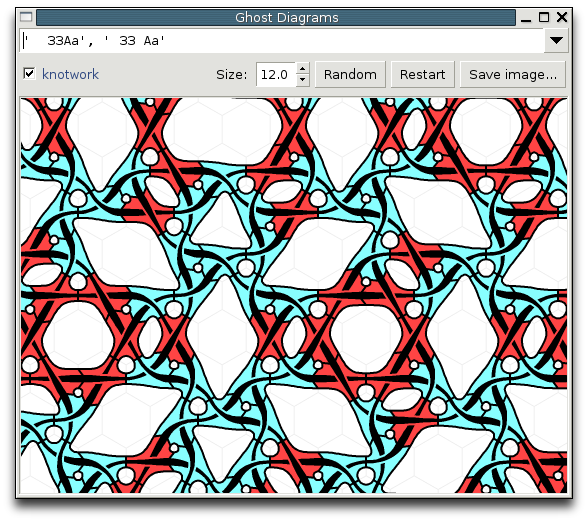 This site takes a given pattern and tries to find a way to tile the plane with that pattern. From the site itself:
Ghost Diagrams is a program that takes sets of tiles and tries to find patterns into which they may be formed. The patterns it finds when given randomly chosen tiles are often surprising.It turns out that tiling patterns are a form of computation of equal power to Turing machines, lambda calculus, and cellular automata. For example, here is a tileset implementing "Rule 110", a cellular automaton known to be capable of universal computation. Considerations similar to the halting problem and Godel's theorem apply. There is no upper limit to their capacity to surprise us. Furthermore, tiles have an intuitive quality that other forms of computation lack. You can see how they fit together.
An organism is more than the sum of its organs. When the organs are fitted together, the organism becomes something more. This surprising something more we call "spirit" or "ghost". Ghost Diagrams finds the ghosts implicit in simple sets of tiles.
See this draft chapter from my thesis for further details and pretty pictures.
These are quite beautiful. Enjoy.
(Hat tip: Ilachina, a frequent and respected contributor.)
Subscribe to:
Posts (Atom)