Powered By Blogger

Monday, June 12, 2006

Simpson's Math


Erica Klarreich writes about the math on The Simpson's. The entire article is worth your time.

I didn't know that so many of the show's writers are scientists. No wonder the humor is smart, fast, and incredibly fresh with each episode.

This was one of my personal favorites:

"
The Simpsons writers often play on mathematical cultural stereotypes, extracting humor by exaggerating both the mathematical illiteracy of the U.S. public and the nerdiness and self-aggrandizement of the mathematically gifted. In a characteristic exchange, in the third-dimension episode, mad scientist Professor Frink tries to explain to Police Chief Wiggum the nature of the three-dimensional space through which Homer Simpson is wandering.

a7356_2342.jpg

Prof. Frink - Discoverer of the Frinkahedron, or cube.
Fox Broadcasting Company

Frink: It should be obvious to even the most dimwitted individual who holds an advanced degree in hyperbolic topology that Homer Simpson has stumbled into the third dimension. . . . (drawing on a blackboard) Here is an ordinary square.

Wiggum: Whoa, whoa—slow down, egghead!

Frink: But suppose we extend the square beyond the two dimensions of our universe, along the hypothetical z-axis, there. This forms a three-dimensional object known as a "cube," or "Frinkahedron" in honor of its discoverer.

"One of the themes we've harped on is Professor Frink trying to seize credit for something," Keeler says. "That should be very familiar to people in academia."

Just terrific.

Here's a link for the anwer to final question in the Science News article.


More from New Scientist

Article one:

"Researchers at the Max Planck Institute for Plasma Physics and the Humboldt University, both in Berlin, have used underwater electrical discharges to generate luminous plasma clouds resembling ball lightning that last for nearly half a second and are up to 20 centimetres across.

They hope that these artificial entities will help them understand the bizarre phenomenon and perhaps even provide insights into the hot plasmas needed for fusion power plants.

You can watch a super-slow-motion video of the ball lightning here (3.7MB AVI)."


Article two:
"What happened to Titan's craters? NASA's Cassini mission should have seen hundreds of impact craters on Saturn's giant moon, but so far it has only spotted a handful.

The latest clues in the mystery of the missing craters suggest a conspiracy between volcanoes, rain and settling soot - perhaps aided by an eggshell-thin crust.

Cassini has aimed its radar at Titan five times, mapping five narrow strips of terrain. In a paper published in Nature, the radar team analyse the second strip in detail."


Personals are not so personal: Government is looking


"New Scientist has discovered that Pentagon's National Security Agency, which specialises in eavesdropping and code-breaking, is funding research into the mass harvesting of the information that people post about themselves on social networks. And it could harness advances in internet technology - specifically the forthcoming "semantic web" championed by the web standards organisation W3C - to combine data from social networking websites with details such as banking, retail and property records, allowing the NSA to build extensive, all-embracing personal profiles of individuals."

People are signing up to social networking sites like myspace.com because they think it's cool to tell total strangers something about themselves. Sure, I guess I can see that, I mean, the guy in Iowa is dying to know more about my likes and dislikes, so why not tell him and whoever else is interested.

Well, the National Security Agency is interested but it's not because they want to be friends. They can use the very data people post to connect people and discover patterns that you yourself may not see. Ordinarily, this isn't really a problem because most of what people post is harmless, more is absolutely meaningless. But, here's the problem: it may be meaningless to you and most people, but if someone knew another item of information that item could be used to infer something about you that, whether true or not, could be problematic.

For example, suppose you post pictures of children and talk about how much you like kids. Harmless, even laudatory. But now suppose someone who is "close" to you, say, similar name or lives near you, or goes to your school, posts something about pediophilia. Well, one can posting could be connected to another and, viola, you are a pediophile. (The usual problem especially for the NSA, revolves around terrorism, but the idea is identical.)

Of course, you're innocent but now you have to prove that. Proof of innocence is very difficult not to mention the time and effort you have to go through.

In short, social network sites are attractive, even fun. But there's a downside that you may not see. Start to look for it and stop posting personal information.

Friday, June 09, 2006

MInd control: it's here


This is an interesting article on how Peter Brunner, wearing a skull cap with electrodes, can think, and only think, of what he wants to type. As it by magic his thoughts are transfered to the computer screen. He is typing without fingers. He is typing with thought.

As wonderful as this is, I just can't help thinking it's a hoax. Now, I'm sure it's real but this somehow seems like one of those demonstrations that look great. But we find out years later it was really just a magic act like when a magician makes a dove apprear from an empty hat.

Hopefully, this is real and that it is continually developed so that the handicapped can use it for communication. How wonderful that would be.

Monday, June 05, 2006

How are Science Journals Like Google?

The answer: They, like pages cited by Google, try to improve their ranking by increasing the number of papers that cite that journal.

Dr. West, the Distinguished Professor of Medicine and Physiology at the University of California, San Diego, School of Medicine, is one of the world's leading authorities on respiratory physiology and was a member of Sir Edmund Hillary's 1960 expedition to the Himalayas. After he submitted a paper on the design of the human lung to the American Journal of Respiratory and Critical Care Medicine, an editor emailed him that the paper was basically fine. There was just one thing: Dr. West should cite more studies that had appeared in the respiratory journal.

If that seems like a surprising request, in the world of scientific publishing it no longer is. Scientists and editors say scientific journals increasingly are manipulating rankings -- called "impact factors" -- that are based on how often papers they publish are cited by other researchers.

"I was appalled," says Dr. West of the request. "This was a clear abuse of the system because they were trying to rig their impact factor."

Just as television shows have Nielsen ratings and colleges have the U.S. News rankings, science journals have impact factors. Now there is mounting concern that attempts to manipulate impact factors are harming scientific research.


So, here's a journal that wants to up its score; the editor tells the author to cite more references from that journal. That's the same as increasing a page rank from Google by having more links in the page. Granted the comparison is a little weak because Google increases the score for a page based on pages that point to that page. Nonetheless, it's not too much of a stretch to make the comparison.

Why do this? From the article:

Impact factors are calculated annually for some 5,900 science journals by Thomson Scientific, part of the Thomson Corp., of Stamford, Conn. Numbers less than 2 are considered low. Top journals, such as the Journal of the American Medical Association, score in the double digits. Researchers and editors say manipulating the score is more common among smaller, newer journals, which struggle for visibility against more established rivals.

Thomson Scientific is set to release the latest impact factors this month. Thomson has long advocated that journal editors respect the integrity of the rankings. "The energy that's put into efforts to game the system would be better spent publishing excellent papers," says Jim Testa, director of editorial development at the company.

Impact factors matter to publishers' bottom lines because librarians rely on them to make purchasing decisions. Annual subscriptions to some journals can cost upwards of $10,000.

The result, says Martin Frank, executive director of the American Physiological Society, which publishes 14 journals, is that "we have become whores to the impact factor." He adds that his society doesn't engage in these practices.

What's the impact and future of these "impact factors?"

Scientists and publishers worry that the cult of the impact factor is skewing the direction of research. One concern, says Mary Ann Liebert, president and chief executive of her publishing company, is that scientists may jump on research bandwagons, because journals prefer popular, mainstream topics, and eschew less-popular approaches for fear that only a lesser-tier journal will take their papers. When scientists are discouraged from pursuing unpopular ideas, finding the correct explanation of a phenomenon or a disease takes longer.

"If you look at journals that have a high impact factor, they tend to be trendy," says immunologist David Woodland of the nonprofit Trudeau Institute, of Saranac Lake, N.Y., and the incoming editor of Viral Immunology. He recalls one journal that accepted immunology papers only if they focused on the development of thymus cells, a once-hot topic. "It's hard to get into them if you're ahead of the curve."

As examples of that, Ms. Liebert cites early research on AIDS, gene therapy and psychopharmacology, all of which had trouble finding homes in established journals. "How much that relates to impact factor is hard to know," she says. "But editors and publishers both know that papers related to cutting-edge and perhaps obscure research are not going to be highly cited."

Another concern is that impact factors, since they measure only how many times other scientists cite a paper, say nothing about whether journals publish studies that lead to something useful. As a result, there is pressure to publish studies that appeal to an academic audience oriented toward basic research.

Journals' "questionable" steps to raise their impact factors "affect the public," Ms. Liebert says. "Ultimately, funding is allocated to scientists and topics perceived to be of the greatest importance. If impact factor is being manipulated, then scientists and studies that seem important will be funded perhaps at the expense of those that seem less important."

This makes me wonder just how much science and research is done for publicity and for simple ratings. Like television shows that pander to ratings and show audience what sells but not nececsarily what's important, journals now look at what's popular and not what's needed. This is one more data point showing how science is degrading itself and doing no one any favors.

Thursday, June 01, 2006

More beauty in the cosmos

I can't resist the constant lure of beauty outside our planet. I go to the Astronomy Picture of the Day just about everyday, if only to admire what can't be seen with the naked eye. Yet, just overhead is a beauty, stars, comets, planets, that while out of reach are "out of sight."

Wow!

Friday, May 26, 2006

Cloaking: Not just in Startrek

Some physicists have worked out what it would take to make a cloaking device. The device would effect light to make it bend around an object so that you wouldn't be able to see the object. At present this is only possible for wavelengths longer than visible light. But, wait a few years and the bugs may get worked out.

Physicists have drawn up blueprints for a cloaking device that could, in theory, render objects invisible.

Light normally bounces off an object's surface making it visible to the human eye. But John Pendry and colleagues at Imperial College London, UK, have calculated that materials engineered to have abnormal optical properties, known as metamaterials, could make light pass around an object as so it appears as if it were not there at all.

Metamaterials are exotic composites made of electronic components such as wires and inductors that can be engineered to precisely control the way light travels through them.

Thursday, May 25, 2006

Penile growth

In a “landmark development” researchers have created an “artificial penis” that has allowed rabbits with damaged penises to successfully mate. The urologists say that the procedure might one day help treat men with severe erectile dysfunction.

The technique involves a new method of tissue-engineering which enabled the team to use the animals' own cells to build the spongy tissue structure that makes up the bulk of the penis.

The functioning penises were the latest achievement of Anthony Atala and colleagues at the Wake Forest Institute for Regenerative Medicine in Winston-Salem, North Carolina, US. This is the same team that hit the headlines in April with the first bio-engineered human bladders which were successfully implanted into patients.

This is one more significant step along the way to helping people even more. This same group was able to grow human bladders and now penile tissue. As these developments advance, I think we should keep in mind just how important animal experimentation is and how much that helps people.

Tuesday, May 23, 2006

Global warming: Not what the alarmists think

Pete DuPont writes in an op-ed on the Wall Street Journal opinion site about global warming:

Since 1970, the year of the first Earth Day, America's population has increased by 42%, the country's inflation-adjusted gross domestic product has grown 195%, the number of cars and trucks in the United States has more than doubled, and the total number of miles driven has increased by 178%.

But during these 35 years of growing population, employment, and industrial production, the Environmental Protection Agency reports, the environment has substantially improved. Emissions of the six principal air pollutants have decreased by 53%. Carbon monoxide emissions have dropped from 197 million tons per year to 89 million; nitrogen oxides from 27 million tons to 19 million, and sulfur dioxide from 31 million to 15 million. Particulates are down 80%, and lead emissions have declined by more than 98%.

When it comes to visible environmental improvements, America is also making substantial progress:

• The number of days the city of Los Angeles exceeded the one-hour ozone standard has declined from just under 200 a year in the late 1970s to 27 in 2004.

• The Pacific Research Institute's Index of Leading Environmental Indicators shows that "U.S. forests expanded by 9.5 million acres between 1990 and 2000."

• While wetlands were declining at the rate of 500,000 acres a year at midcentury, they "have shown a net gain of about 26,000 acres per year in the past five years," according to the institute.

• Also according to the institute, "bald eagles, down to fewer than 500 nesting pairs in 1965, are now estimated to number more than 7,500 nesting pairs."

Environmentally speaking, America has had a very good third of a century; the economy has grown and pollutants and their impacts upon society are substantially down.

Read the rest and rest easy.

Monday, May 22, 2006

Journal of Online Mathematics and its Applications: Expository Mathematics in the Digital Age

This article makes excellent points in how we should go about publishing articles on the web. Much of what it recommends applies to non-mathematical articles and math writings. Below is what I submitted in comment. Take a minute to read the article and then my comments.

The article presents some excellent points for authors such as staying away from propietary products like Word or Excel. Also, it makes the point that while the author may lay out an article in a certain format the is no way to know how the reader will see that article. Hence authors should be careful with reliance on formatting and instead concentrate on content.

Who can say how, for example, Firefox will display compared to Opera?

All good points and worth saying. I must, however, disagree with the articles reliance on MathML. I've not seen any software that make MathML easy to use. Furthermore, it is only beginning to see support so readers can't count on their browser supporting it.

If you're writing an article with equations how do you go about doing so easily? I don't see MathML as a solution because there's no software that I found that allows authors to use this easily. Easy is the key, especially for equations.

I suggest authors write their work in whatever software they want but post the article in pdf format. Sure, pdf is Adobe's format but the reader software is free and compatible with most operating systems. The reader will see the text and equations as intended by the author. I don't know how it will display on a PDA but I don't think you can get everything anyway. We just can't get universal article presentation on any device in any format.

Also, I would like to point out that Octave is an open source product (free) that is very close to Matlab. It is easy to download, install, and use. If authors would use it for their programming, readers could use Octave to run the scripts without needing costly software like Matlab, Mathematica or Maple.

Thursday, May 18, 2006

Stem cells: Not paying off; too early to tell

Steven Milloy who publishes JunkScience.com, CSRWatch.com writes an opinion piece that stem cell research has yet to produce results but it has produced bogus claims, fraud, and bad science.

There’s little hard evidence of progress on which to pin any hope [on embroynic stem cell research]. Moreover, the lack of federal funding doesn’t in any way impede research progress as privately-funded and foreign researchers are free to conduct whatever research they please on embryonic stem cells.

That freedom, however, has produced no results. What good can come from federal funding of futility?

An interesting take but I think he goes too far. Sure, stem cell research is a hot topic that has more than its share of frauds, but still it holds hope for cures. Science doesn't move at break neck speeds, it's slow, painful, and goes in fits and starts. While we don't have cures yet, it's much too early to stop work, or federal funding.

Displaced protons damage DNA

[C]omputational chemists at the University of Georgia have discovered for the first time that when a proton is knocked off one of the pairs of bases that make up DNA, a chain of damage begins that causes "lesions" in the DNA. These lesions, when replicated in the copying mechanisms of DNA, can lead to serious disorders such as cancer.

The research [was] just published in the Proceedings of the National Academy of Sciences (PNAS)...

Call it a "pinball proton." While chemists have shown other causes of DNA damage, the report in PNAS is the first to report how protons, knocked away by such mechanisms as radiation or chemical exposure, can cause lesions in DNA. The work was done entirely on computers in the Center for Computational Chemistry, part of the Franklin College of Arts and Sciences at UGA.

"This kind of damage in DNA subunits is about as basic as you can get," said Schaefer. "This is the simplest kind of lesion possible for such a system."


This article is on interest for two reasons. First, it begins to, perhaps, tell us how cancer may originate or at least tell us something about DNA damaging mechanisms. This is the obvious reason. Slightly more subtle is that the work was done entirely with a computational model. That is, there was no experimentation done with actual DNA molecules. Just computers simulating how DNA would behave under various conditions.

Hopefully, this work will be expanded to real, physical DNA and we'll learn more.

Tuesday, May 16, 2006

City in the Sky

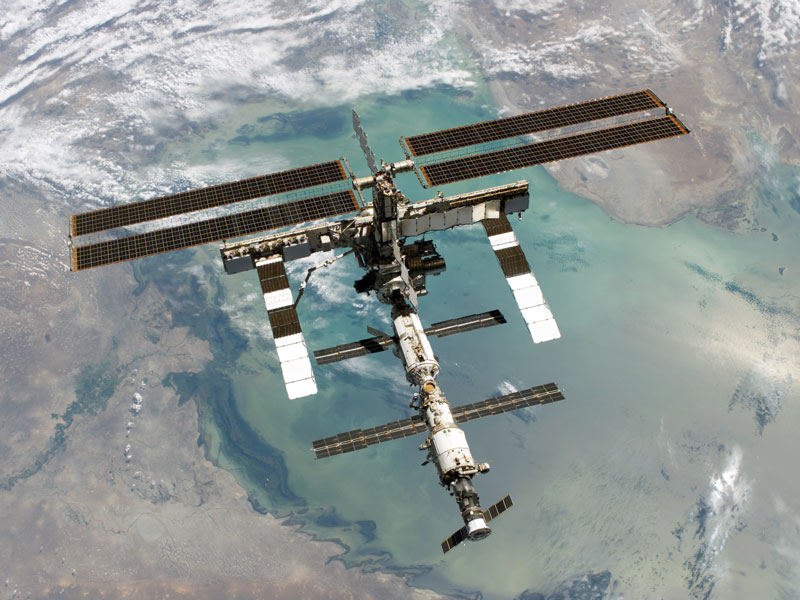
From the Astronomy Picture of the day comes this most beautiful photo of the International Space Station. The picture was taken by the crew os the shuttle Discovery as it pulled away. In the background is the Caspian Sea. You can see the modules, trusses, and huge solar arrays that provide electricity to the station.

Thursday, May 11, 2006

Black holes: See your dripping faucet

New Scientist has a brief article on studying black holes as a leaky faucet.

Thursday, May 04, 2006

Out of Commission

I am recovering from a biking accident now and will return to posting in a few weeks.

Please check back later.

Friday, April 28, 2006

Prevent Aids: Stay faithful, get circumcised (men only!)

Studies now show that the best way to prevent the spread of AIDS is to be faithful to one's partner. No secret there. If you're partner is uninfected and so are you, then you're safe. If one has lots of partners, well, he will likely have relations with an infected person.

Circumcision is a suprise though. Seems that current studies show that circumcised men reduce male to female transmission by 60%-75%. I read about a study in Africa on this very issue and the researchers were so astounded by this discovery that they stopped the study and told the uncircumcised men to get a circumcision. They felt that continuing the study put people at risk because the prevention was so much greater.

Some Physicists oppose the use of nuclear weapons

Various physicists and mathematicians oppose the use of nuclear weapons against Iran and they've written a letter for President Bush, see the link.

Unfortunately, these scientists misunderstand the nature of military planning. They intimate that nuclear weapons should not be an option and want the President to say so. That would be wrong. The President, and any military planner, cannot simply rule-out options and leave himself no alternative. It's impossible to predict what an adversary will do or not do. Because of that, any planner has to leave all options open for the "just in case" scenario. To close off options is to self-limit oneself and thereby give an adversary an advantage he would not have otherwise.

If these scientists did more work with the military I think they could appreciate more of how the military works, plans, and responds to world events. It's not simple and it's not easy.

Thursday, April 27, 2006

Factors in why we lie

I don't often cite psychology in my blog because, frankly, I don't read much about it. But this report summary struck a nerve. It discusses why people lie and that fact that we (the "royal we," See the movie The Big Lebowski) are more inclined to lie to co-workers or friends than to strangers.

"We found that consumer’s willingness to lie is related to not only a desire to protect their public selves, or the impressions they convey to others, but also [their] private selves, or their sense of self worth," explain Jennifer J. Argo (University of Alberta), Katherine White (University of Calgary), and Darren W. Dahl (University of British Columbia).

The first study to use social comparison theory to explain why and when we lie, the researchers argue that our willingness to lie is directly related to perceived threats to our self-esteem and self-image. People feel threatened by the possibility of being suckers and lie more readily when they overpaid for an item. However, people are less likely to lie if they know that a better deal is attainable, say, with a short-term gym membership.

"When public self image is threatened, individuals are often motivated to engage in impression management tactics such as lying," explain the authors.

Tuesday, April 25, 2006

Eye glasses that change with you

Science News reports on newly developed eye glasses that can change their focus electronically depending on what the wearer needs. Here's how the article describes the workings of these new glasses:

[T]he researchers created sandwiches of glass sheets separated by a fluid layer 5 micrometers thick. The filling consists of a transparent substance, a type of liquid crystal, that's made up of rod-shaped molecules suspended in a liquid. The team used precise computer-chip–manufacturing methods to apply a bull's-eye pattern of transparent electrodes to the inner surface of one of the glass sheets.

In response to voltages applied to those electrodes, the liquid-crystal rods rotate into new orientations, explains Guoqiang Li of the University of Arizona and a member of the development team. The rod orientation determines the speed at which light passes through the liquid-crystal layer. Light rays bend as they traverse the layer and so can become focused, much as they would when passing through an ordinary lens.

While the glasses look clunkly now, you can be sure that with futher development and work, the glasses will look better, perform better, and be useful.

Sunday, April 16, 2006

Designer Drink: Alcoholic without alcohol

It is now a thought experiment: How to design a molecule that acts on the brain as alcohol does, but, the molecule will not effect the human with sickness, nausea, headaches, or a hang-over? The molecule (or pill, really) will give the taker, that is, druggie (let's be honest) his craved high but without the nasty side effects.

New Scientist reports:

Alcohol exerts its effects on the brain mainly by latching onto signalling molecules called GABA-A receptors. There are dozens of subtypes of these, some of which are associated with specific effects of alcohol. Memory loss, for example, seems to occur because alcohol binds to a subtype in the hippocampus called alpha-5. Nutt [psychopharmacologist David Nutt of the University of Bristol in the UK] says it would be possible to design molecules that bind strongly to the good subtypes but more weakly to the bad ones.

In fact such "partial agonists" of GABA-A receptors already exist in the form of bretazenil and pagoclone, which were developed as anti-anxiety drugs but never commercialised. These molecules also have the advantage of being instantly reversible by the drug flumazenil, which is used as an antidote to overdoses of tranquillisers such as Valium. Alcohol also inhibits NMDA receptors, which are part of a general excitatory signalling circuit, so a second ingredient of the alcohol substitute would be an NMDA antagonist such as dizoclipine, originally developed as a drug for stroke.

So, now we have science, at the thought level to be sure, looking at how to develop designer drugs for alcohol replacement. Somehow this just strikes me to be a drug pusher's dream. We have LSD, heroin, pot, cocaine, and meth. Some natural, some not. Now, someone seeks to design an alcohol-effects-based drug. Alternatively, if such a drug would help alcoholics and others to avoid the problems associated with drinking, then maybe there is something here. Hard for me to tell.

Friday, April 07, 2006

New York Times Book Review: 'Programming the Universe,' by Seth Lloyd

From the review:
"Broadly speaking, entropy is the amount of disorder and information in a system. Take, for example, a fresh, unshuffled deck of cards. In that state it has low entropy and contains little information. Just two pieces of data (the hierarchy of suits and the relative ranks of the cards) tell you where to find every card in the deck without looking. Give it a good shuffle and look again. The deck has a lot of entropy and a lot of information. If you want to locate a particular card, you have to hunt through the entire deck. There is only one perfectly ordered state but about 1068 disordered ones, which is why you will never, ever accidentally shuffle the deck back into its original order."
This definition of entropy is one that we hear quite often. Entropy is the amount of disorder or randomness. What does that really mean? Frankly, I haven't a clue. What I do have is the belief that others do not have a clue either. They have equations and they speak with authority, but in the end, what does randomness mean?

The deck of cards for example: The only way one can say that a new deck of cards is ordered is if one knows what ordered cards are--- before you look the deck. If you think ordered cards are when the red and black suits alternate, then that arrangement would be an ordered deck. A new deck would not be ordered because the suits are grouped together. If, to continue, you counted in some other way than how we are taught to count, a different ordering of the cards would be, by definition, ordered.

In short, entropy as it is defined here, and this is how it is often defined, requires one to have outside information with which to measure "randomness." This information cannot come from the cards, it is external to the system. Thus, what one sees as order may not be order at all to someone else. Is entropy then dependent on the observer? Perhaps that's really what is happening, the observer computes the entropy but a different observer could compute a different entropy?

What I know for certain is that I don't know what random means, I don't know what ordered means and I certainly don't know what entropy means.

Perhaps you could help me out?

Thursday, April 06, 2006

Drugs trials gone bad, horribly bad

A catastrophic drug safety trial which left six healthy volunteers fighting for their lives was the result of “a powerful pharmacological effect of the product in humans”, the UK government agency charged with investigating the incident said on Wednesday.

The novel drug, called TGN1412, caused multiple organ failure in the six men injected with it at a Northwick Park Hospital, London, UK, on 13 March.

The severe patient reaction in the first human phase I safety trial of the drug was not due to a dosing error, product contamination or manufacturing problems, and the trial was conducted properly according to the agreed protocol, the Medicines and Healthcare products Regulatory Agency (MHRA) said, announcing its interim findings.

The “unprecedented reaction” to the drug was not seen in preclinical test animals at much higher doses, Kent Woods, chief executive officer of the MHRA told reporters. The drug, made by German pharmaceutical company TeGenero, was being tested as a potential treatment for certain autoimmune diseases and leukaemia.

“Even in hindsight, we can see no evidence of any such adverse reactions from the preclinical studies,” Woods said. “The doses given to the humans in the trial were diluted by 500 times – a substantially lower dose than that given to non-human primates, which didn’t show ill effects.”

Five of the six patients have been released from the hospital and the other person is, apparently, doing better. That's good news.

Here are some lessons:

  1. Drug trials are inherently dangerous. Don't let a physician tell you that the trial is safe because it's supervised. Yes, the trials are supervised but that doesn't make them safe. I have a friend at NIH (National Institutes of Health in Bethesda, MD, just outside of Washington, DC) and he says trials are better than safe. Why? Because the subjects are constantly monitored and watched by doctors all the time. That is not sufficient to guarantee safety.

  2. Next, lab tests are not enough. There were no problems like these complete organ shut-downs found with lab animals. While animal testing is a necessity, it alone is not enough. Human trials, despite these awful consequences still must be performed. Imagine if the drug were marketed to humans based solely on animal trials? While the problems here are severe, at least they were found before a public release. In that sense, these trials did what they should do: the trials found a fatal problem before the drug could hurt many people.

  3. Computer simulations are bunk. If these trials had such detrimental effects, and they did, and these effects were completely unforeseen, that tells you that computer simulations which are based on what scientists believe they know, are even more likely to fail. Sure, simulations help scientists to think about a problem. They can highlight problems and potential problems. But, even more than animal testing, they are critically limited. If animal tests are not sufficient, simulations are even less sufficient (if that's even possible).
What's clear here is that despite the risks, drug trials must be performed on a limited number of humans to proof safety. Humans are too complex, too unpredictable, for scientists to think they predict effects without trials. These trials, while exceptional, saved other people. Thank goodness we still do human testing.


What women want, what men should now get

This article from New Scientist says that as women grow in their earning power they seek mates that are more physically appealing rather than financially appealing. In the past women looked for men to be providers so that physical appeal was less important than the ability to make a living. Now that women make a very good living on their own, their preferences have changed.

WHAT do women want from a man? In the past, surveys have overwhelmingly shown that women want a rich man, and men want a good-looking woman. While not much has changed for men, as women's financial independence has increased, it seems that their preferences have changed.

Fhionna Moore and colleagues at the University of St Andrews, UK, analysed questionnaires from 1851 heterosexual women between the ages of 18 and 35. They found that as a woman's level of "resource control" increases - in other words as they become more financially independent - so does their preference for physical attractiveness in potential partners.

Women who had low levels of control over their cash rated the financial status of a man over his looks. Those with a decent source of income rated physical attractiveness more highly. The study will appear in Evolution and Human Behavior.

Frankly, this is all fine by me. (Prepare for social commentary, for what this is worth:)

First, men are often attracted to women for their physical appeal, so why shouldn't women be the same? More importantly, now that women do, in fact, earn so much, it's also time that men get from women what women have gotten from men. Namely, that men be permitted (that is, socially acceptable) to stay home and take care of the house without scorn and redicule from others. Let the woman support her husband; it doesn't have to be the other way around.

Next, should the relationship not work out, there should be great effort to have the woman pay for husband support so that alimony will go both ways depending on the earning power of each party. No longer will it be assumed that the man will pay. Finally, there should be equal rights in reproductive freedom. Why is it that a woman is the only party to decide the fate of an unborn baby? The father should be an equal part of that decision as well.

Wednesday, April 05, 2006

More astronomy pics

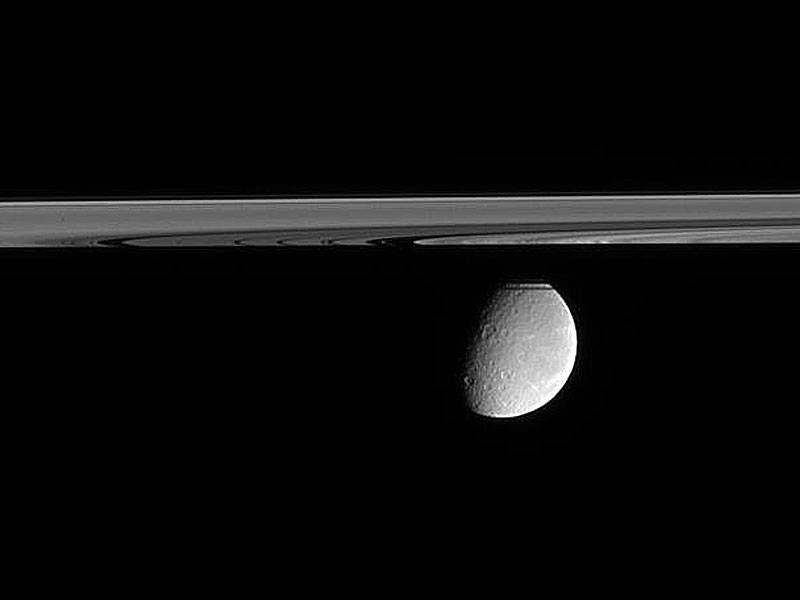
Once more, I still find the astronomy pictures of the day just amazing. Here is a moon of Saturn shown within the shadow of the rings.

Explanation: When orbiting Saturn, be sure to watch for breathtaking superpositions of moons, rings, and shadows. One such picturesque vista was visible recently to the robot Cassini spacecraft now orbiting Saturn. In late February, Cassini captured Rhea, the second largest moon of Saturn, while looking up from slightly beneath Saturn's expansive ring plane. Signature dark gaps are visible in the nearly edge-on rings. A shadow of Saturn's F ring cuts across the cratered ice-moon. Cassini is scheduled to continue sending back images from the orbit of Saturn until at least 2008.

Great fractals and animations


While surfing just a bit today, I stumbled upon this terrific site. It has many beautiful fractal images and even some animations.

The images are truly beautiful and show the complexity of fractals very well. I downloaded one animation and while it was fun to look at, it wasn't really worth the download time. Nonetheless, a few minutes looking over these images is lots of fun. Enjoy.

Monday, April 03, 2006

Grow your own bladder

Bladders engineered in the laboratory from patients' own cells and then implanted into the body have succeeded in their first clinical trial.

The feat was accomplished by Anthony Atala, at Wake Forest University Medical School in Winston-Salem, North Carolina, and his colleagues. He says that while scientists have had success with skin transplants grown on scaffolds in the past, this is the first time they have grown and transplanted a discrete, complex organ.

The success is the culmination of an idea that the team began exploring 16 years ago. Atala adds that they are also working on growing bio-engineered hearts and pancreases in the lab.


This is a fantastic discovery. The ability to grow even part of a needed organ is a tremendous step forward in medical care.

Many thanks to the researchers for all their great work.


Euclid's Fourteenth Book

When a famous mathematician has something new to say, the whole world pays attention.

Euclid's Elements, which presented the state of the art in geometry around 300 B.C., has been extraordinarily influential. This massive, 13-volume compendium set the standard for mathematical exposition and precise discourse for many centuries. More than 2,000 editions have been published, and new, interactive versions now appear on the World Wide Web.

What's more, there is compelling evidence that Euclid of Alexandria (c. 365–275 B.C.) had a fourteenth book in mind. Officials of the Avril Foundation for Old Occidental Languages have announced that, after a year devoted to authentication and analysis, they are prepared to release the text of a manuscript that appears to be a Latin translation of research notes jotted down by Euclid in preparation for writing a fourteenth volume of Elements.

Ivars Peterson goes on:

It's clear that Euclid was uncomfortable with the fifth and most complicated of the five postulates that begin Elements. This postulate states, "If a straight line falling on two straight lines makes the interior angles on the same side less than two right angles, the two straight lines, if produced indefinitely, meet on that side on which the angles are less than two right angles."

Euclid's newly discovered notes propose an alternative way of expressing this notion: "Through any given point can be drawn exactly one straight line parallel to a given straight line." Euclid went on to consider two other cases: In one case, no parallel line can be drawn through the point, and in the other case, more than one parallel line can be drawn. In these two situations, he says, the sum of the interior angles of a triangle is no longer exactly equal to two right angles.

On the surface of a sphere, for example, the sum of the angles of any triangle is greater than two right angles, Euclid notes. Such a geometry has no parallel lines, yet it obeys his first four postulates.

The manuscript hints that Euclid also explored the curious geometry that arises from the existence of multiple parallels. "I have discovered things so wonderful that I was astounded," he wrote at one point. "Out of nothing I have created a strange, new world." Unfortunately, much of this section of the manuscript has deteriorated beyond repair, so only a few tantalizing fragments remain.

Read the rest and then check the date.


Too little sleep: correlated with obesity and diabetes

Widespread sleep deprivation could partly explain the current epidemics of both obesity and diabetes, emerging data suggest.

Too little sleep may contribute to long-term health problems by changing the concentrations of hormones that control appetite, increasing food intake, and disrupting the biological clock, according to Eve Van Cauter of the University of Chicago.

Van Cauter and other researchers discussed possible links between sleep deprivation, expanding waistlines, and obesity-related problems this week in Washington, D.C., at a meeting titled A Scientific Workshop on Sleep Loss and Obesity: Interacting Epidemics.

The article goes on to explain that moderate amounts of sleep, about 8-hours, seems not to correlate with diabetes or obesity.

Each new study seems to say something, but it's never clear just which study one should believe. This one tells us to sleep about 8-hours a night. Seems right to me, but then I sleep about that now. Of course, my waistline isn't what it should be so maybe I should sleep more? Or, should I sleep less but use that "extra" time to exercise? Who can say?

Square Root of Two: A review

Doug Ensley and John Ensley wrote a cute review of the book The Square Root of 2: A Dialogue Concerning a Number and a Sequence where they adopted the style of the book and wrote in the form of a dialogue.


Unfortunately, the book sounds pretty dull and not worth the time. Still, if you have second to read the review, it's entertaining. Here's a sample:

What did you think of David Flannery’s book on the square root of two?

At first I thought, “Can there really be 250 pages of stuff to say about the square root of two?” I also thought it had a cool cover.

So you judged a book by its cover?

Yeah, I guess I did at first. I also wanted to find out how anyone could possibly write an entire book about the square root of two.

In all fairness, the book is more about some mathematics pertaining to the square root of two among other things. It is only as long as it is because of the playful informal dialogue used throughout the entire book.

Isn’t it kind of weird to write a math book in dialogue form? The boldface voice made me think of God on a mountain speaking from a burning chalkboard.

The dialogue form between Master and Pupil is a tradition that goes back to Greek writers like Plato.

I still thing it is weird to write in dialogue form, but I’ll admit that it does make the math pretty easy to understand.


Friday, March 31, 2006

The Sun: What a sight

I can't get enough of these:

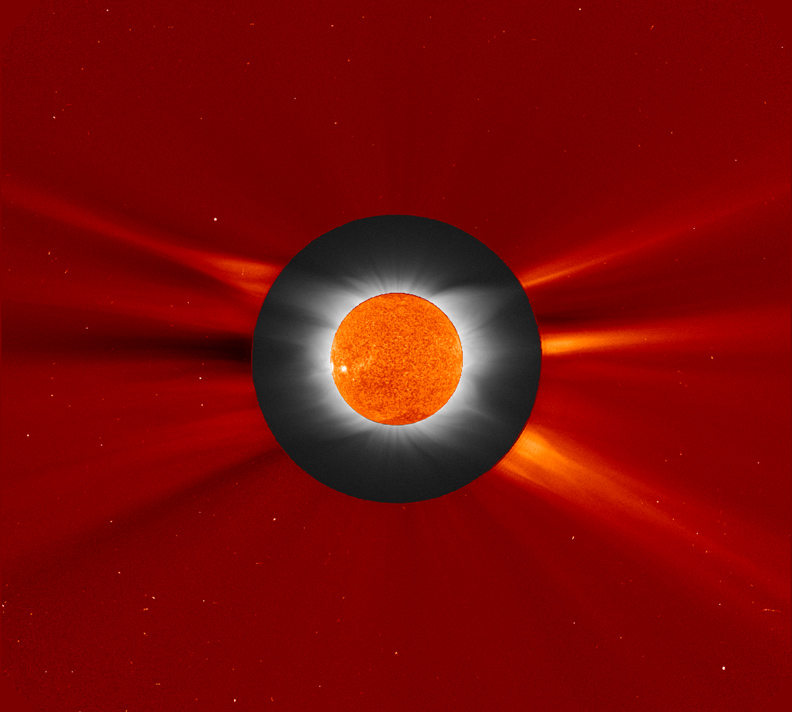
Explanation: Neither rain, nor snow, nor dark of night can keep the space-based SOlar Heliospheric Observatory (SOHO) from watching the Sun. In fact, from its vantage point 1.5 million kilometers sunward of planet Earth, SOHO's cameras can always monitor the Sun's outer atmosphere, or corona. But only during a total solar eclipse can earth-based observers see the lovely coronal streamers and structures - when the Moon briefly blocks the overwhelmingly bright solar surface. In this composite view, SOHO's uninterrupted view of the solar corona above the solar photosphere (center) and corona far beyond the Sun's disk, are shown in orange hues. The middle, donut-shaped region is the corona as recorded by the Williams College Eclipse Expedition to Kastelorizo Island, Greece during the March 29th total solar eclipse. Merging ground and space-based views allows astronomers to trace features in the corona that reach from just above the Sun's surface into the solar wind.

Thursday, March 30, 2006

Are you boring your friends?

There is now a device that lets users know if they are boring the people they're talking to.

A DEVICE that can pick up on people's emotions is being developed to help people with autism relate to those around them. It will alert its autistic user if the person they are talking to starts showing signs of getting bored or annoyed.

One of the problems facing people with autism is an inability to pick up on social cues. Failure to notice that they are boring or confusing their listeners can be particularly damaging, says Rana El Kaliouby of the Media Lab at the Massachusetts Institute of Technology. "It's sad because people then avoid having conversations with them."

While developed for people with autism, I have to believe that many folks I know could use this as well.

Seriously, the device is quite interesting in that in uses a tiny camera to recognize facial features in listeners. Score one more for technology!

Ask: Try it!

Walt Mossberg, in his column with the Wall Street Journal, writes:

[T]he overhaul has been far more than just marketing. Ads have been cut back to just three at the top and five at the bottom of each page, and they run on a colored background so you know they're not real search results. Instead of running ads down the right side of the page, as Google does, Ask uses that space to help the user refine search results.

In general, Ask's search-results pages are richer and better organized than typical Google results, and they give greater priority to content over ads.

Ask.com has its search engine, but it also has news, maps, weather, encyclopeida, blogs and other interesting things. Give it a try. You'll be surprised how good it is.

Wednesday, March 29, 2006

Editorial: Books today

I wish to take a moment to reflect on some of the books I see today. In particular, let me begin by asking: What is the purpose to a book? Is it to be read? Is it for reference? Is it for enjoyment?

I was reading The Road to Reality : A Complete Guide to the Laws of the Universe by Roger Penrose last night before going to sleep. Yes, I know, that's not usual bedtime reading but that's what I like, usually. This book tries to be all things to all readers. It has equations and claims to be a sole-source for the known physics of today. A kind of repository to nature's laws. That's fine, but Penrose goes about this by trying to write to the educated reader, one who has a substantial mathematics background.

He then tries to write to the layperson and to do that he explains the mundane. That is, if you know what a complex number is, for example, you certainly don't need him to explain it. If you don't know what a complex number is, well, I don't see how you can read the rest of the book, no matter how much you see that definition. Some minimal background is required to read a book that like this. Trying to please both types of audiences, and everyone in between I should add, simple makes the book unreadable.

What's more, the book is extremely thick: 1136 pages. That's over one-thousand pages bound in a single text! It weighs a few pounds---Amazon says the shipping weight is 3.4 pounds. What does this mean? It means that a person is hardpressed to hold the book and read the pages. The physical structure and weight of a single volume this big makes it impossible.

So, perhaps this book is a reference? Well, no, it's not that because it's clear not organized nor is it indexed to be a useful reference.

In short, the book fails to be much of anything other than a lot of some things but not enough of one thing to be good.

This sounds, and it is, a severe critique of what I am sure Penrose considers an impressive work. The problem is that it's not limited to his work. His book is but an example of a trend.

Nowadays I am seeing more and more books with similar problems. The books don't know who their audience is so they try to be all things to all people. That's a failure. More, books are getting to be extremely long, well in excess of 500-pages at a time. That makes them difficult to read, physically, as I noted above, and difficult to want to finish. You have to have substantial mental stamina simply to stay with the book.

And here's one more point, although Penrose's book does not do this: Books are getting very expensive. I found this book entitled: From Eudoxus to Einstein : A History of Mathematical Astronomy by C. M. Linton that was reviewed on the Mathematical Association of American website. (Here's the review.) The book looks great and I would love to buy it. It costs $79.00 at Amazon, even more if you pay full-price. That's pretty steep. When I look in the book (Thank You, Amazon, for that!) I see that book is good probably great but it's not worth the price.

So, what should be done? First, every author should decide to write books for a particular audience and once decided, leave it at that. If it's a popular book, then fine. If not, then make it a technical book worthy of an educated reader. Next, books are for reading so make them short, to the point, and easy to take with you. A book should be carried around, read at one's convenience. Somehow, I think authors can't help themselves and say much more than they should.
Heavens, if an author has a lot to say, make the book a multiple volume set.

Lastly, book prices should be set so that one can buy many different books and not spend so much money on a single copy to the detriment of buying other books. Would that be so hard?

Note to readers: Ordinarily I don't rant like this, but the trend with books is clear and it's not good. I hope authors and publishers will correc
t their course, and soon.

Astronomy: Pic of the day

From the site:

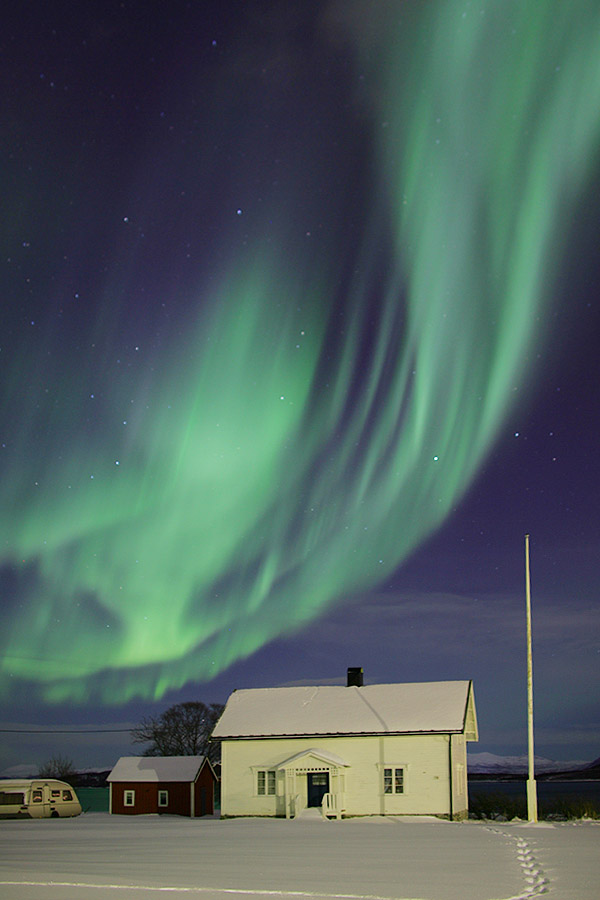
Green and Black Aurora Over Norway
Credit & Copyright: Frank Andreassen (nettfoto.no)

Explanation: What causes gaps between aurora curtains? These unusual gaps can make Research using data from four Cluster spacecraft orbiting the Earth has likely found the secret: auroral gaps, sometimes knows as black auroras, are actually anti-auroras. In normal auroras, electrons and/or predominantly negatively charged particles fall toward Earth along surfaces of constant magnetic field. They ionize the Earth's atmosphere on impact, causing the bright glows. In auroral gaps, however, negatively charged particles may be sucked out from the Earth's ionosphere along adjoining magnetic field lines. These dark anti-auroras can climb to over 20,000 kilometers and last for several minutes. Pictured above, a series of well-defined auroral gaps is seen dividing green aurora curtains high above Harstad, Norway, earlier this month.

This is another beautiful photo for your enjoyment.

Sunday, March 26, 2006

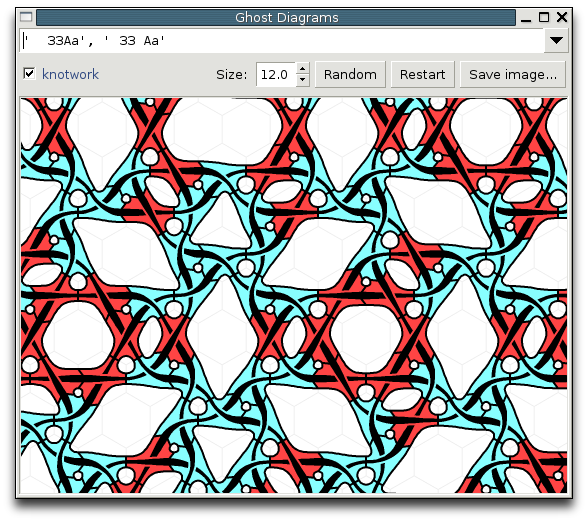
Ghost diagrams: Tilings of the plane

This site takes a given pattern and tries to find a way to tile the plane with that pattern. From the site itself:

Ghost Diagrams is a program that takes sets of tiles and tries to find patterns into which they may be formed. The patterns it finds when given randomly chosen tiles are often surprising.

It turns out that tiling patterns are a form of computation of equal power to Turing machines, lambda calculus, and cellular automata. For example, here is a tileset implementing "Rule 110", a cellular automaton known to be capable of universal computation. Considerations similar to the halting problem and Godel's theorem apply. There is no upper limit to their capacity to surprise us. Furthermore, tiles have an intuitive quality that other forms of computation lack. You can see how they fit together.

An organism is more than the sum of its organs. When the organs are fitted together, the organism becomes something more. This surprising something more we call "spirit" or "ghost". Ghost Diagrams finds the ghosts implicit in simple sets of tiles.


See this draft chapter from my thesis for further details and pretty pictures.

These are quite beautiful. Enjoy.

(Hat tip: Ilachina, a frequent and respected contributor.)

Friday, March 24, 2006

Astronomy photo of the day

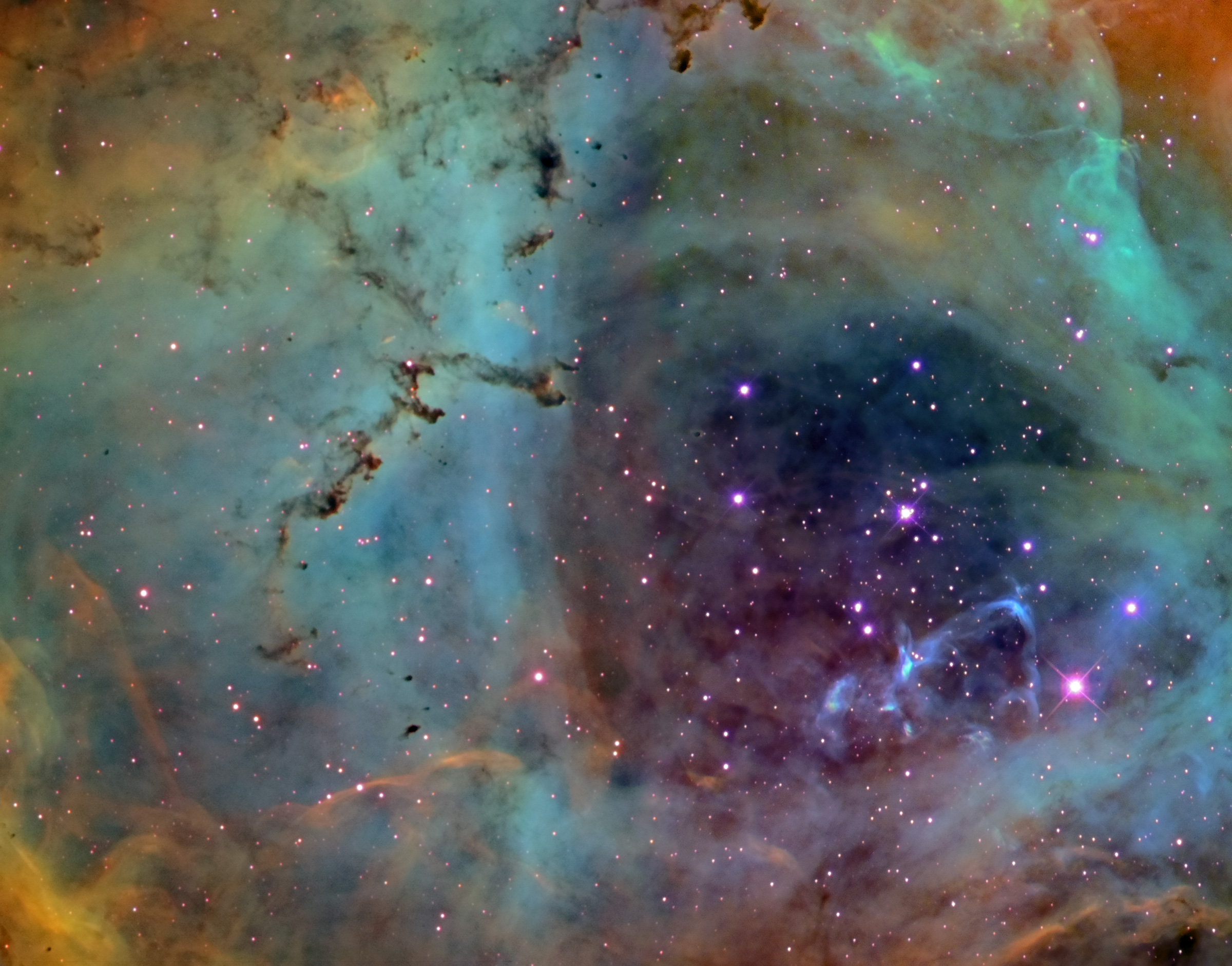
Explanation: Not all roses are red of course, but they can still be very pretty. Likewise, the beautiful Rosette Nebula and other star forming regions are often shown in astronomical images with a predominately red hue - in part because the dominant emission in the nebula is from hydrogen atoms. Hydrogen's strongest optical emission line, known as H-alpha, is in the red region of the spectrum, but the beauty of an emission nebula need not be appreciated in red light alone. Other atoms in the nebula are also excited by energetic starlight and produce narrow emission lines as well. In this gorgeous view of the Rosette's central regions, narrow band images are combined to show emission from sulfur atoms in red, hydrogen in blue, and oxygen in green. In fact, the scheme of mapping these narrow atomic emission lines into broader colors is adopted in many Hubble images of stellar nurseries. This image spans about 50 light-years in the constellation Monoceros, at the 3,000 light-year estimated distance of the Rosette Nebula.
These pictures are terrific and I like posting them. I don't plan to make this a daily posting, but for now they're worth looking at. Enjoy.

Thursday, March 23, 2006

Astronomy: Picture of the Day and caption


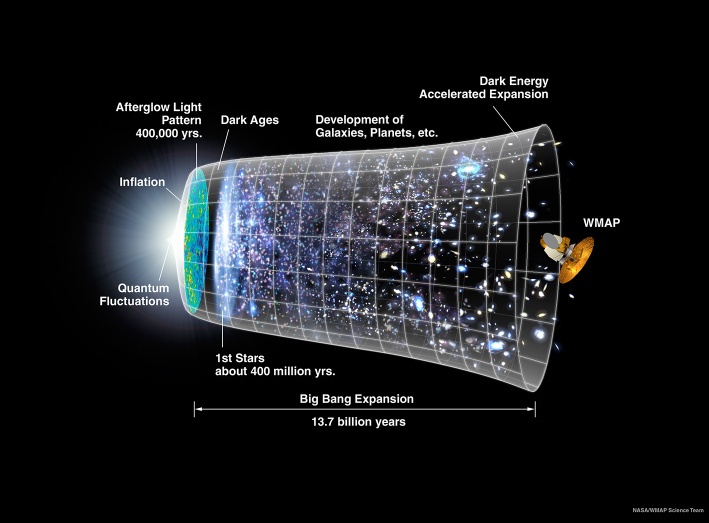
Explanation: The Universe is expanding gradually now. But its initial expansion was almost impossibly rapid as it likely grew from quantum scale fluctuations in a trillionth of a second. In fact, this cosmological scenario, known as Inflation, is now reported to be further quantified by an analysis of three years of data from the WMAP spacecraft. WMAP's instruments detect the cosmic microwave background radiation - the afterglow light from the early Universe. WMAP's amazing success in exploring the first trillionth of a second and favoring specific inflationary scenarios lies in its ability to make unprecedented, precise measurements of the properties of the microwave background. The subtle properties are distilled from conditions in the early Universe and related to its first moments of existence. Schematically, this diagram traces the 13.7 billion year (plus a trillionth of a second ...) history of the Universe from the quantum scale to the formation of stars, galaxies, planets, and WMAP.

I got this link today from Andy Ilachinski, who has a blog on photography that I recommend. Here's what Andy, a physicist, had to say:
It's that *last* part that's interesting to me. I've always been mistyfied by assertions regarding cosmic events using "human-scaled macroscopic" (intuitive) variables/labels such as "time". In this case, since it is the expansion of the entire *universe*, i.e., the entire space-time edifice! exactly what is the reference frame in which this
"trillionth of a second" has any meaning? If its the "conventional" one,

(a) there is *no* universal frame (that's the essence of Einstein's
great insight: no GLOBAL time), and

(b) even if there *were* a global reference frame, the only thing that could be is a component of the rapidly expanding space-tiome continuum...a parameter that is doing the expanding is being used to qualify the expansion?

So, exactly how can we understand in our own minds the idea of the entire universe at this microscopic (whatever that means?) scales. I don't understand it one bit. If you do, please help me out.

Wednesday, March 22, 2006

Catching photons for space communications

MIT scientists say they can catch individual photons to make space communications quicker and better. The link here didn't provide many details but it looks rather interesting.

Monday, March 20, 2006

Complexity: Will it ever amount to anything?

Here's a paper that says complexity research and work will never go very far.

Complexity research will never become a single, encompassing theory-of-everything, or an independent discipline. It will thrive at the border between disciplines and in particular by interacting with engineering (thus approaching the 'science of the artificial' that Herbert Simon was promoting) and it will surely create several seed technologies.
The authors say that we may see applications come from it, and if we do, now is that time. It will only exist along the boundaries of various disciplines:


I think the authors are too pessimistic. Complexity has been around a while, that's true. Has it delivered on its promises? Probably not. But then, the promises were too grand. (Nowadays, to get any funding the promises are always grand and overblown. It's the times we live in.)

Complexity is a new idea that still needs work. What's more, it's a new idea that needs development of the a mathematical framework so that it can be studied. The idea of studying local rules that create emergent behavior is so new that we don't have the mathematics to explain it. That's where complexity needs to go: to math and from there to applications.

Friday, March 17, 2006

Chemistry at Columbia University: Irreproducible results

A Columbia University chemistry professor has retracted two papers and part of a third published in a leading journal after experiments performed by a graduate student could not be reproduced.

The senior author of all three papers, which were published in 2004 and 2005 in The Journal of the American Chemical Society, was Prof. Dalibor Sames; the graduate student, listed as an author on each, was Bengu Sezen, who left the university after getting her doctorate last year.

The article goes on to explain that because other scientists tried to reproduce the results and couldn't, this is an example of science correcting itself.

I've written about this before and used the stem cell faked data "from South Korean stem-cell researcher Hwang Woo Suk" as an example. When scientists go about their work, and part of that is trying to reproduce the results of others, they provide perfect checks and balances to one another. it's a good system, but it's not good enough.

What's disappointing here is the graduate student probably faked her work and got (not earned!) her degree, a Ph. D., no less. The university needs to do a full investigation and if these results were faked (not just wrong, but deliberately falsified) to rescind her degree. If not, what message does this send to other would-be liars? Well, just fake it, no one will find out, at least not until it's too late. And, then so what? You already have your degree and can go on anyway.

Next, the school should discipline the faculty advisor. After all, it's the advisor's responsibility to supervise and review all the work of the graduate student. He or she has the authority to approve or disapprove what goes on in his or her lab. If faulty work goes out, it is the advisor who is ultimately responsible. Yes, advisors are busy. Sure, they can be duped. They are vulnerable to self-duping, because they have a vested interest in seeing work published. Their name is part of the work and they garner credit for tenure and promotion with each publication. Moreover, they obtain funding based on past work. Considered together, that's all the more reason that the advisor has responsibility.

Finally, the school itself is cast in a bad light. It would do Columbia well to investigate this cheating further, discipline each participant properly, and enact rules and policies so that it doesn't happen again.

Chemistry at Columbia University: Unreproducible results

A Columbia University chemistry professor has retracted two papers and part of a third published in a leading journal after experiments performed by a graduate student could not be reproduced.

The senior author of all three papers, which were published in 2004 and 2005 in The Journal of the American Chemical Society, was Prof. Dalibor Sames; the graduate student, listed as an author on each, was Bengu Sezen, who left the university after getting her doctorate last year.

The article goes on to explain that because other scientists tried to reproduce the results and couldn't this is an example of science correcting itself.

I've written about this before and used the stem cell faked data "from South Korean stem-cell researcher Hwang Woo Suk" as an example. When scientist go about their work, and part of that is trying to reproduce the results of others, they provide perfect checks and balances to one another. it's a good system, but it's not good enough.

What's disappointing here is the graduate student probably faked her work and got (not earned!) her degree, a Ph. D., no less. The university needs to do a full investigation and if these results were faked (not just wrong, but deliberately falsified) to rescind her degree. If not, what message does this send to other would-be liars? Well, just fake it, no one will find out, at least not until it's too late. And, then so what? You already have your degree and can go on anyway.

Next, the school should discipline the faculty advisor. Afterall, it's the advisor's responsibility to supervise and review all the work of the graduate student. He or she has the authority to approve or disapprove what goes on in his or her lab. If faulty work goes out, it is the advisor who is ultimately responsible. Yes, advisors are busy. Sure, they can be duped. They are vulnerable to self-duping, because they have a vested interest in seeing work published. Their name is part of the work and they garner credit for tenure and promotion with each publication. Moreover, they obtain funding based on past work. Considered together, that's all the more reason that the advisor has responsiblitly.

Finally, the school itself is cast in a bad light. It would do Columbia well to investigate this cheating futher, discipline each participant properly, and enact rules and policies so that it doesn't happen again.


Wednesday, March 15, 2006

Mathworld goes Wikipiedia

When looking for some more links on billiards in math, I came across this entry. What's interesting is that the topic is one I like. But more than that is that the page asks for the reader to add to it.

This makes mathworld look like Wikipedia which is something I didn't know before.

Tuesday, March 14, 2006

Computer model of a virus


Researchers announced on Tuesday that they created a computer simulation of a virus, claiming to have built the first complete model of any entire life-form.

Although the notion of a “computer virus” usually conjures up concerns about data security, the scientists say their development will contribute to improvements in public health as well as the development of technologies such as artificial nanomachines.

Details of the work by crystallographers at the University of California at Irvine and computational biologists at the University of Illinois at Urbana-Champaign will be published in the March issue of the science journal Structure.


This is pretty darn cool. A virus modeled with a computer simulation. I look forward to reading more about it.

Planet Mars Odyssey Mission

More maps and images of mars. Worth time exploring.

Quantum Mechanics and New Age Nonsense

The New York Times has a good essay about the misuse and misapplication of quantum mechanics to new age thought. The essay is about movies:
These films and the quantum mysticism industry behind them raise a disturbing question about the muddled intersection between science and culture. Do we have to indulge in bad physics to feel good?
And then:

When I first heard that Marlee Matlin had made a movie about quantum theory, I was excited. (Total disclosure: Ms. Matlin once bought an option on the film rights to an essay of mine about Albert Einstein and his wife.) What could be more deserving of wide-screen cinematic treatment than the weirdness and mystery of the laws that sculpture our space-time adventures?

But hours and hours spent watching the two films and navigating their splashy Web site have tempered my enthusiasm. These films and the quantum mysticism industry behind them raise a disturbing question about the muddled intersection between science and culture. Do we have to indulge in bad physics to feel good?

The essay goes on to tell how physicists have abandoned Wigner's idea that quantum mechanics relates to consciousness and have gone on to other studies. Yet, bad physics continues.

Read the entire essay.

Visit Mars Via Google


Google has maps (well, sort of) of the red planet Mars. Take a peek.

Monday, March 13, 2006

Sun activity: Get ready for it


Sun spot activity is set to increase from what is now a low point. This article from Science News indicates that one model predicts this flurry of activity to be in 2008, a year later than originally thought. Other models predict the activity to begin sooner than that.

Even at its quietest, the sun about once a week belches out a billion-ton cloud of charged particles and magnetic fields. When those eruptions are directed toward Earth, they can irradiate astronauts, disable satellites, and knock out power grids on the planet.
No matter when it comes, you can expect troubles with communications, and other earthly activities.

Friday, March 10, 2006

Exams: How to pass them and a peek at what's wrong with scientists

The scientists, from Washington University in St Louis, found that students understood and retained information more readily when subjected to frequent tests and quizzes while studying than students who simply read material over and over again.

"Our study indicates that testing can be used as a powerful means for improving learning, not just assessing it," said Prof Henry Roediger of the university's psychology department.

So, it's the year 2006 and scientists are just getting around to studying how to teach? I thought teachers knew this already and when I was in school, I had lots of short quizes and then tests and exams. I even remember an algebra class that started everyday with a 5-minute quiz.

When scientist are doing this type of work, and this is how it's reported, I can see why the public at large doesn't support much of what scientists do. It gives the rest of us a bad reputation. Sorry to say that, but it's true.

(Tip: Best of the Web OpinionJournal)

Thursday, March 09, 2006

Predictive models: How well do they work?

"Prediction is very hard, especially about the future." -Dirac
From the Wall Street Journal, the Numbers Guy:
Ahead of the Oscars, an economics professor, at the request of Weekend Journal, processed data about this year's films nominated for best picture through his statistical model and predicted with 97.4% certainty that "Brokeback Mountain" would win. Oops. Last year, the professor tuned his model until it correctly predicted 18 of the previous 20 best-picture awards; then it predicted that "The Aviator" would win; "Million Dollar Baby" won instead. Sometimes models tuned to prior results don't have great predictive powers.
As I read to the end of the column, this extra bit was there.

There is always lots of discussion among decisionmakers of models and whether models that represent given data can be used to predict future events. Usually, like this paragraph finds, the models can't.

The underlying problem with most models is that we (scientists, that is) don't know the underlying physical processes and mathematical equations that govern events. If we know what they are, then we can (usually!) do a good job representing the phenomena that lead to the events we want to predict. Often, though, we simply don't know what the correct model is. So, we pick something we like, and that's usually driven by personal prejudice.

Few scientists admit to that prejudice, but it's there nonetheless. Ask a chaologist about models and he'll tell you why a chaotic model is best and how the world is governed by non-linear equations. Ask a cellular automatist and he'll extol the virtues of cellular automata as capturing the very thoughts of God exactly and therefore the perfect model of any of God's creations.

These models all have their place, it's just that place is usually not one for prediction.

Here's another example from MATLAB. It's part of their demo for the software.

This figure is a curve fit (cubic, that is, a third power polynomial) to census data from 1900 to 1990.

The predicted value for 2000 is 280 million people. A cubic does a pretty good job of fitting the data. A higher order polynomial would fit the data even better.


This plot is what happens for an 8th-order polynomial fit. It fits the given data well, only it "predicts" the population for the year 2000 at -70 million. That's negative 70 million.

Need I say more?

Executives and their mathematical statements

From the Numbers Guy at the Wall Street Journal Online:
Google Inc. reads, indexes and searches through billions of Web pages. On any given day, eBay Inc.'s more than 100 million members are listing millions of items for sale. Yet when it comes to the law of large numbers, executives at both tech powerhouses have committed statistical misdemeanors.

The law of large numbers says that the more times you measure something, the truer your results, and less they are affected by random variation. Flip a coin a million times, and you're likely to get heads half of the time (or very close to it). But flip that coin five times, and you might get heads four times, twice, or never.

But in corporate-speak, the "law of large numbers" has been misused as a catch-all explanation for slowing growth as companies mature: It's harder to maintain high growth rates from a larger base. Last week, Google finance chief George Reyes told a Merrill Lynch & Co. investor conference that the company is "getting to a point where the law of large numbers starts to take root." (The Online Journal's MarketBeat column pointed out that Mr. Reyes meant the law of diminishing returns.) And in a January appearance on CNBC, eBay chief executive Meg Whitman said, "Now, our businesses are getting larger and we will obviously face the law of large numbers, but we have actually changed the trajectory of the growth curve in our two largest businesses over the last three quarters." (She used the term correctly in a 1999 appearance on CNBC.) Several other executives have misused the term.

Misstating a statistics law isn't a federal offense, and lots of analysts make the same mistake when posing questions about disappointing earnings, in effect providing companies with an excuse for slow growth (reporters, including those at The Wall Street Journal, have also used the term incorrectly).

An eBay spokesman told me the term is "common corporate vernacular." Google declined to comment.

I found this part of his weekly column worth repeating, so I am.

The column, by the way, is only available via an on-line subscription and the column is not printed in the paper version of the Wall Street Journal. Carl Bialik's (the author) comment are always on point, well written and provide ever more evidence of how we, (the royal "we") often misuse numbers in our daily lives.


Water on Saturn's moon Enceladus


LOS ANGELES - The Cassini spacecraft has found evidence of liquid water spewing from geysers on one of Saturn's icy moons, raising the tantalizing possibility that the celestial object harbors life.

The surprising discovery excited some scientists, who say the Saturn moon, Enceladus, should be added to the short list of places within the solar system most likely to have extraterrestrial life.

Recent high-resolution images snapped by the orbiting Cassini confirmed the eruption of icy jets and giant water vapor plumes from geysers resembling frozen Old Faithfuls at Enceladus' south pole.

"We have the smoking gun" that proves the existence of water, said Carolyn Porco, a Cassini imaging scientist from the Space Science Institute in Boulder, Colo.

If Enceladus does harbor life, it probably consists of microbes or other primitive organisms capable of living in extreme conditions, scientists say.

The findings were published in Friday's issue of the journal Science.


This could be the start of finding life on a planet other than earth. Exciting news.

(Tip: Ilachina)

Wednesday, March 08, 2006

LyX Document Processor


A friend of mine recommended LyX document processor for writing. He told me that this allows you to simply write and it will worry about formatting what you write. It's compatible, and uses, LaTeX which is a good thing. I am playing with it tonight, in fact, and playing with another super program, EINSTein, but that's for another post.

Tuesday, March 07, 2006

Extr-terrestial cells: They're here


Here's an exciting article about red cells over India. The cells, if we may use that term loosely, fell from the sky and could be the result of a meteor. Under an optical microscope they appear like biological cells yet they do not contain DNA.

What are these mysterious particles? Beats me, but the paper and articles are interesting to read.

Here is the scientist who discovered this and here is a paper he wrote.


(Hat tip: Ilachina)

Sunday, March 05, 2006

Science news: Omega and the limits of mathematics


Gregory Chaitin is getting more attention on his idea the algorithmic complexity can be used to show the limits of mathematics.

I don't have time just now to comment, but I plan to do so soon. I find something wrong with his thinking and while I can't articulate it yet, I think there's something odd going on.

Thursday, March 02, 2006

Patents for the Absurd

I ran across this site when I was doing a web search on radar. Take a minute to browse the patent abstracts and see what silliness the patent office gives patents to. It'll surprise you.

Here's one example:

Doggie poop freeze wand, Patent number 6883462

The invention discloses a device and vehicle for decomposition and discard of animal waste. It's an elongated hollow tubular housing made of aluminum or PVC, a detachable cylinder filled with a compressed freezing chemical or refrigerant, or compressed liquid enzymes, which is inserted into the hollow housing, an operation button exposed for use, empty space at the handle end for the placement of plastic trash bags, and a threaded top on the end of the housing encapsulating the empty space. The decomposition device is aimed at the animal waste to be removed, and the operation button is pressed, which in turn manipulates the pressurized freezing chemical or enzymes, forcing the contents out of the opposite end, to freeze or breakdown the animal waste, dependent upon the choice of cylinder.

Wednesday, March 01, 2006

Heavy Drinker: How you can tell

I thought this was a joke, and it really was meant to be. From the Mini-AIR, Journal of Improbable Results newsletter:

2006-03-14 MAY WE RECOMMEND: Tipple, Hatch, and Court

MATHEMATICS OF INSTABILITY
"An Improved Method for Predicting Which Heavy Drinkers Become
Intoxicated," Ernest L. Abel and Michael Kruger, Psychological
Reports, vol. 94 , no 3, 2004, pp. 1343-8.

Here is the abstract for this article:

Not all heavy drinkers become intoxicated. We sought to improve predictability of intoxication of heavy drinkers. Based on criteria for heavy drinking in the National Household Survey on Drug Abuse (NHSDA), we identified characteristics related to heavy drinking. We then created a dichotomous heavy drinker typology variable (yes/no) and determined how well we were able to identify drinkers who be- came intoxicated at least twice a month. Of those who fit this heavy drinking profile, 54% drank regularly to the point of intoxication, the same percent as those who become intoxicated in the self-reported heavy drinking group. However, 77% of those who fit both the profile and were self-described heavy drinkers, drank regularly to intoxication. We concluded that a demographic typology combined with self-reported drinking improves predictability of intoxication in heavy drinkers, and is a promising direction for research.
So, here you have it: Ask a drunk if he's a drunk and that'll improve the chances that you can identify him as a drunk. Wow! Someone wrote a paper to tell you that.