Powered By Blogger

Friday, August 10, 2007

Is this real?

My last post was about image editing. So, I went to the Astronomy Picture of the Day for a real image. Alas, it's not, from their caption:

Colors in the gorgeous image were picked to emphasize light emitted by specific elements in the nebula excited by the energetic starlight.

So, what picture does capture reality?

Pictures: From Graphics to outright lies

Here's an image that we start with.

I have a dear friend whose hobby is photography. He doesn't just take photos though because he's an artist. So, he takes pictures, digital pictures, and then he processes them to make beautiful prints. You can see some here. What's interesting is that the pictures you see are not what the scene showed but rather the pictures are what he wants you to see. They are art, and as art, they are gorgeous and well worth having. I proudly display many of these works in my office.

But they are not a capture of reality. (It is interesting to ask just what is a capture of reality and how do you know it. That's a post for another time.)

Now two scientists have devised an automated algorithm that allows you to easily remove, edit, and change your digital pictures to take out what you don't like and replace with something that will fill-in the picture realistically. This is letting a computer effectively edit out reality from your pictures.

Digital photographers could soon be able to erase unwanted elements in photos by using tools that scan for similar images in online libraries.

Research teams have developed an algorithm that uses sites like Flickr to help discover light sources, camera position and composition in a photo.

Using this data the tools then search for objects, such as landscapes or cars, that match the original.

The teams aim to create image libraries that anyone can use to edit snaps.

In the past you could edit pictures, use Photoshop and change what you liked and didn't like. Now, it is automated (well, almost) so that soon you won't have to work at making phony images. Phony images are fine, of course, we are free to change them as we like. But to have the process automated, well, that just seems like making it all the more easy to distort reality.

This is the same image with the roof removed and phony boats inserted. A beautiful graphic but not a photo of the actual scene.

From dust to dust..

The Bible tells us that man goes from dust to dust. How fitting then that we should find the following:
Life on earth is organic. It is composed of organic molecules, which are simply the compounds of carbon, excluding carbonates and carbon dioxide. The idea that particles of inorganic dust may take on a life of their own is nothing short of alien, going beyond the silicon-based life forms favoured by some science fiction stories.

Now, an international team has discovered that under the right conditions, particles of inorganic dust can become organised into helical structures. These structures can then interact with each other in ways that are usually associated with organic compounds and life itself.

So, while we think of life as special, we are no more special than dust, or helically-shaped molecules.

Until now, physicists assumed that there could be little organisation in such a cloud of particles. However, Tsytovich and his colleagues demonstrated, using a computer model of molecular dynamics, that particles in a plasma can undergo self-organization as electronic charges become separated and the plasma becomes polarized. This effect results in microscopic strands of solid particles that twist into corkscrew shapes, or helical structures. These helical strands are themselves electronically charged and are attracted to each other.

Quite bizarrely, not only do these helical strands interact in a counterintuitive way in which like can attract like, but they also undergo changes that are normally associated with biological molecules, such as DNA and proteins, say the researchers. They can, for instance, divide, or bifurcate, to form two copies of the original structure. These new structures can also interact to induce changes in their neighbours and they can even evolve into yet more structures as less stable ones break down, leaving behind only the fittest structures in the plasma.

So, could helical clusters formed from interstellar dust be somehow alive? "These complex, self-organized plasma structures exhibit all the necessary properties to qualify them as candidates for inorganic living matter," says Tsytovich, "they are autonomous, they reproduce and they evolve".

Call it in, but the Bible had it first. (Hattip: ilachina)

Friday, July 27, 2007

Google Earth Image: A Plane in Flight


While working this morning with Google Earth, I came across this image. It's just outside of Chicago's O'Hare airport, by the way.

At first glance I thought I was looking an airport, then I realized there weren't any runways nearby. So I asked myself, how did the airplane get there? I then realized that the images are from satellites, of course!, so the plane you see is actually in flight.

Pretty cool, eh?

(The white line is for work; it's not part of the image itself.)

Friday, July 20, 2007

NSF: U.S.A. shows slow growth in technical articles published

The United States is not increasing the number of research articles (science and engineering) it publishes. We still produce more than any other country but our rate of growth is level while other countries are producing papers at an accelerated rate.

A new National Science Foundation (NSF) report finds the number of U.S. science and engineering (S&E) articles in major peer-reviewed journals flattened in the 1990s, after more than two decades of growth, but U.S. influence in world science and technology remains strong.

The report, Changing U.S. Output of Scientific Articles: 1988 - 2003, finds changes occurred despite continued increases in funding and personnel for research and development. Flattening occurred in nearly all U.S. research disciplines and types of institutions.

In contrast, emerging Asian nations had large increases in publication numbers, reflecting their growing expertise in science and technology. European Union totals also went up.

This is not a surprise to anyone who even glances at the literature today. Check out arXiv.org and you'll see more and more preprints from outside the Unites States. True, many of these are from the states but more and more are not.

Still, the NSF finds some positive news:

"In addition to numbers published, one should look at another very important indicator -- article quality," said Derek Hill, senior analyst and a coauthor of the report. "The more often an article is cited by other publications, the higher quality it's believed to have. While citation is not a perfect indicator, U.S. publications are more highly cited than those from other countries."

In raw numbers, the United States continues to publish far more articles than any other country and remains a major force in world S&E. However its overall share of published articles has declined while other nations produce more.

And how are other nations doing in publishing?

Four Asian societies--China, Singapore, South Korea, and Taiwan--out-distanced all others in the world between 1992 and 2003 with an average annual growth rate of 15.9 percent in publications.

According to the report, Japan's article output rose at an average annual rate of 3.1 percent, five times faster than the United States.

The European Union, which passed the U.S. several years ago in total numbers of articles published, posted an average annual growth rate of 2.8 percent during the same period, more than four times faster than the United States.

It's no secret that the U.S. is ahead now in total numbers but we will not stay there for long. Witness, for example, who is doing basic research in physics ---the Europeans at CERN while our basic research stalls.

The truth is that it's very difficult to get funding for research in industry today. It's tough to get funding at universities, too. And do you know what else? When you get funding there is little support to publish. In fact, the trend is not to publish so as not to tell others (competitors) what you are doing.

I am now writing a paper on some of my work and the one thing that comes out is: tell enough to get the idea across but not so much that others can reproduce what I've done. For a company, that makes sense because, after all, the company is in business to make money. If the company tells others how to do what we now do, well, it won't be long before our market share dwindles to little. However, this trend is now true at universities where professors and administrators seek to patent and sell research. It didn't used to be that way: professors sought to publish whatever they did, sometimes even publishing junk. Today, schools want to profit so publishing is not as important as it used to be.

I fear that in the near future our lack of scholarly discourse, of which publications are central, will mark a steady decline in our scientific progress. (While I'm on this topic, let me state one more indicator. The U.S. is losing promising scientists because we do not seek to employ them when they graduate. So they return to their native countries and contribute there instead of here. In essence we give them an education that they take back and then compete with us. Is that bad? I don't know.)




Interesting physics experiments in the offing

University of Washington physicist (and science-fiction author) John Cramer is moving forward with his experiment in backward causality, thanks in part to tens of thousands of dollars in contributions sent in by his fans. Although Cramer emphasizes that his lab is looking at “nonlocal quantum communication” rather than backward time travel per se, the gadgetry he’s assembling could settle a controversy surrounding a seemingly faster-than-light effect that Albert Einstein thought was downright spooky.

Boiled down to its basics, the experiment involves splitting laser light into two beams, so that characteristics of one beam are reflected in the other beam as well. That's an example of what physicists call quantum entanglement. Specifically, Cramer has been planning to fiddle with one of the entangled laser beams such that it takes on the property of waves or particles. If one beam behaves like particles, the entangled photons of light in the other beam should behave like particles, too.

I can't do better than the author of this link, so go here to read it all.

Thursday, July 19, 2007

Sex in your sleep

I stumbled upon this while looking at space.com for when the planet Mars will be visible in August. It's somewhat interesting, though.

If you think it’s impossible to have sex while you sleep, think again, according to a new study.

There are at least 11 different sex-related sleep disorders, collectively referred to as “sexsomnia” or “sleepsex,” that affect people who are otherwise psychologically healthy—causing them to unknowingly engage in various sexual activities during the night.

Carlos Schenck, a psychiatrist at the Minnesota Regional Sleep Disorders Center, and his colleagues have studied a number of behavioral disorders associated with sleep.

“Any basic instinct can come out in the context of sleep,” Schenck told LiveScience. “All sorts of things can happen.”


So, be careful when you're sleeping, as if that's possible. But, if your roommate tells you something weird about yourself, it just may be true.

A WOW video

I got this link from a good friend in an email today. I didn't think much about it, but I started to watch, and I have to say, it's simply fantastic. You'll see a scale model of the B-29 bomber with an X-1 rocket. The B-29 takes off with the X-1 on its belly. The B-29 then flies up and releases the X-1. The rocket flies on its own, and even goes to an accelerated flight. Then the rocket safely lands and you see the B-29 flying. Watch for the flat spin, it's about half-way through, and then you'll see the rest of the flight.

It is truly fun to watch and when you think of the work it took to make these remote control airplanes, and that they work together, well, that's just fantastic. Here's what my friend said:

This aircraft runs on four chainsaw motors. You can just imagine how much time, effort, skill and money these guys have put into this thing.
Here's the link:

http://users.skynet.be/fa926657/files/B29.wmv

Tuesday, July 17, 2007

Simple yet inexplicable illusions and unknowns


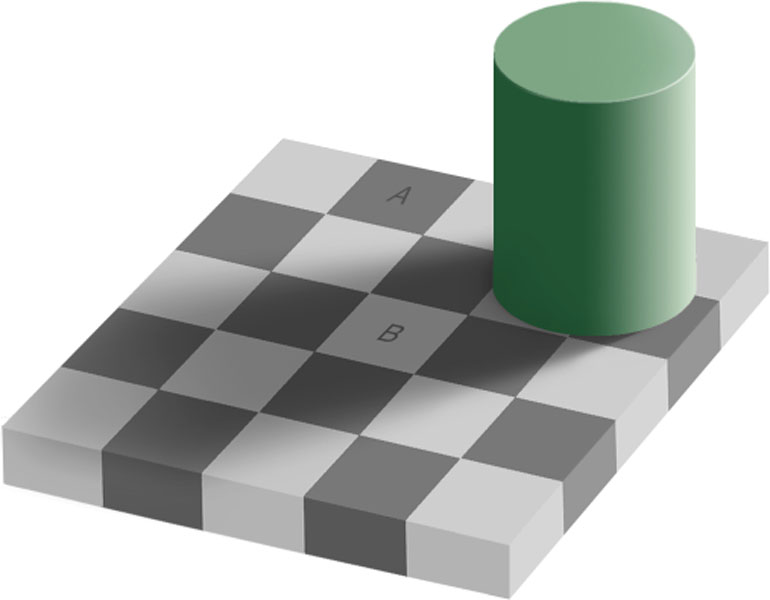
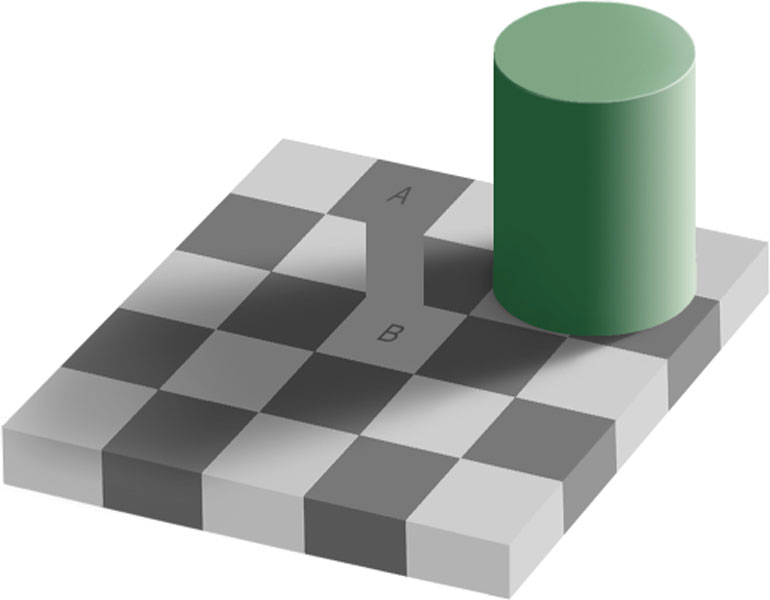
The Astronomy Picture of the Day today is not about astronomy, per se, but rather about illusions. The image above is fairly common. You see the checkerboard pattern but are squares A and B the same color? They look different to me. Then you see the picture below.

The squares are connected so that instead of looking like different colors, they look close to identical. (I still see square A as darker than square B but maybe that's my age showing.)

No one knows why people see the squares as different colors, but we do.

The site also has a link that, with a few clicks, takes you to this picture.


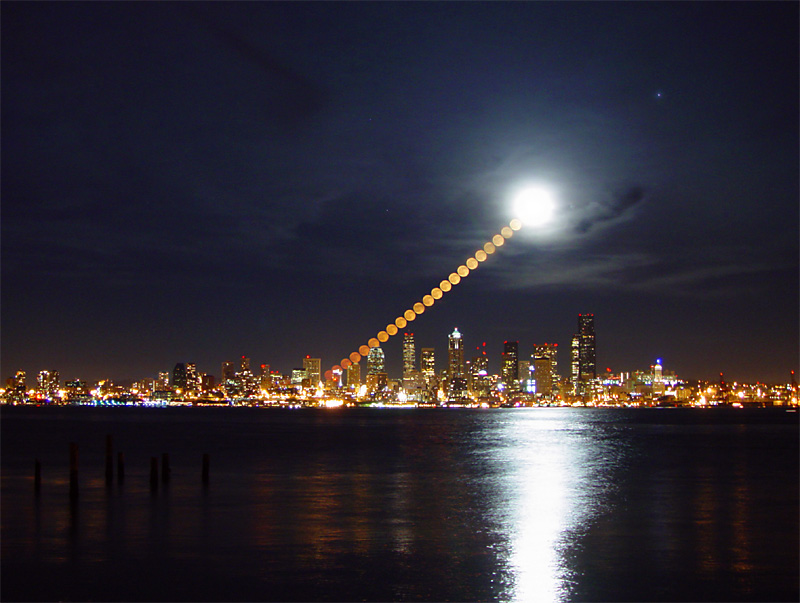
Ever notice that when the moon is near the horizon it looks much bigger than it does high in the sky? I've seen it may times, low to the horizon, and my wife calls that a "harvest moon," although that's not really right. In any case, the moon does seem much larger when it is near the horizon than when it's high. In truth, the moon always has an angular diameter of about 0.5-degree, so it's not any bigger when it is low than when it's high.

No one knows why we see the moon this way, some say we interpret distance objects as wider (so on the horizon we "see" this distance but in high in the sky we don't interpret it as such) or one's eyes focus differently for the different positions of the moon.

So, here are two simple phenomena which no one understands. These pictures reminded me of another phenomena that I thought was a legend. The phenomena is that if you place equal measures of cold water and hot water in a freezer the hot water will freeze first. Sounds crazy, I mean, the hot water has to cool to the temperature of the cold water before it can freeze so we would expect the cold water to freeze first. The cold water has a head-start as each cools to 32-degree Fahrenheit.

Not so. In fact, yesterday I was browsing the (now purchased and its way to me) book The Science of Cooking by Peter Barham and in there I found the following.

In this short excerpt, we see that hot water does freeze faster than cold water and yet the experts, physicists no less, are stumped. They have no idea why.

I think we should revel in these puzzles and see that with all we know, we know very little. Our eyes mislead us in viewing a simple picture, they mislead us in viewing the heavenly skies, and science can't explain (yet!) the nature of water freezing. Simple yet inexplicable.

It makes me wonder: just what can we know and of what can we be certain?

Wednesday, July 11, 2007

Beautiful graphics: Singles in the U.S. and Viagra emails

On Carl Bialik's Blog (The Numbers Guy for the Wall Street Journal) he has interesting post on single women in New York City. You can find his post at the link above.

What I found interesting was not just the post (if you're married, as I am, finding single women isn't much of a concern) but the graphic he linked to, shown above and a link here. The graphic presents a quick way to see where most single people live, color coded by gender; men are blue, women are orange. At a glance you can see density of singles and make quick comparisons of sizes based on the circle size. Each circle not only tells the number of singles, and the gender, but also location given the placement of the circle on the underlying map of the United States.

Graphics such as these are simply wonderful. They show data in a clear, easy to use manner, that allows the reader to quickly see trends or numbers that a table would obscure.

Here's another beautiful graphic:

This graphic comes from the current issue of American Scientist and it is in Brian Hayes's column How Many Ways Can You Spell V1@gra? His column is very good; I recommend you click the link and read it.

The graphic though, is truly wonderful. He shows you various spellings of Viagra (the article is about the proliferation of spam and Viagra is a common spam email) along the left column. The color bars help organize the different spellings (red for ordinary alphabetic characters; yellow for accented characters; olive for spellings with numbers and other non-alphabetic characters; brown for spellings with spaces or hyphens; and blue for correct spellings. Time is along the bottom, left to right and the number of emails (he uses his received spam for data) is shown by the area of the disks. From this it's easy to see that:
Vertical correlations within the table suggest that many of the mailings were coordinated and may have been conducted by the same individuals or groups.
With a glance you can see patterns in the data, relate pieces of data to each other, and quickly see what the author is trying to show you.

Monday, July 09, 2007

Astronomy Picture of the Day: Can't resist

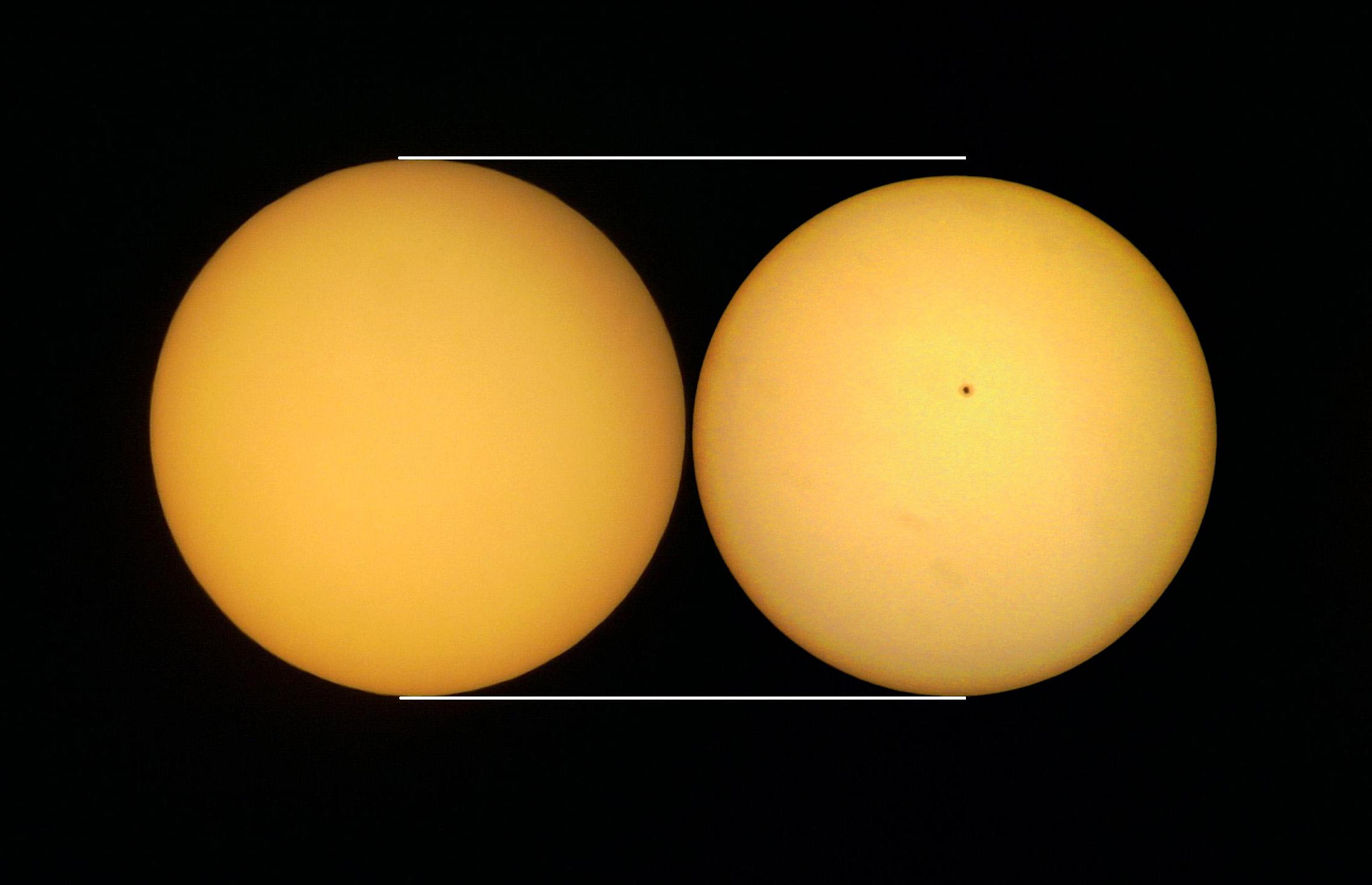
Explanation: When is the Sun most distant from Earth? It happened again just this past weekend. A common misconception is that the Sun is most distant during the winter, when it's the coldest. In truth, however, the seasonal temperatures are more greatly influenced by the number of daylight hours and how high the Sun rises. For example, during northern winter, the tilt of the Earth causes the Sun to be above the horizon for a shorter time and remain lower in the sky than in northern summer. The picture compares the relative size of the Sun during Earth's closest approach in January (northern winter) on the left, and in July (northern summer) on the right. The angular size of the Sun is noticeably smaller during July, when it is farther away. If the Earth's orbit was perfectly circular, the Sun would always appear to be the same size. These two solar images were taken from Spain during 2006, but the same effect can be seen in any year from any Earth-bound location.

Friday, July 06, 2007

Astronomy Picture of the Day


Explanation: Spiral galaxy NGC 2903 is only some 20 million light-years distant in the constellation Leo. One of the brighter galaxies visible from the northern hemisphere, it is surprisingly missing from Charles Messier's famous catalog of celestial sights. This impressively sharp color image shows off the galaxy's beautiful blue spiral arms. Included in the ground-based telescopic view are intriguing details of NGC 2903's central regions -- a remarkable mix of old and young star clusters with immense dust and gas clouds. In fact, NGC 2903 exhibits an exceptional rate of star formation activity near its center, also bright in radio, infrared, ultraviolet, and x-ray bands. Just a little smaller than our own Milky Way, NGC 2903 is about 80,000 light-years across.
I can't get enough of these.

No Way Physics: Thought provoking

Many principles of physics are of the form "If you do this, what will happen is that." Newton's second law, for example, says that the acceleration of a particular mass will be proportional to the force applied to it. Such principles imply that certain effects are practically impossible. A small number of principles, however, belong to a different category. These say, in effect, "That cannot happen." Such principles imply that certain effects are physically impossible.

Notorious examples of the latter include the first two laws of thermodynamics. The first law says that energy cannot be created or destroyed ("You can't win"), while the second can be stated in several forms, such as that heat cannot be transferred from a colder to a warmer body or that the entropy of a closed system always increases ("You can't break even, either"). Other examples include Heisenberg's uncertainty principle and the relativity principles regarding the impossibility of recognizing absolute velocity and the prohibition of faster-than-light travel.

Such principles often represent not "new physics" but deductions from other principles. What is different about them is their form. And to say that something is physically impossible tends to make scientists want to rebel.

The article goes on to explain that such laws force scientists to re-think their theories, to try to find ways to make something work that is actually impossible. Such provocations lead us to new theories and new technologies.

While some things are truly impossible, sometimes being told something is impossible is the first step to getting it done.

Wednesday, June 27, 2007

Mathematics Plus: A truly wonderful zine


A friend of mine sent me an innocent email just a few minutes ago. It read:

Dave,

I like Cambridge U.'s Plus Math-zine.
They came out with their new quarterly
issue this month:
http://plus.maths.org/issue43/

Greg C.

So, I ambled over to this site not knowing what to expect. Was I in for a most pleasant surprise!

Here's a beautiful zine that gives the most beautifully illustrated articles on so many topics. I think anyone who goes through these zines, the current issue or past issues (hit the archives button) will be in for a treat.

I've spent some time just now downloading and printing articles on Euler, special relativity, game theory, Godel, among others.

The articles have links to other sites, animations, videos, code listings, and each article is available as a pdf file so you can easily print them. Some you'll want to read on-line, see the animations, play the videos, and enjoy. Others you can print for later.

Enjoy, I know I will.

Science toys at home

I ran across this site while waiting for a program to run. It's pretty neat.

I love the theme of science-oriented toys you can make at home with everyday things around your house.

Thursday, June 21, 2007

Peet to peer Patents

Peer-to-Patent opens the patent examination process to public participation for the first time.

Become part of this historic pilot program. Help the USPTO find the information relevant to assessing the claims of pending patent applications.

Become a community reviewer and improve the quality of patents.

This is an idea whose time has come. There will be kinks to work out, processes to improve, but it's almost impossible to believe that the patent office cannot benefit from this. Kudos to everyone who made this possible.

Here's a good interview on this.

Portraits of Scientists

The Wisconsin Historical Society presents portraits of scientists. It's worth some time to thumb through them.

Wednesday, May 30, 2007

Computer interface for the future, NOW

Click on the link to see the whole video. You'll see how images and text can move on the screen in front of the person, be manipulated and shared in real-time.

It's worth viewing, maybe even twice.

Google with a Street View


This is utterly fantastic!

At maps.google.com there is now, for San Francisco, a street view of the city. With Adobe Flashplayer you can see video captures of the streets of the city.

Try this and be amazed.

Friday, May 04, 2007

Molten core on the planet Mercury, possibl

"NASA scientists working with high-precision planetary radars in California have discovered strong evidence that the planet Mercury might have a molten core.

"Scientists had not expected to find a magnetic field at Mercury," said Professor Jean-Luc Margot of Cornell University, leader of the research team. "Planetary magnetic fields are associated with molten cores, and the prevailing theory was the planet was too small to have a molten core."

Since then, multiple radar observations have ruled out a solid core, leading to the finding that Mercury's core is molten -- or at least the outer core is molten and not forced to rotate along with its shell."

I'm not sure what this means in the grand scheme of things, but it goes to explaining more of our universe. And that's a good thing.

Fighting rape with co-evolution

The mallard Anas platyrhynchos: a species with high levels of forced copulations. Females have very elaborate vaginas (left) to counter males' phalluses (right). (Image: Patricia Brennan et al.)

"Some female ducks and geese have evolved complex genitalia to thwart unwelcome mating attempts, according to a new study.

Males of some species, such as mallard, have a notorious habit of "raping" females. They and other wildfowl are among the 3% of bird species whose males have phalluses big enough to insert into the vaginas of females, whether or not the female consents.

Now, in the most detailed analysis yet of duck and goose vaginas, researchers have established that females of these species have evolved vaginal features to thwart unwelcome males.

Some vaginas had spiral channels that would impede sex by twisting in the opposite direction to that of the male phallus. Others had as many as eight cul-de-sac pouches en route, that could prevent fertilisation by capturing unwelcome sperm. Moreover, these features were only found in species renowned for forced sex. All other species had simple male and female genitalia.

“These structures are wonderfully devious, sending sperm down the wrong road or impeding penetration,” says Birkhead.

He says that the features demonstrate an evolutionary "arms race" in which control over reproduction alternates between the sexes. If the male develops a longer, more elaborate phallus to force copulation, females wrest back control by developing features to thwart males who rape.

“It shows that females are not passive in averting exploitation by males with large phalluses,” says Birkhead. "

This is a terrific example of co-evolution. The aggressive males evolve to perpertuate their genes, hence the force coupling. The females evolve, almost simultaneously it seems, to counter the evolution of the males.

Fascinating.

Research on Erectile Dysfunction


Here's something truly amazing. Not for it's work, although I have to believe it's good, but for the nature of the research.

"Like a column collapsing under the burden of a heavy roof, erectile dysfunction is a classical mechanical engineering problem, says a US urologist. Using mathematical models of penis geometry and hydrostatic pressure, doctors can predict when penises will fail – and in which vagina – he says.

The most widely investigated parameter of penile rigidity is intracavernosal pressure (ICP) – the fluid pressure achieved by blood build up in the two expandable "caverns" of the penis. For a healthy man, the erect ICP is between 60 and 90 millimetres of mercury (mmHg), but can drop to just 30 mmHg, in men with erectile dysfunction (ED)."

Here's the abstract from the Journal:

"Two major branches of engineering mechanics are fluid mechanics and structural mechanics, with many practical problems involving the effect of the first on the second. An example is the design of an aircraft's wings to bend within reasonable limits without breaking under the action of lift forces exerted by the air flowing over them; another is the maintenance of the structural integrity of a dam designed to hold back a water reservoir which would exert very large forces on it. Similarly, fluid and structural mechanics are involved in the engineering analysis of erectile function: it is the hydraulic action of increased blood flow into the corpora cavernosa that creates the structural rigidity necessary to prevent collapse of the penile column."

If you have a copy of the paper, please email it to me. Thanks.


First it was animals, then people...

OOPS, that's wrong. It's first people then animals, so says the article. Used to be we tried experimental drugs on animals and then prescribed the drugs on people. That's in reverse:

Vets have rejected claims by a British animal welfare charity that giving dogs drugs to treat behavioural problems will create a population of "pill-popping pets".

The Royal Society for the Prevention of Cruelty to Animals expressed alarm at the news that an antidepressant called Reconcile - containing the same serotonin-reuptake inhibitor used in the human drug Prozac - has been licensed for use in dogs by the US Food and Drug Administration.

"Pet owners have a duty of care towards their animals," says charity scientist Penny Hawkins. "Pharmaceuticals should not be used to help sustain an unsustainable lifestyle by addressing problems that should be dealt with by other means, such as more exercise."

Pet owners have a duty of care towards their animals. Drugs should not be used to sustain an unsustainable lifestyle

But vets specialising in treating behavioural problems say medication can be extremely useful in treating anxiety symptoms such as howling and destructiveness.

Dogs with behavioural problems account for about a quarter those that are euthanised by veterinary practices, so by increasing the chances of successfully managing a problem drugs can improve welfare.

It used to be that if you had a dog, and it was a problem, you either gave the dog away, or had it killed. Simple. Dogs are dogs, after all, not people. Now, we're seeing a slide to drugs for dogs (and I'm sure other animals) that will only take us further along to more drugs, more medical treatment, more costs, and, if owners opt not to do these things, there will be societal (read: animal rights activits) pressure to force owners to do them.


Web browsers: Still unsafe

YOU are surfing the net, and stop at a sports site you regularly visit to read the latest headlines. You are always careful to avoid sites that appear suspect, so you feel safe online. Unbeknownst to you, though, and to the innocent owner of the website, a piece of malicious code has been added to the page you are viewing. This uploads software onto your computer via your browser, turning it into a "zombie" PC under the remote control of a malicious user.

While installing firewalls and antivirus software on your computer may keep it safe from conventional threats such as worms and viruses, these security tools do not inspect data downloaded through browsers - a loophole that attackers can exploit. "The firewall is dead," says Google security specialist Niels Provos.

The threat is real, not just a theoretical possibility:

Provos warned that many web users are becoming the victims of "drive-by" downloads of bots from innocent websites corrupted to exploit browser vulnerabilities. As firewalls allow free passage to code or programs downloaded through the browser, the bot is able to install itself on the PC. Anti-virus software kicks in at this point, but some bots avoid detection by immediately disabling it. Once a computer has become infected with the malicious software, the zombie periodically connects to a web server controlled by the botmaster to receive instructions and download more software.

To determine the scale of the problem, Provos's group at Google analysed several billion web pages and selected 4.5 million suspicious pages for more detailed study. To test for malicious software, or malware, they loaded a program designed to simulate a computer with a vulnerable version of Internet Explorer and monitored what happened. They found around 450,000 web pages that launched drive-by downloads of malicious programs. Another 700,000 pages launched downloads of suspicious software. More than two-thirds of the malicious programs identified were those that infected computers with bot software or programs that collected data on banking transactions and emailed it to a temporary email account.

You don't even know it's there. The result: be very careful with the sites you go to. If possible, don't use Internet Explorer; IE is a disaster for security.


Tuesday, April 17, 2007

Happy Birthday, Leonhard Euler

Sunday, April 15, is the 300th birthday of Leonhard Euler (pronounced "oiler"), one of the most important mathematicians ever to have lived.

Click the above link to read a wonderful description of his famous equation: eiÏ€ = –1

If you want to read some wonderful books, check out Paul Nahin's books: An Imaginary Tale and
Dr. Euler's Fabulous Formula: Cures Many Mathematical Ills.

These books are worth reading and you'll learn about the mathematics of Euler.

The Mathematical Association of America has a wonderful column by Ed Sandifer entitled "How Euler Did It." Dr. Sandifer translates (I guess) some of Euler's original papers, tells you what Euler did, how he did it, and why that result is important.

Rotating polygons in space and in the lab

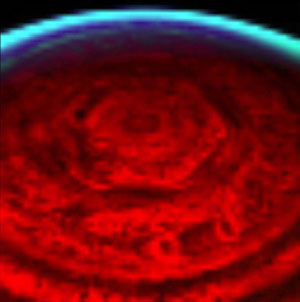
It was recently reported that there's a hexagonal rotating structure (see the image at left) at the North pole of Saturn.

We may not have found other life in our Solar System, but we have, it appears, found a polygon. An odd, six-sided, honeycomb-shaped feature circling the entire north pole of Saturn has captured the interest of scientists with NASA's Cassini mission.


NASA's Voyager 1 and 2 spacecraft produced images of the hexagon over two decades ago. The fact that it has appeared in the recent Cassini images indicates that it is a long-lived feature. A second hexagon, significantly darker than the brighter historical feature, is also visible in the Cassini pictures. The spacecraft's visual and infrared mapping spectrometer is the first instrument to capture the entire hexagon feature in one image.


Now others have seen the same phenomenon in the lab.


The unusual phenomenon in question involves rotating a bottom plate under a liquid in a circular (cylindrical) container. Bohr and his team of students at the Technical University and at the Niels Bohr Institute set up an experiment to find out whether or not such conditions would lead to stable deformations of a water surface into polygon shapes. The findings from their experiment were published May 3rd in Physical Review Letters.

Bohr tells PhysOrg.com that a somewhat similar experiment took place eight years ago with a different team (including Clive Ellegaard and others). “We had fluid falling on a plane, like water from a faucet. We found that even if the rim of the plate is completely circular, the fluid surface can be shaped like a polygon.”
While the first polygon experiment Bohr did involved stationary polygons, the most recent effort shows rotating polygons. “Not only are these shapes rotating,” says Bohr, “but they are rotating at a different speed than the plate beneath them.”
This is a fascinating phenomena that is, apparently, unexplained as yet. Here's another site for a video and more links.


(Hat tip: Ilachina)

Are cellular phones killing bees?

Interesting article on how our cellular phones could be disrupting the navigation of bees.

Thursday, April 12, 2007

Putnam Mathematical Competition Problems

Click on the link for the pdf file of the Putnam Mathematical Competition problems.

Good luck with them!

Sunday, April 08, 2007

Planet of the Apes: Apes as People

In a ground-breaking case at the Mödling district court, just southwest of Vienna, Austria, a judge is to rule over "the humanness of a chimp"– specifically, over whether it deserves a legal guardian.

The chimpanzee in question is called Hiasl. He was born in the Sierra Leone jungle in 1981, captured by animal traders and illegally shipped to Austria, destined for a vivisection lab. Customs officials intercepted the crate and Hiasl was handed to an animal sanctuary. Now, years later, the sanctuary has gone bankrupt and Hiasl is to be sent to a zoo.
This is the most ridiculous legal item I've seen a long time. Of course the chimp is NOT a human. To say otherwise is to say that we, (you, me, your friends, etc.) are chimps. Clearly not the case.

Nonetheless, as an animal lover (dogs, in particular) I should think the court could see it's way to appointing a caregiver for the chimp without equating the chimp to a human. The caregiver would have certain rights as an owner and thereby take care of the animal. Anything more is an insult to humans.

Air traffic control, automatically

Fighter pilots will one day be able to control entire squadrons of uncrewed combat aircraft as well as their own plane, following successful flight demonstrations of a multi-aircraft remote control system in UK airspace.

In addition to cutting the number of pilots risked in military operations, the remote control system could one day also be used to auto-land hijacked planes. Or they might allow lone pilots to orchestrate complex search and rescue operations.

This is not as new as it would seem. Just today I was in a meeting discussing how we might see unmanned aerial vehicles flying in U.S. airspace and how cargo planes could become pilotless. This demonstration is one step to seeing those ideas become a reality.


Wheat at risk

"This thing has immense potential for social and human destruction." Startling words - but spoken by the father of the Green Revolution, Nobel laureate Norman Borlaug, they are not easily dismissed.

An infection is coming, and almost no one has heard about it. This infection isn't going to give you flu, or TB. In fact, it isn't interested in you at all. It is after the wheat plants that feed more people than any other single food source on the planet. And because of cutbacks in international research, we aren't prepared. The famines that were banished by the advent of disease-resistant crops in the Green Revolution of the 1960s could return, Borlaug told New Scientist.

The disease is Ug99, a virulent strain of black stem rust fungus (Puccinia graminis), discovered in Uganda in 1999. Since the Green Revolution, farmers everywhere have grown wheat varieties that resist stem rust, but Ug99 has evolved to take advantage of those varieties, and almost no wheat crops anywhere are resistant to it.

Not only is Ug99 a threat in itself, but even if we have resistant wheat, we have still another problem:
However, Ug99 has another ace up its sleeve. The spores blowing in the wind now are from the asexual stage that grows on wheat. If any blow onto the leaves of its other host, the barberry bush (Berberis vulgaris), they will change into the sexual form and swap genes with whatever other stem rusts they find. Barberry is native to west Asia. "As if it wasn't challenging enough breeding varieties that resist this thing," laments Ward. "All I know is that what blows into Iran will not be the same as what blows out."
One solution is to apply fungicide to the crops which for many countries will work until new wheat can be developed that's resistant. But for poor countries fungicide is too expensive.

If you like to gamble, maybe it's a good time to go long on wheat futures?

Monday, April 02, 2007

The food cycle in the ocean

A shortage of big sharks along the U.S. East Coast is letting their prey flourish, and that prey is going hog wild, demolishing bay scallop populations.

That's the conclusion of researchers led by the late Ransom Myers of Dalhousie University in Halifax, Nova Scotia, who died this week. Combining census surveys from the past 35 years, Myers' team found shrinking populations of big sharks and shellfish and increasing numbers of smaller sharks and rays.

"Affecting something at the top [of the food web] is going to have huge consequences as effects ramify through the system," says study collaborator Charles H. Peterson of the University of North Carolina's Institute of Marine Sciences at Morehead City. As part of the new study, he and his colleagues explored some of those effects by protecting bay scallops from the cownose ray (Rhinoptera bonasus), one of the flourishing midlevel predators.

So, the cownose rays have multiplied and are eating more of the delicacies of scallops. What to do? Should we hunt down the rays now or, as the article later suggests make the rays a delicacy themselves?
Cownose rays have grown so abundant along the U.S. East Coast that fisheries managers are trying to promote them as a seafood delicacy. TV cooking-show host Emeril Lagasse has even developed some recipes. (Picture caption)
I have never eaten a ray and have no desire to ever do so. But if people like them, why not hunt them and eat them? They are part of the food chain, as are we, and we should look at them as food just like we do for a cucumber.

Bon apetit!


Sunspots erupt out high!

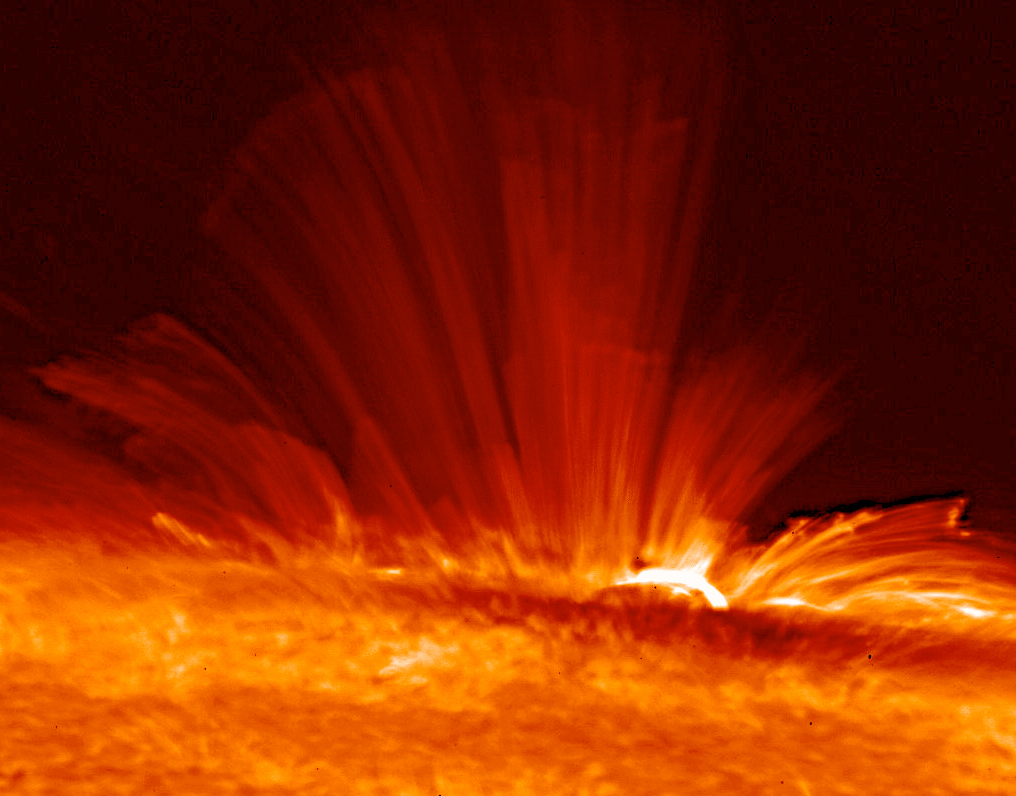
From the Astronomy Picture of the Day:
Why are there dark spots on the sun? Although noted for thousands of years, sunspots have been known for decades to be regions of the Sun that are slightly depressed and cooled by the Sun's complex and changing magnetic field. High resolution pictures like the above image from Japan's new Sun-watching Hinode satellite, however, are helping to increase modern understanding. In the center of the above image is a sunspot, but not seen in the usual orientation --this sunspot is seen sideways. Of particular interest is erupting glowing gas that shows how the Sun's magnetic field comes right out of the spot center, but curves markedly around the spot edges. Better understanding of how the Sun ejects particles into space may result in more accurate predictions of solar storms that affect satellites, astronauts, and even power grids on Earth.

Monday, March 19, 2007

Fauxtography spotting

Nice post on discovering forgeries in digital photographs.

Jurassic Crocodile In Eastern Oregon


Artists conception of the ancient creature.


An ancient sea-going crocodile has surfaced from the rocks of Crook County in eastern Oregon.

It's discovery by the North American Research Group (NARG), whose members were digging for Jurassic-age mollusks known as ammonites, is another confirmation that the Blue Mountains consist of rocks that traveled from somewhere in the Far East, says retired University of Oregon geologist William Orr, who was called in to examine the find for the state.

The remains - about 50 percent of a 6- to 8-foot reptile, including long, needlepoint teeth - were found imbedded in Jurassic rock on private property in the Snowshoe Formation of the Izee Terrane south of Dayville, Ore. Rocks containing the fossils were slowly cut out of the rock, after NARG members realized that the linear appearance of the fossils in the region's hard rocks suggested that a whole creature had been found, Orr said.

"This taxon was a crocodile-like creature but had a fish tail," said Orr, a NARG adviser and director of the Thomas Condon State Museum of Fossils at the University of Oregon. "This creature lived in Jurassic times, so it's 150 to 180 million years old. It probably lived in an area from Japan to East Timor, somewhere in the western Pacific in a tropical estuarine environment."

The fossils are generally found in Japan or China so that the finding in Oregon indicates that possible:
[T]he remains in Oregon migrated eastward in rock by continental drift, a theory of land movement in geological time now encompassed under plate tectonics. Terrane formations, such as those where these fossils were found, are believed to be portions of the earth's crust riding apart of a plate that is pushed upward at contact with another plate.
An incredible find.


Monday, February 26, 2007

Verification of Pollack's art with fractals

Richard Taylor from the University of Oregon reported 8-years ago that he found Jackson Pollack's artwork to have fractal qualities. Not that they are a fractal, because fractals have detail at all scales of magnification. So, some people wanted to use Taylor's approach to verify found paintings as original Pollack artwork.

Well, a graduate student at Western Reserve University in Cleveland, Katherine Jones-Smith
made some doodles on a page—"pretty ugly" ones, she says—she found that they shared the qualities of a Pollock, according to an analysis that follows Taylor's approach. "Either Taylor is wrong, or Kate's drawings are worth $40 million," says Jones-Smith's collaborator Harsh Mathur. "We'd be happy either way."
This started a discussion as to whether Taylor's approach can actually verify artwork.

Frankly, fractals are a mess when you try to define them because so many objects that you would like to be fractals don't fit in a single definition.

I think Michael Barnsley says it best:
For authentication, it doesn't matter whether it's legitimate to call Pollock paintings fractal, says Michael Barnsley of Australian National University in Canberra. Taylor has a reproducible technique that produces numbers from a painting, and he can correlate those numbers with different artists. "That doesn't allow you to authenticate or not authenticate a painting, but you could certainly add it into the collection of information that you have to say that it's more likely," he says.
Fractals are ill-defined now but the methods we use to measure fractal dimension have a place in our mathematical toolbox. A place, among many other tools, but not the only tool.

Wednesday, February 14, 2007

Astronomy Picture of the Day

I LOVE these pictures from NASA and the Hubble telescope. They never cease to amaze me and I marvel at their beauty. Just gorgeous.

Thursday, February 08, 2007

What a picture from Hubble

It's like something out of photoshop with the imagination of an artist. EXCEPT, it's real. This is a picture from the Hubble Telescope, on the Astronomy Picture of the Day. Here's their explanation:
This stunning group of galaxies is far, far away - about 450 million light-years from planet Earth - cataloged as galaxy cluster Abell S0740. Dominated by the cluster's large central elliptical galaxy (ESO 325-G004), this sharp Hubble view takes in a remarkable assortment of galaxy shapes and sizes with only a few spiky foreground stars scattered through the field. The giant elliptical galaxy spans over 100,000 light years and contains about 100 billion stars, comparable in size to our own spiral Milky Way. The Hubble data reveal a wealth of detail in even these distant galaxies, including magnificent arms and dust lanes, star clusters, ring structures, and gravitational lensing arcs.
Wow, that one part (just a part) of the image is 100,000 light years across and contains approximately 100-billion starts. Read that again. The galaxy is enormous and it's only a small part of the image.

Staggering. Just staggering.

Juggling light: It can be done

A pulse of light can be stopped, transported, and restarted again using a cloud of super-cold atoms, US researchers have shown. The technique could ultimately be used for advanced computing devices or gravity detectors.

The experiments demonstrate physicists' increasing ability to manipulate light. Being able to control it in this way could be useful for optical or quantum computers, the team suggests.

I didn't understand the details of the article, but if you do, please leave a comment about it.

NASA reviews policy after astronaut goes beserk

NASA is reviewing its psychological screening process for astronauts, following astronaut Lisa Nowak's arrest for allegedly attempting to murder a romantic rival.

Police in Orlando, Florida, US, say that Nowak drove 1500 kilometres to try to kidnap and possibly kill Air Force Captain Colleen Shipman (see Astronaut accused of attempted murder released on bail). Both women may have been vying for the affections of NASA astronaut Bill Oefelein.

In response to the shocking event, NASA Administrator Michael Griffin has requested an internal review of the psychological screening procedures used to admit new astronauts. He also asked for a review of any follow-up psychological evaluations of working astronauts, including who conducts the screening.

I've busy with work and unable to post for a while. But the news on Nowak is unbelievable. This woman is a disgrace to NASA and a disgrace to the United States Navy. What's worse is that NASA, and I bet the Navy, never bothered to see the signs of her deranged behavior.

Let's hope NASA changes their policies to screen out such people, and not just at the start of a career, but throughout an astronaut's career and the same goes for the Navy.

Thursday, January 18, 2007

Getting close to mid-night: Bulletin of Atomic Nuclear Scientists

So, the famous Bulletin of Atomic Scientists believes we are two minutes closer to destruction than we have been in the past. Here's how they put it:

This deteriorating state of global affairs leads the Board of Directors of the Bulletin of the Atomic Scientists--in consultation with a Board of Sponsors that includes 18 Nobel laureates--to move the minute hand of the “Doomsday Clock” from seven to five minutes to midnight.

This is another example of people with a certain expertise in one area, thinking they have expertise in another area. Scientists are generally smart people, perhaps some of the smartest on the planet we call home. But being smart as a scientist does not mean one is competent in other areas.

For example, while Richard Feynman was a genius in physics, he was no politician. That is, Feynman's expertise in physics did not mean that he had any deep insight in politics. He may have insight of his own, of course, but if you want political opinion it's best to go with a politician.

What's this have to do with the time creeping closer to mid-night?

Just this: the catastrophe that the Bulletin is "predicting" is more of a political catastrophe and not a scientific one. It is a political question as to whether nuclear bombs will be detonated not a scientific one. If the world ends due to nuclear bombs that responsibility rests with our political leaders; scientists have done their part already in building the bombs.

This year, The Bulletin also cites "Global Warming" as part of the coming (five minutes away!) catastrophe. Once again, the scientists have no say in Global Warming (if it even exists and I don't believe it). The question of climate is beyond the control of any scientist. Sure, scientists study climate and have opinions but whether the world will "end" due to some climate change is beyond them.

To try to predict "the end" is to scare people into believing others who, while smart in one area, have no business in other areas.

Thursday, January 11, 2007

Invisibility: Mathematically possible

November 30, 2006: The invisibility cloak recently built by scientists at Duke University and Imperial College in London has received enormous attention all over the world. This breakthrough cloaking device makes a copper disk invisible at specific microwave frequencies. As it turns out, Mathematics Professor Allan Greenleaf of the University of Rochester along with Matti Lassas, who is now at the Helsinki University of Technology, and Gunther Uhlmann of the University of Washington, started the mathematics behind invisibility several years ago in the context of medical imaging and quantum mechanics. Joined by fourth member Yaroslav Kurylev of Loughborough University, the team has announced the mathematics of full-wave invisibility at all frequencies (http://www.arxiv.org/abs/math.AP/0611185). In their latest work, they examine the problem of cloaking not just passive objects, but also active devices that are emitting electromagnetic waves, and show that this requires modifying the original constructions.

(hat tip: Ilachina)

Goldbach conjecture: Proved?

Here's a paper that the authors say proved Goldbach's conjecture. From Wikipedia:

Goldbach's conjecture is one of the oldest unsolved problems in number theory and in all of mathematics. It states:

Every even integer greater than 2 can be written as the sum of two primes.

For example,

4 = 2 + 2
6 = 3 + 3
8 = 3 + 5
10 = 3 + 7 = 5 + 5
12 = 5 + 7
14 = 3 + 11 = 7 + 7
etc.


It's a very old problem and one that if solved, would be welcomed news in mathematics.

Journal of Fourier Analysis and Applications

The University of Maryland is having a two-day seminar on Fourier Series in February. As part of the program you can get a trial copy of the Journal of Fourier Analysis and Applications free, just follow link above.

The journal is math-oriented but worth perusing. Enjoy.

Sunday, January 07, 2007

Junk science

Ian Gilmartin, 60, has invented a mini water wheel capable of supplying enough electricity to power a house - for free. The contraption is designed to be used in small rivers or streams - ideal for potentially thousands of homes across Britain.

It is the first off-the-shelf water-wheel system that can generate a good supply of electricity from as little as an eight-inch water fall.

Have a laugh and read the article.

Dark Matter: What matters to the universe


The study, published in Nature journal, provides the best evidence yet that the distribution of galaxies follows the distribution of dark matter.
Scientists have mapped a small part of the sky in terms of the distribution of dark matter. There is reason to believe that this will show that the evolution of galaxies follows this distribution and that dark matter does, indeed, play a unique role in the development of our universe.

Additional article here, original article from Nature here.

Tuesday, December 26, 2006

Addicted to the 'Net? You're not alone

Ever feel that you have to publish something as often as possible on the Internet? Crazy to see your name on the screen, in Google listings or on Yahoo!? If so, you're not alone.

Hello, my name is Richard and I am an egosurfer. The habit began about five years ago, and now I need help. Like most journalists, I can't deny that one of my private joys is seeing my byline in print. Now the internet is allowing me to feed this vanity to an ever greater extent, and the occasional sneaky web search has grown into a full-blown obsession with how high up Google's ranking my articles appear when I put my name into the search box. When I last looked, my best effort was a rather humiliating 47th place. You know you have a problem when you find yourself competing for ranking with a retired basketball player from the 1970s.

Not that I'm alone in suffering from a dysfunctional techno-habit. New technologies have revealed a whole raft of hitherto unsuspected personality problems: think crackberry, powerpointlessness or cheesepodding (see "Modern maladies", bottom). Most of us are familiar with sending an email to a colleague sitting a couple of feet away instead of talking to them. Some go onto the web to snoop on old friends, colleagues or even first dates. More of us than ever reveal highly personal information on blogs or MySpace entries. A few will even use internet anonymity to fool others into believing they are someone else altogether. So are these web syndromes and technological tics new versions of old afflictions, or are we developing fresh mind bugs?

Developing a bad habit is easier than many might think.

No argument here.

Phase change memory

A team of scientists has announced a breakthrough in computer memory technology that heralded more sophisticated and reliable MP3 players, digital cameras and other devices.

Scientists from IBM, Macronix and Qimonda said they developed a material that made "phase-change" memory 500 to 1,000 times faster than the commonly-used "flash" memory, while using half as much power.

"You can do a lot of things with this phase-change memory that you can't do with flash," IBM senior manager of nanoscale science Spike Narayan told AFP.

"You can replace disks, do instant-on computers, or carry your own fancy computer application in your hand. It would complement smaller technology if manufacturers wanted to conjure things up."

Technical details of the research were to be presented to engineers gathered at the 2006 International Electronic Devices Meeting in San Francisco.

Interesting and exciting. The quest for better memory devices never ceases, and never ceases to amaze me.

(hat tip: Ilachina)

Wednesday, December 20, 2006

The Three-Body Problem: Book Review

The following review was posted to the Mathematical Association of America's website.

The Three-Body Problem by Mauri Valtonen and Hannu Karttunen


Publisher: Cambridge University Press (2006)
Details: 345 pages, Hardcover

Price: $80.00
ISBN: 0521852242

Category: Monograph
Topics: Mathematical Physics, Dynamical Systems, Classical Mechanics, Celestial Mechanics

MAA Review

[Reviewed by David Mazel, on 12/20/2006]

An undergraduate, having taken calculus and some physics, comes across the two-body problem. Specifically, what is the motion of two bodies in space acting under their mutual gravitational attraction? She quickly finds that she can solve the equations, and for given initial conditions, the solutions are conic sections. Then, the natural question to ask is: What is the solution if we now expand the system to three bodies? Here the problem is not so easy. In fact, it is impossible to solve in closed form.

This book begins by recounting what the student would have learned in that physics class and then goes into specifics of the three-body problem. Not only is the problem unsolvable in closed form; the solution, in general, involves chaotic dynamics. Nonetheless, there is much that can be learned by studying various forms of the problem under differing conditions. This book goes a long way to exploring these forms and explaining how the different scenarios can be approached.

The authors begin with a presentation of Newtonian mechanics and the solution of the two-body problem. The authors use physics to motivate the mathematics and derive the equations of motion — here, and throughout the book. Thus, the discussions are complete and present the ideas from the view of mathematical physics.

After discussion of the two-body problem we are introduced to Hamiltonian mechanics and some restricted three-body problems such as satellite orbits, and scatterings of bodies from a binary orbit. Other topics include escapes, three body scattering, and capture. The final topics deal with perturbations and various astrophysical problems such as black holes and the evolution of comet orbits.

Throughout the book the authors present diagrams to illustrate their points but these diagrams are limited in their utility. The authors could have presented more illustrative diagrams and figures to better qualify the text.

When I started reading I thought the book would discuss chaos and its relationship to the three body problem. After all, that's the first thought that comes to mind today. There is mention of this phenomenon, but very little, and no attention given to simulating orbits of three-body motion. For me, this was a disappointment.

Finally, the spirit of the book is mathematical physics; consequently, the authors often leave it to the reader to sort through the mathematics. I often found, for example, that I had to review earlier parts of the text and search for the equations — always present somewhere in the text but not explicitly noted nor cited — needed to follow the derivations and fill in many of the steps.

In short, this is a good text on the mathematical physics of the problem for the experienced practitioner. Everyone else, I'm afraid, will find it a challenge to read and follow the mathematics.

Friday, December 15, 2006

Mathematics in the court room

Ivars Peterson writes of two cases where mathematics comes to light in court.

Robots as Transformers

Remember as a kid how you could take a robot and with a few twist and changes make the robot into something else? The robot wasn't actually a robot and while it didn't move by itself, you had a pretty good idea of how, if you had the technology, that robot could move. A little imagination and your play robot was the real thing. Then, if you had a little sadistic bent to yourself, you could pull off a limb of your robot. Now, could you imagine how to make this deformed robot move? I bet you could.

Fast forward to the present and meet Victor Zykov from Cornell University. He and he colleagues have built a robot that, when it loses a limb, is able to visualize itself (not as seen by a child playing with the robot) and determine how to move with the limbs it has left.

So, this robot can remake itself in terms of mobility when it's damaged.

Read the article, it's fascinating and is a leap forward in robotics.

Wireless power: No more extension cords?

1) Power from mains to antenna, which is made of copper
2) Antenna resonates at a frequency of 6.4MHz, emitting electromagnetic waves
3) 'Tails' of energy from antenna 'tunnel' up to 5m (16.4ft)
4) Electricity picked up by laptop's antenna, which must also be resonating at 6.4MHz. Energy used to re-charge device
5) Energy not transferred to laptop re-absorbed by source antenna. People/other objects not affected as not resonating at 6.4MHz
It's not the end of extension cords, but it is the beginning of looking at how we might use the concept of resonance to delivery electricity to electronic devices.


The answer the team came up with was "resonance", a phenomenon that causes an object to vibrate when energy of a certain frequency is applied.

"When you have two resonant objects of the same frequency they tend to couple very strongly," Professor Soljacic told the BBC News website.

Resonance can be seen in musical instruments for example.

"When you play a tune on one, then another instrument with the same acoustic resonance will pick up that tune, it will visibly vibrate," he said.

Instead of using acoustic vibrations, the team's system exploits the resonance of electromagnetic waves. Electromagnetic radiation includes radio waves, infrared and X-rays.

hat tip: Ilachina

Images by Neutrinos

This a photo of the sun. Not taken with the usual medium for viewing the sun (photons), but taken with neutrinos. Partly at night. Through the earth. It was photographed by the Super-Kamiokande experiment in Japan with 503.8 days and nights of exposure.


More on neutrios here.

Earth from Space: Smithsonian Institution

These sand dunes in Yemen are part of Earth's largest expanse of desert, which covers much of southern Saudi Arabia as well. Data from two satellites were combined to produce this image's vivid colors: blue indicates the rocky composition of the land surface and contrasts sharply with the highly reflective sand dunes in yellow.

Here's a wonderful site that lets you view our planet Earth from space. Unlike Google Earth that lets you move through imagery of the planet, this site allows you to view our planet based on ecology and social topics.
(hat tip: ilachina)

Tuesday, December 05, 2006

Understanding Black Holes

This is clever and instructive site that explains black holes in an interactive manner.

Thursday, November 30, 2006

Quantum computers: Pure fantasy

QUANTUM computing will never work. At least, that's the view of one physicist who thinks that unavoidable noise will always stand in its way.

So says Michael Dyakonov of the University of Montpellier in France. The link has a short article about the noise corrections needed will make quantum computers for any reasonable size (in bits) impossible due to noise.

Wednesday, November 29, 2006

Radioactive isotopes for sale


I can't make this stuff up.

Hat tip: Atlas Shrugs.

Self-Reference: How much is too much?

This paper has the first author cited 28 times in the references.

Hat tip: Mini-AIR

Open source science: Model for Innovation

In a perfect world, scientists share problems and work together on solutions for the good of society. In the real world, however, that's usually not the case. The main obstacles: competition for publication and intellectual property protection.

Is there a model for encouraging large-scale scientific problem solving? Yes, and it comes from an unexpected and unrelated corner of the universe: open source software development.


Sharing helps everyone to do better; if you don't believe it, ask a grade schooler. This turns out to be true in business as well. There was study not long ago (I don't have a link) that found the people who cooperate with others do better at work than people who keep their work private.

Thursday, November 16, 2006

Images of the brain and universe


These aren't particularly new but I don't remember posting them. The first picture is a slice of tissue of the brain of a mouse. Note the fractal structure. Mark Miller from Brandeis did this.

The second picture is of a simulation of the beginning of the universe showing large cluster of galaxies surrounded by stars, galaxies and dark matter. Pretty amazing similarity, huh?

Tuesday, November 14, 2006

Bruce Schneier: Wrong on this one

I often read Bruce Schneier's blog because he covers topics in security and cryptography. His security ideas are often on target but miss the point. (He's concerned with the security devices and often fails to account for psychology and why people do what they do. More on that another time.) His posts on cyptography are another story. These are usually excellent and insightful. You should read these, but skip the security posts.

Tonight, I saw the following:

The Inherent Inaccuracy of Voting

In a New York Times op-ed, New York University sociology professor Dalton Conley points out that vote counting is inherently inaccurate:

The rub in these cases is that we could count and recount, we could examine every ballot four times over and we'd get -- you guessed it -- four different results. That's the nature of large numbers -- there is inherent measurement error. We'd like to think that there is a "true" answer out there, even if that answer is decided by a single vote. We so desire the certainty of thinking that there is an objective truth in elections and that a fair process will reveal it.

But even in an absolutely clean recount, there is not always a sure answer. Ever count out a large jar of pennies? And then do it again? And then have a friend do it? Do you always converge on a single number? Or do you usually just average the various results you come to? If you are like me, you probably settle on an average. The underlying notion is that each election, like those recounts of the penny jar, is more like a poll of some underlying voting population.

He's right, but it's more complicated than that.

That's a quote from Schneier's blog. I was mortified to see that Schneier agreed with Conley who obviously has no idea what he's talking about. If you have a jar of pennies you can count them exactly. The fact that the one counting may make mistakes is a fault of the process. To correct that, you need a better process.

Here's how one person put it in the comments:

I don't think that Dalton Conley has ever counted a large jar of pennies.

If your count doesn't converge on a single number, then you aren't doing it correctly. Clear a large flat surface. Create stacks of 10 pennies. Group the stacks of 10 by 10s. Collect the groups of 100 by 10. Check the stacks, check the groups, check the collections. Check again. Have your friend repeat the checks. Resolve any discrepancies.

This is accounting, not quantum physics. The pennies are all on the table in front of you and if you can't get an accurate accounting, you aren't trying hard enough.

This fellow, Ray, made me smile.

Sunday, November 12, 2006

Astonomy Picture of the Day

I go to this site just about everyday. I don't always post their pictures, but oftentimes the pictures are too beautiful not to post. Here's one that I like:


From the site:
Three thousand light-years away, a dying star throws off shells of glowing gas. This image from the Hubble Space Telescope reveals the Cat's Eye Nebula to be one of the most complex planetary nebulae known. In fact, the features seen in the Cat's Eye are so complex that astronomers suspect the bright central object may actually be a binary star system. The term planetary nebula, used to describe this general class of objects, is misleading. Although these objects may appear round and planet-like in small telescopes, high resolution images reveal them to be stars surrounded by cocoons of gas blown off in the late stages of stellar evolution.
You've got to admit, this is simply gorgeous. Ah, nature, where beauty is ever-present and ever delightful.

Tuesday, November 07, 2006

Heads UP!


What do you see? If you're my pal Andy you probably see an asteroid heading straight for planet Earth. Kiss yourself good-bye!

If you're not him, then maybe you see Janus, one of the moons of Saturn.
Janus orbits Saturn and sometimes trades places with its sister moon Epimetheus. Janus has a largest diameter of about 190 kilometers and while covered with large craters lacks small craters. One possible reason for this is a fine dust that might cover the small moon, a surface also hypothesized for Pandora and Telesto. Pictured above, Janus was captured in front of the cloud tops of Saturn in late September.

If you're like my pal though, you needn't worry. I'm sure we'll find a way to disrupt our lives without need for celestial malfeasance.

Monday, November 06, 2006

Experience at the Apple Store

My IPOD shuffle would not be recognized when I plugged it into a USB port on any computer I tried; I tried at least three times.

So, I finally took it to the Apple store yesterday in Bethesda, Maryland. The store is open and we walk in. It's a small store, most space is for product display. I walk to the back and see a fellow behind a counter and a line in front. I start to wait but see a screen with names. I infer there is some sort of sign up computer in the front. I wonder around and find a woman, in her fifties, with an apple shirt and she looks like an employee.

She: Can I help you?
Me: Yes, my ipod won't charge or be recognized when I plug it in.
She: Yes, I've seen that before.
Me: Can you fix it?
She: How long have you had it?
Me: I got it around Jan or Feb.
She: Oh, then it's still under warranty.

Me: Can you look at it and tell me if you can fix it?
She: Do you have an appointment?
Me: Well, no, do I need an appointment?
She: Yes, you do.
Me: Can't I just drop it off and whenever it's ready I can come back. I am already here, in person. It's not working so leaving it is fine with me.
She: No, you have to have an appointment.
Me: I can't drop it off?
She: No. You need an appointment and we're filled for today. It's like getting your car fixed, you have to have an appointment.

Me: Well, no I don't. There's a key drop and I can just drop my car off for repairs. Can't I do that here?
She: You must know the mechanic.

Me: pause....
She: Would you like me to help you make an appointment?
Me: Sure, that would be great.
She: Here. (She hands me a card.) Go to this website and you can make an appointment there.
Me: This is nuts. (I walk out.)

Wednesday, November 01, 2006

How Things Work Home Page

I stumbled across this link while using "Stumble Upon" when I was on the phone a few minutes ago. Here's a sample of the questions, you'll have to visit the site to get the answers.

1547. If I were to heat up a brownie and a white piece of cake, would the brownie heat up faster by radiation transfer because of its darker color? — B

1546. How can light "travel" through a vacuum when there were no "particles" in the vacuum on which it could "transmit" its charge? — DC

For my industrial design project, I am redesigning the microwave oven and adding some extra functions. Is it possible for microwaves to somehow measure food properties such as calories, sugar, salt, vitamins, and fat content? How can I translate those readings onto an LCD display so that the user can see them, and can they also be transferred to a computer via Bluetooth? — IB

1544. If something is coasting or moving at a steady pace, is it experiencing a net force of zero? — NP

1543. Can/should a microwave be disposed with the normal trash, what if any are the environmental impacts of the magnetron or other parts sitting in a landfill? — DNR

1542. Why do deep water wells need a pump at the bottom rather than one at the top? — LG, Vancouver